Zing Forum

Reading

yt-dlp-mcp: An Innovative Bridge Connecting Audio-Visual Content and LLMs via the MCP Protocol

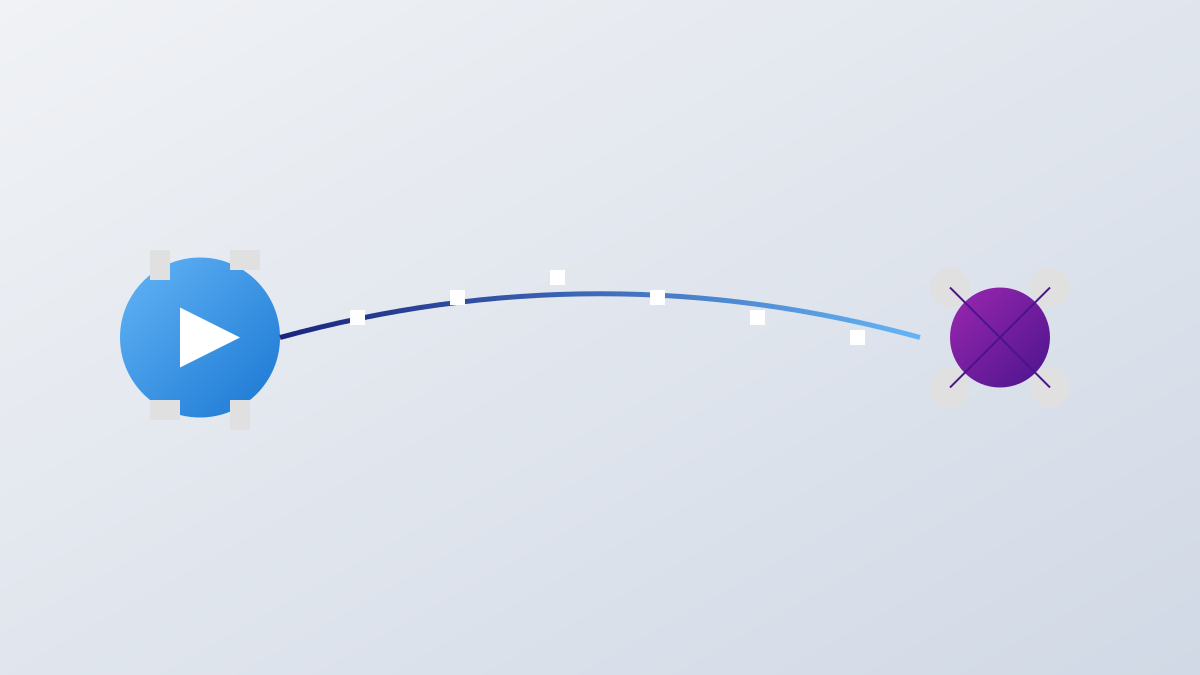
yt-dlp-mcp is a Model Context Protocol (MCP) server that uses the yt-dlp tool to bring audio-visual content from platforms like YouTube into the context of large language models (LLMs), enabling intelligent analysis and Q&A of video content.

MCPyt-dlpvideoLLMtranscriptionYouTubemultimediaprotocol
Published 2026-05-21 00:44Recent activity 2026-05-21 00:54Estimated read 7 min
yt-dlp-mcp: An Innovative Bridge Connecting Audio-Visual Content and LLMs via the MCP Protocol
1

Section 01

yt-dlp-mcp: Introduction to the MCP Bridge Connecting Audio-Visual Content and LLMs

yt-dlp-mcp is a Model Context Protocol (MCP) server that uses the yt-dlp tool to bring audio-visual content from platforms like YouTube into the context of large language models (LLMs). It addresses the limitation of LLMs' direct understanding of audio-visual content, enabling intelligent analysis and Q&A of video content.


2

Section 02

Project Background and Model Context Protocol (MCP) Concept

Project Background

In the internet era, video and audio content have become the main carriers of information dissemination. However, LLM training data is mainly derived from text, so their ability to directly understand audio-visual content is limited. How to make LLMs "see" and "hear" video content is an important practical issue.

MCP Concept

Model Context Protocol is an open protocol standard launched by Anthropic. It aims to standardize the connection method between AI models and external data sources/tools, define unified interface specifications, reduce integration complexity, and allow developers to focus on business logic.

3

Section 03

Working Principle and Technical Architecture of yt-dlp-mcp

Technical Architecture

The core architecture consists of three components:

  1. MCP Server: Implements the MCP standard interface, serving as a bridge between LLMs and the external world
  2. yt-dlp Integration: Uses yt-dlp to handle video downloading and metadata extraction
  3. Content Conversion: Converts audio-visual content into text understandable by LLMs (subtitle extraction, audio transcription, etc.)

Workflow

  1. The LLM sends a request for the target video URL to the server via the MCP protocol
  2. The server calls yt-dlp to obtain video metadata, subtitles, or audio streams
  3. Prioritize extracting subtitle text; if there are no subtitles, transcribe the audio
  4. Return the processed text to the LLM to be included in its context
  5. The LLM performs operations like Q&A and summarization based on the content
4

Section 04

Core Functions and Features

Multi-Platform Support

Inheriting the advantages of yt-dlp, it supports thousands of video platforms (YouTube, Bilibili, Vimeo, etc.).

Flexible Content Acquisition

  • Subtitle Priority: Extract embedded or auto-generated subtitles
  • Audio Transcription: Extract audio and perform speech recognition when there are no subtitles
  • Metadata Extraction: Obtain structured information such as title, description, and tags

Standardized Interface

Complies with MCP protocol specifications and can seamlessly integrate with MCP-supported LLM applications like Claude Desktop and Cursor.

5

Section 05

Application Scenarios and Practical Value

Video Content Q&A

Users can ask about key steps in the video, the speaker's views, etc., and the LLM will answer based on the subtitle/transcribed text.

Batch Video Analysis

Researchers or creators can process videos in batches, extract key information, generate summaries, analyze topic distribution, and improve efficiency.

Knowledge Base Construction

Convert video content into text and index it into the knowledge base to make video resources searchable and referenceable, enriching the knowledge management system.

6

Section 06

Technical Significance and Ecological Value

yt-dlp-mcp represents the trend of standardization and modularization of AI toolchains. It integrates independent tools (yt-dlp) into AI workflows via the MCP protocol, enabling "plug-and-play" to improve development efficiency and system scalability.

For developers: Easily expand the capability boundaries of applications without implementing video processing logic from scratch; For end users: AI assistants have stronger multimedia understanding capabilities.

7

Section 07

Future Outlook

With the development of the MCP ecosystem, we expect more similar "bridge" projects to emerge, connecting various data sources and tools to LLMs. yt-dlp-mcp provides a reference implementation for AI-based audio-visual processing. In the future, there may be more platform-specific MCP servers, as well as rich features like video frame analysis and multimodal understanding.

