Zing Forum

Reading

Xfinity AI Agent Server: A Bridge Connecting UI and OpenAI Agent

This open-source project demonstrates how to build a session negotiation server that bridges the ChatKit front-end interface and OpenAI-hosted agent workflows, enabling production-grade AI dialogue system deployment.

OpenAIAgentChatKit会话管理AI 服务器智能体流式响应生产部署中间件
Published 2026-05-29 06:44Recent activity 2026-05-29 06:50Estimated read 8 min
Xfinity AI Agent Server: A Bridge Connecting UI and OpenAI Agent
1

Section 01

Introduction: Xfinity AI Agent Server—A Bridge Connecting UI and OpenAI Agent

Xfinity AI Agent Server is an open-source session negotiation server that sits between the ChatKit front-end interface and OpenAI-hosted agent workflows. It addresses challenges in AI application production such as session management, UI integration, security authentication, and traffic control. It has achieved production-grade deployment (accessible at https://chat-server.jim.so) and provides a reference for developers to build production-ready AI dialogue systems.


2

Section 02

Background: Core Challenges in AI Application Production

With vendors like OpenAI launching hosted agent services, it has become easier for developers to build AI applications using backend capabilities. However, converting prototypes into production systems still faces multiple challenges:

  • Session Management: Maintaining multi-user session states
  • UI Integration: Seamlessly integrating custom front-end interfaces
  • Security Authentication: Ensuring access for authorized users
  • Traffic Control: Handling concurrent requests and rate limiting These issues need to be addressed by a middle-layer session server that coordinates the front-end and back-end.
3

Section 03

Project Overview and Architecture Design

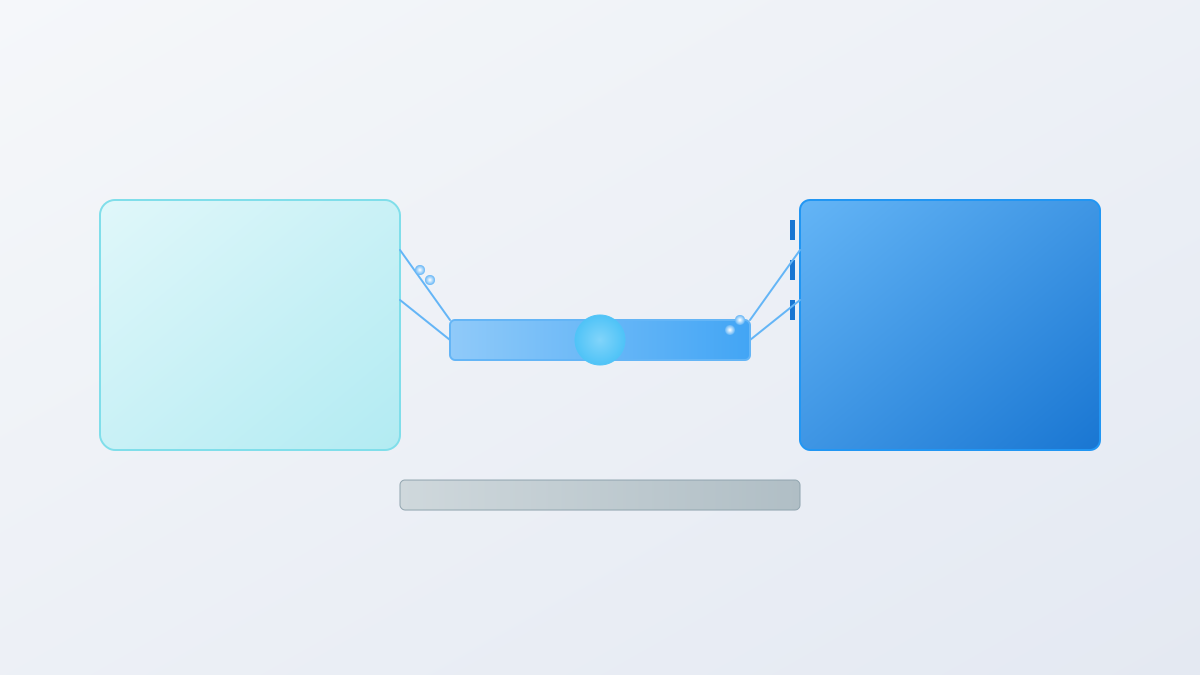
As a session negotiation middleware, Xfinity AI Agent Server's core responsibility is to coordinate communication, authentication, and state management between the ChatKit front-end and OpenAI-hosted agents. The project uses a three-layer architecture:

  1. Front-end Layer: ChatKit UI provides interactive capabilities such as chat interface components and message processing
  2. Middle Layer: Agent Server handles session negotiation (create/manage/destroy sessions), protocol conversion (HTTP/WebSocket to OpenAI API, streaming response forwarding), authentication and authorization, error handling, and retries
  3. Back-end Layer: OpenAI Managed Agent provides AI capabilities like large model inference and tool calling
4

Section 04

Core Function Implementation

The project implements three core functions:

  • Real-time Message Streaming: Supports SSE/WebSocket for handling streaming responses, allowing users to see the AI response generation process in real time
  • Multi-session Management: Maintains independent sessions for multiple users, ensuring isolation, state persistence, and resource cleanup
  • Secure Transmission: Uses HTTPS encryption, secure API key storage, request signature verification, and CORS policy configuration
5

Section 05

Technology Selection and Deployment Practice

Reasons for Selection

Using the OpenAI front-end SDK directly is simpler, but building a custom server has significant advantages: controllability (full control over data flow), observability (logging/monitoring), customization (authentication/rate limiting), and cost optimization (caching/batch processing)

Deployment and Operations

The project demonstrates cloud-native deployment practices: containerization support, environment configuration management, health checks and monitoring, and auto-scaling capabilities The project has been deployed online and is accessible at https://chat-server.jim.so

6

Section 06

Application Scenarios

This architecture is suitable for multiple scenarios:

  • Enterprise Customer Service System: Integrate with existing customer service interfaces to provide intelligent Q&A and ticket processing
  • Internal Knowledge Assistant: Handle identity authentication and permission control to help employees access knowledge bases
  • Educational Tutoring Platform: Manage student sessions and learning progress
  • Content Creation Assistance: Add AI capabilities to creation tools, handling communication and content review
7

Section 07

Development Insights and Future Expansion Directions

Development Insights

  • Separation of Concerns: Layered processing of UI rendering, session management, and AI inference
  • Emphasize the Middle Layer: It is the system's glue and a key control point for security, performance, and observability
  • From Prototype to Production: Need to focus on details like configuration management, error handling, and logging

Future Expansion

  • Multi-model support (Claude, Gemini, etc.)
  • Load balancing and multi-instance deployment
  • Advanced semantic caching
  • A/B testing capabilities
  • Dialogue data analysis and improvement
8

Section 08

Conclusion

Xfinity AI Agent Server fills the gap between front-end UI and hosted AI services. It is a concise and practical open-source project that provides a good starting point for developers to integrate AI capabilities into their products. Mastering this middle-layer architecture design and implementation will become an essential skill for full-stack developers in the era of widespread AI applications.

