Zing Forum

Reading

Workshop Agents: An Intelligent Agent Workflow for YouTube Videos Based on Genkit

An AI agent system built using the Google Genkit framework, enabling an automated workflow for YouTube video search, content analysis, and blog generation.

GenkitAI代理YouTube内容生成自动化工作流视频分析博客写作
Published 2026-03-29 14:44Recent activity 2026-03-29 14:59Estimated read 7 min
Workshop Agents: An Intelligent Agent Workflow for YouTube Videos Based on Genkit
1

Section 01

Introduction: Workshop Agents—An Automated Workflow for YouTube Content Based on Genkit

Workshop Agents is an AI agent system built on the Google Genkit framework, designed to address efficiency pain points for content creators in YouTube content processing. It automates the entire workflow of video search, content analysis, and blog generation: after users input a topic, the system automatically filters high-quality videos, extracts key information, and generates structured blog posts, significantly improving creation efficiency.


2

Section 02

Project Background and Creation Pain Points

In the era of information explosion, YouTube is an important source of knowledge acquisition, but content creators face many pain points: the traditional process requires switching between multiple tools (search, note-taking, organization, writing), which is time-consuming and inefficient. The Workshop Agents project was born to solve this problem—by automating video discovery, analysis, and blog generation through the Genkit framework, allowing creators to focus on core creativity.

3

Section 03

Genkit Framework and System Workflow

Introduction to Genkit Framework

Genkit is an AI application development framework launched by Google. Key features include: unified model interface (supports Gemini/OpenAI, etc.), stream processing, structured prompt management, and tool calling capabilities.

System Workflow

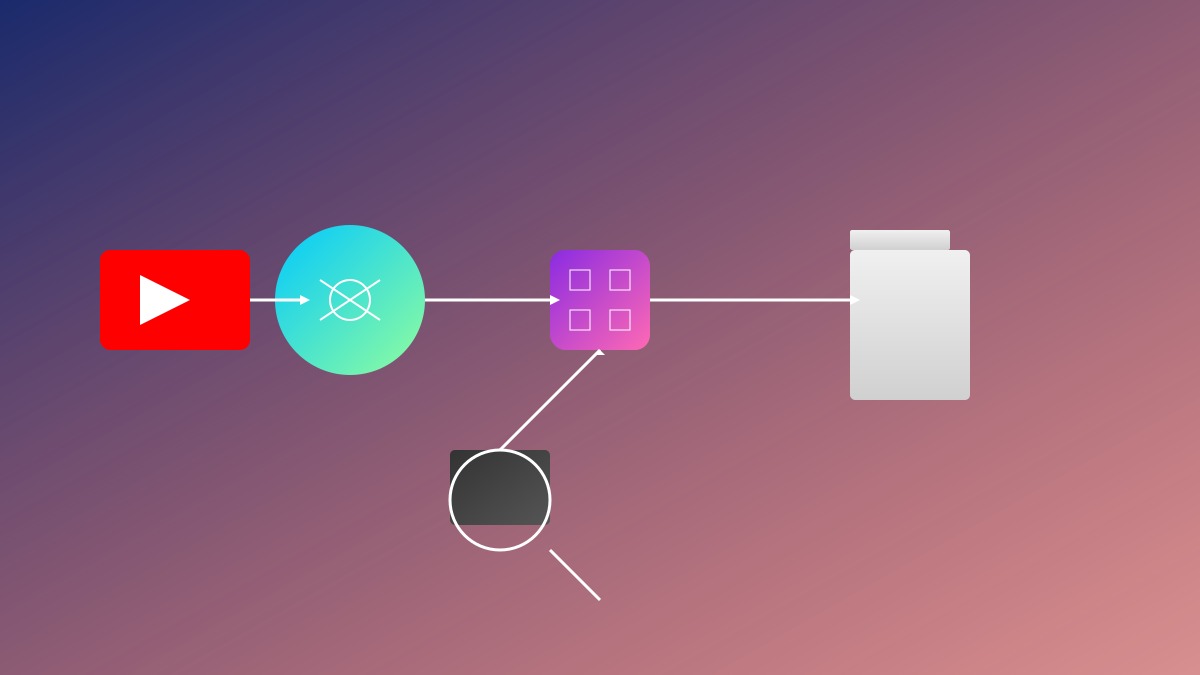
  1. Intelligent Video Discovery: Search agents generate optimized queries, filter high-quality videos, and extract metadata (title, view count, channel information, etc.);
  2. In-depth Content Analysis: Obtain video transcript text, extract topics, key points, logical structure via content understanding agents, evaluate credibility, and correlate content across multiple videos;
  3. Blog Content Generation: Writing agents plan outlines, compose content (convert spoken language to written language, supplement background), perform multi-round polishing, and suggest multimedia elements.
4

Section 04

Core Features and Application Scenarios

Core Features

  • Configurable Workflow: Adjust search depth, number of videos, output style (technical blog/tutorial, etc.), target platform (Medium/WeChat Official Account, etc.);
  • Source Tracking: Automatically generate source lists (video URL, timestamp, author information);
  • Originality Assurance: Deduplication mechanism to avoid redundancy, detect similarity to prompt plagiarism risks;
  • Human-Machine Collaboration: Segment editing, style adjustment, multimedia insertion functions.

Application Scenarios

Suitable for technical bloggers (video to tutorial/meeting summary), industry analysts (trend reports/expert interpretations), learners (notes/review outlines), content curators (selected summaries/knowledge base construction).

5

Section 05

Technical Highlights and Limitations

Technical Highlights

  • Multi-agent Collaboration: Each agent focuses on specific tasks (search/analysis/writing), uses the most suitable model, and intermediate results can be reviewed;
  • Progressive Generation: First outline then content, reducing coherence challenges and supporting stream output;
  • Intelligent Caching: Cache results for popular topics, incrementally update new videos to improve efficiency.

Limitations

  • Content quality depends on source videos (poor original content leads to poor generated results);
  • Copyright considerations: Comply with YouTube terms, respect original works, and cite appropriately;
  • Manual verification of factual accuracy is required (details like data/citations);
  • API costs: Long videos or large-scale processing may incur high fees.
6

Section 06

Future Directions and Conclusion

Future Directions

  • Multimodal Understanding: Integrate information from audio, images, presentations, etc.;
  • Real-time Stream Processing: Support real-time analysis of live content;
  • Personalized Recommendations: Recommend videos and generate styles based on user preferences;
  • Platform Integration: Seamless integration with tools like Notion and WordPress.

Conclusion

Workshop Agents does not replace human creators; instead, it takes on tedious information processing tasks, allowing creators to focus on thinking and creativity. AI handles broad information processing, while humans handle deep value judgment—this is the new paradigm for future content creation.

