Zing Forum

Reading

Wardian: A Local Command Center for Multi-Agent CLI Workflows

An integrated agent environment desktop application that provides a unified command center for managing multi-agent conversations, supporting PTY management, real-time telemetry, task queues, and skill hot-swapping.

AI智能体CLI工具工作流编排桌面应用多智能体管理开发工具智能体环境
Published 2026-05-22 07:14Recent activity 2026-05-22 07:22Estimated read 6 min
Wardian: A Local Command Center for Multi-Agent CLI Workflows
1

Section 01

Wardian: Introduction to the Local Command Center for Multi-Agent CLI Workflows

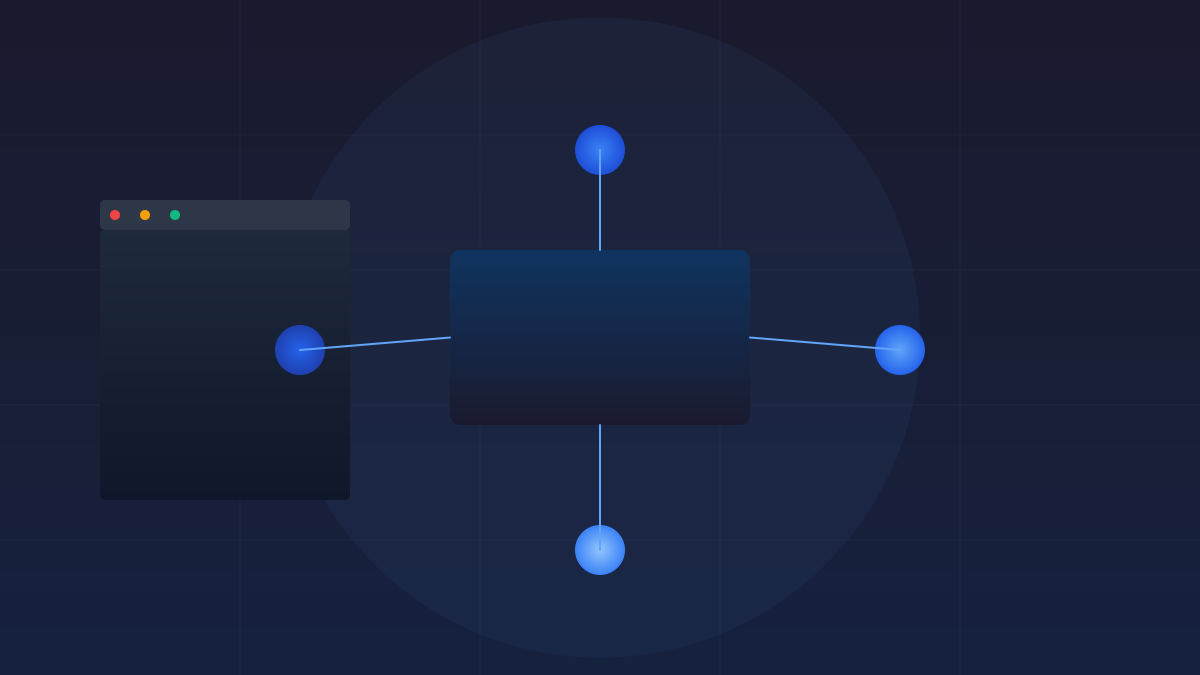
Wardian is an integrated agent environment desktop application designed to address the challenges of multi-agent conversation management and workflow coordination, providing developers with a localized unified command center. Its core values include: unified management of multi-agent terminal sessions (PTY management), real-time monitoring of operational status (telemetry), collection of work results (completion queue), chaining agents into deterministic pipelines, support for skill hot-swapping, etc. It is positioned as an agent orchestration platform.


2

Section 02

Background: Practical Challenges in Multi-Agent Management

As AI agents gradually become daily tools for developers, how to efficiently manage multiple concurrently running agent conversations and coordinate workflows between them has become a practical challenge. The Wardian project was born to solve this problem.

3

Section 03

Core Features

Unified Session Management

Provides a graphical interface that clearly displays the status, historical output, and current tasks of all running agent conversations, reducing the cognitive burden of collaboration.

Real-Time Telemetry and Monitoring

Monitors metrics such as agent resource usage, response time, and error rate, helping to identify performance bottlenecks and optimize configurations.

Completion Queue

Work completed by agents is placed in a queue waiting for human review, enabling decoupling of human-machine collaboration and supporting asynchronous processing.

Skill Hot-Swapping

Dynamically change the agent's skill set at runtime without restarting, improving iteration flexibility.

Deterministic Pipeline

Chains multiple agents into an automated workflow pipeline, suitable for complex multi-stage tasks.

4

Section 04

Technical Architecture and Implementation Details

Cross-Platform Support

Provides precompiled binary files covering mainstream systems such as Windows x64, macOS (Apple Silicon/Intel), and Linux (Debian/Ubuntu/AppImage).

Secure Startup Instructions

The binary files are unsigned, so you need to bypass system warnings on first launch: For Windows, click "More info → Run anyway"; for macOS, open via right-click or execute xattr -cr; for Linux, add execution permissions or install via apt.

CLI Control Interface

Provides the wardian command-line tool, supporting agent identity discovery, peer coordination, and direct control of Wardian functions.

5

Section 05

Supported Agents and Use Cases

Supported Agent Runtimes

Already adapted to five mainstream agent CLI tools: Gemini CLI, Claude Code, Codex CLI, OpenClaw, and Aider, unifying their lifecycles and models.

Use Cases

  • Parallel multi-project development: Unified management of agent conversations across different projects
  • Workflow orchestration: Chaining agents to complete complex tasks (code generation → testing → documentation)
  • Team management: Sharing agent conversations and work results
  • Long-duration tasks: Monitoring progress and collecting results to avoid work loss
6

Section 06

Project Status and Notes

The project is in the early development stage. APIs, disk formats, and UI layouts may change between versions. It is recommended to use a fixed version and submit issues to feedback problems.

7

Section 07

Summary and Future Outlook

Summary

Wardian represents a new direction for agent management tools from single use to unified platform management, providing unique values such as unified view, state persistence, human-machine decoupling, cross-tool coordination, etc., to improve multi-agent collaboration efficiency.

Future Outlook

  • Expand support for more agents
  • Enhance advanced orchestration features (conditional branching, parallel execution)
  • Team collaboration features (shared workspaces, permission management)
  • Build a plugin ecosystem

