Zing Forum

Reading

UniMedVL: A Unified Foundation Model for Medical Multimodal Understanding and Generation

UniMedVL is a unified medical foundation model that achieves medical multimodal understanding and generation through the Observation-Knowledge-Analysis (OKA) three-layer framework. With a parameter scale of 14B, the model has reached state-of-the-art (SOTA) performance in tasks such as medical visual question answering and medical image generation, and its core paper has been accepted by ICML 2026.

UniMedVL医学多模态视觉语言模型医学AI医疗影像生成ICML 2026开源项目
Published 2026-06-06 02:02Recent activity 2026-06-06 02:22Estimated read 4 min
UniMedVL: A Unified Foundation Model for Medical Multimodal Understanding and Generation
1

Section 01

UniMedVL: Introduction to the Groundbreaking Medical Multimodal Foundation Model

UniMedVL is a unified medical multimodal foundation model developed and open-sourced by the uni-medical team. It integrates understanding and generation capabilities via the Observation-Knowledge-Analysis (OKA) three-layer framework. With a parameter scale of 14B, the model has achieved SOTA performance in tasks like medical visual question answering and medical image generation. Its core paper has been accepted by ICML 2026, and it is accompanied by the UniMed-5M dataset (over 5.6 million samples).


2

Section 02

Project Background: Solving the Fragmentation Problem of Medical AI

Traditional medical AI methods suffer from fragmentation issues such as task isolation and model redundancy. UniMedVL aims to integrate multimodal capabilities through a unified architecture. Its core paper has been accepted by ICML 2026, and the supporting UniMed-5M dataset provides a foundation for training.

3

Section 03

Core Innovation: The OKA Three-Layer Framework

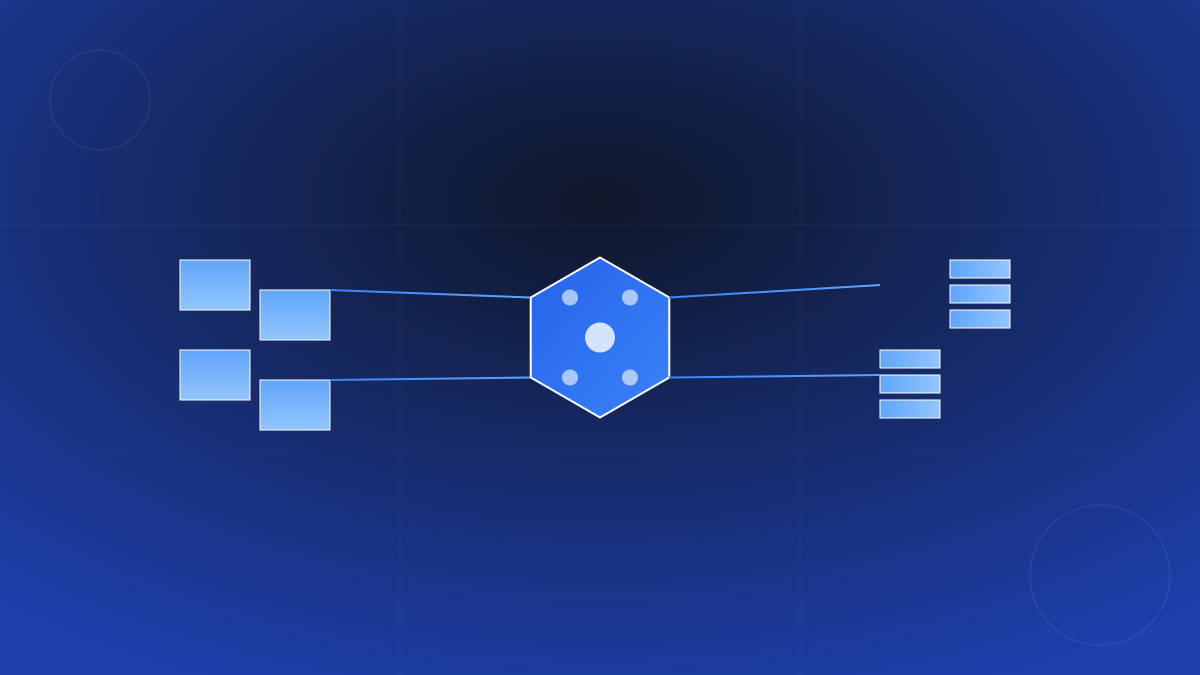
The OKA framework is inspired by clinical workflows: Observation Layer: Perceives features of medical images; Knowledge Layer: Performs reasoning by linking to medical knowledge bases; Analysis Layer: Generates reports/answers. The architecture enables cross-task collaborative enhancement.

4

Section 04

Multi-Stage Progressive Training Strategy

Three-stage training:

  1. Foundation training (85K steps): Establishes vision-language alignment;
  2. Instruction fine-tuning (120K steps): Enhances cross-modal understanding;
  3. Unified training (70K steps): Builds comprehensive capabilities. The progressive strategy ensures stable training.
5

Section 05

Performance: SOTA Results Across Multiple Tasks

In medical VQA, it leads on datasets like SLAKE (75.4%) and PathVQA (53.5%); the average gFID for image generation is 96.29; it has strong generalization ability in cross-modal tasks; the 14B parameter version is more efficient than 7B task-specific models.

6

Section 06

Application Scenarios: Practical Value in Multiple Domains

It supports scenarios such as auxiliary diagnosis, medical education, scientific research analysis, and multimodal interaction, providing a comprehensive solution for medical AI applications.

7

Section 07

Open-Source Ecosystem: Resource Openness and Community Support

It provides pre-trained weights (on HuggingFace), inference code, partially open datasets, and a project homepage to promote technology dissemination.

8

Section 08

Summary and Outlook

UniMedVL represents a significant advancement in medical multimodal AI. Its limitations include incomplete open-sourcing of training code; future plans include expanding modalities and enhancing EMR integration.

