Zing Forum

Reading

Traffic-LAMA-Controller: A Low-Cost Intelligent Traffic Light Control System Based on Visual Reasoning Models

Traffic-LAMA-Controller integrates video recognition and reasoning models with traffic light controllers to achieve intelligent traffic management at lower cost and technical overhead.

智能交通视觉推理交通灯控制视频识别边缘AI智能城市低成本部署流量优化
Published 2026-05-20 09:11Recent activity 2026-05-20 09:19Estimated read 7 min
Traffic-LAMA-Controller: A Low-Cost Intelligent Traffic Light Control System Based on Visual Reasoning Models
1

Section 01

Introduction: Traffic-LAMA-Controller - A New Low-Cost Intelligent Traffic Light Control Solution

Traffic-LAMA-Controller is a low-cost intelligent traffic light control system based on visual reasoning models. By integrating video recognition and reasoning models with traffic light controllers, it achieves intelligent traffic management at lower cost and technical overhead, addressing the high cost and lack of flexibility of traditional systems.


2

Section 02

Current Status and Challenges of Intelligent Traffic Management

Urban traffic congestion is a global problem. Traditional traffic light control systems rely on expensive dedicated hardware and complex sensor networks, resulting in high deployment and maintenance costs and limited flexibility, making it difficult to adapt to dynamic traffic conditions. Advances in artificial intelligence technology (especially visual understanding and reasoning models) have provided new possibilities for intelligent traffic management.

3

Section 03

Overview and Core Innovations of the Traffic-LAMA-Controller Project

This is an open-source project developed by j1m5s3. Its core innovations include:

Vision-first Perception Solution: Uses general video streams as input, reuses existing surveillance cameras or low-cost devices, reducing reliance on dedicated hardware;

Decision-making Capability of Reasoning Models: Identifies traffic participants, understands scene dynamics, predicts traffic flow trends, and makes control decisions—far exceeding traditional rule-based systems;

Low Technical Threshold Deployment: Connects to existing traffic light controllers via standardized interfaces without large-scale infrastructure modification.

4

Section 04

Technical Architecture and Implementation Mechanism

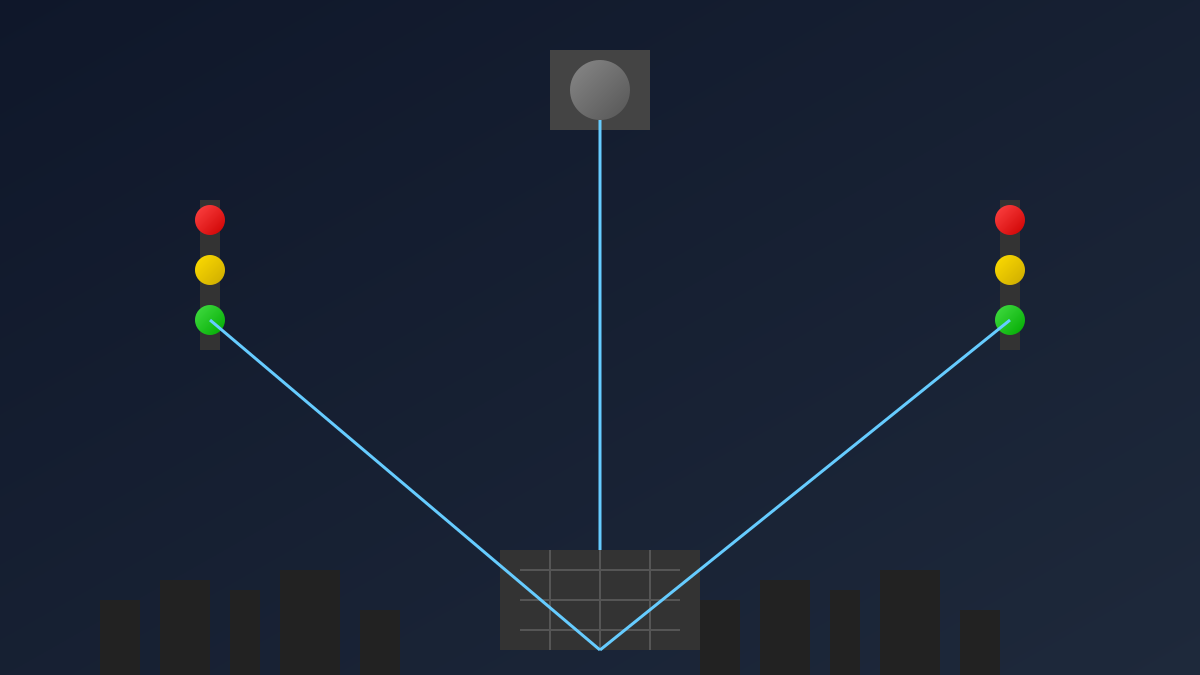
The system architecture consists of four layers:

Video Perception Layer

Supports IP cameras (RTSP/RTMP protocols), USB cameras, and video file simulation input;

Visual Reasoning Engine

Responsible for target detection and tracking, traffic flow analysis, scene understanding, and trend prediction;

Decision Control Layer

Generates strategies such as phase optimization, emergency response, and coordinated control;

Hardware Interface Layer

Connects to traffic light controllers via relay control and NTCIP protocol, with built-in safety mechanisms.

5

Section 05

Cost Advantage Analysis

Reduced Hardware Costs

Reuses existing surveillance cameras, consumer-grade computing devices (e.g., edge AI boxes), and standard network connections, replacing expensive traditional hardware like dedicated induction loops and industrial cameras;

Optimized Deployment Costs

No road construction such as burying induction loops is required, shortening the deployment cycle and reducing impact on traffic;

Simplified Maintenance Costs

Maintenance only requires camera cleaning and software updates, avoiding the need for road closures for repairs when traditional induction loops are damaged.

6

Section 06

Application Scenarios and Value

Applicable to multiple scenarios:

  • Urban Intersection Optimization: Dynamically adjusts signal timing to reduce vehicle waiting time and congestion;

  • Temporary Traffic Management: Rapid deployment to handle construction, large-scale events, or emergencies without permanent equipment;

  • Small Towns and Development Zones: Provides an economically feasible intelligent traffic solution for areas with limited budgets.

7

Section 07

Technical Insights and Future Development Directions

Technical Insights

The system's closed-loop architecture of "Perception-Reasoning-Decision-Execution" can be extended to smart city scenarios such as intelligent parking management, crowd density monitoring and guidance, and public safety event detection;

Future Directions

  • Multimodal Fusion: Integrate radar and LiDAR to improve perception reliability;
  • Federated Learning: Collaborative learning across multiple intersections to share optimization strategies;
  • Vehicle-Road Collaboration: Connect with intelligent connected vehicles for refined management.

This system provides a new low-cost and high-efficiency paradigm for intelligent traffic management, promoting the popularization and application of the technology.

