Zing Forum

Reading

TORU & SOTO RAG System: An Intelligent Q&A Solution for Enterprise Website Content

A Retrieval-Augmented Generation (RAG) system that enables intelligent Q&A based on enterprise website content by combining semantic search and large language models (LLMs). It supports web crawling, content chunking and indexing, and context-aware precise answer generation.

RAG检索增强生成企业知识库智能问答语义搜索开源项目
Published 2026-06-10 21:15Recent activity 2026-06-10 21:28Estimated read 8 min
TORU & SOTO RAG System: An Intelligent Q&A Solution for Enterprise Website Content
1

Section 01

Introduction: TORU & SOTO RAG System—An Intelligent Q&A Solution for Enterprise Website Content

This article introduces the TORU & SOTO RAG system, an intelligent Q&A solution for enterprise website content that achieves precise answers by combining semantic search and large language models (LLMs). The system supports web crawling, content chunking and indexing, and context-aware answer generation, aiming to solve pain points in enterprise knowledge management such as scattered information and difficult retrieval. The following floors will analyze the system's background, architecture, technical highlights, and applications in detail.


2

Section 02

Project Background: Pain Points in Enterprise Knowledge Management and Opportunities for RAG Technology

In digital transformation, enterprises face multiple challenges in knowledge management: information is scattered across a large number of web pages, traditional keyword search struggles to understand user intent, content updates are lagging, and the labor cost of maintaining knowledge bases is high. The emergence of Retrieval-Augmented Generation (RAG) technology provides new ideas to solve these problems—converting enterprise website content into a retrievable knowledge base and combining it with LLM generation capabilities to build an intelligent Q&A system. The TORU & SOTO RAG system is exactly such a RAG solution for enterprise website content.

3

Section 03

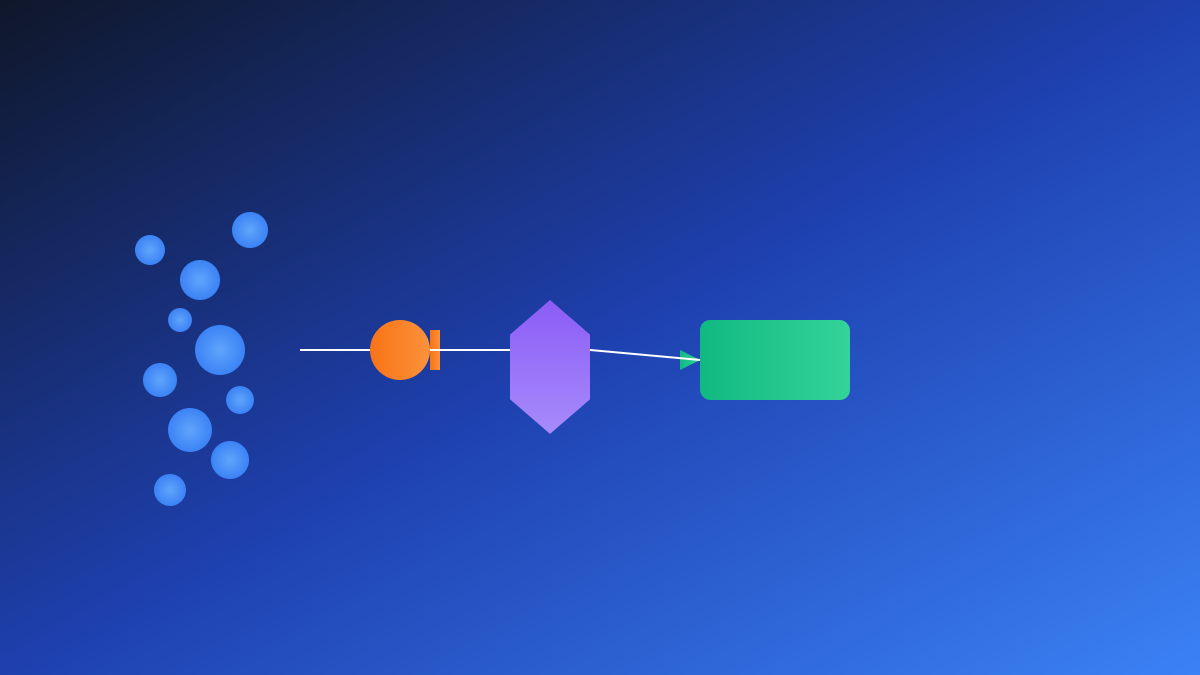
System Architecture and Workflow: Two Phases of Indexing and Querying

The system adopts a two-phase architecture of indexing and querying:

Indexing Phase

  1. Web crawling: Automatically obtain raw text data from the target enterprise website
  2. Content cleaning: Remove irrelevant content such as HTML tags and navigation bars
  3. Intelligent chunking: Split long documents into semantically complete text blocks
  4. Vector encoding: Convert text blocks into high-dimensional vectors using an embedding model
  5. Vector storage: Store vector indexes in a vector database to support efficient similarity retrieval

Query Phase

  1. Query understanding: Receive user natural language questions
  2. Semantic retrieval: Vectorize the query and retrieve the most relevant text blocks
  3. Context assembly: Combine relevant fragments into a context window
  4. Answer generation: Input the context and question into the LLM to generate accurate answers
4

Section 04

Technical Highlights: Semantic Search, Context-Aware Generation, and Automatic Synchronization

The core technical highlights of the system include:

  1. Semantic search advantage: Compared with traditional keyword search, it can understand synonyms, semantic associations, and user intent, and return results sorted by semantic relevance
  2. Context-aware generation: Can synthesize multi-source information to form complete answers, reduce hallucinations based on real content, and output fluently and naturally
  3. Automatic content synchronization: Supports regular re-crawling and indexing of website content to ensure the knowledge base stays synchronized with website updates
5

Section 05

Application Scenarios: Covering Multiple Internal and External Enterprise Scenarios

The system has a wide range of application scenarios:

  • Enterprise internal knowledge base: Employees quickly query company policies, processes, technical specifications, etc.
  • Customer self-service: Deployed in the official website help center to provide 24/7 product information, usage guides, etc., reducing customer service tickets
  • Product documentation assistant: Provide interactive queries for complex products to answer function usage methods
  • Sales support tool: Sales teams quickly obtain product specifications, pricing, competitor comparisons, and other materials
6

Section 06

Implementation Recommendations: Key Considerations for Ensuring System Effectiveness

Recommendations for implementing the system:

  • Data quality: Ensure the website content has a clear structure and accurate information, which is the foundation of RAG system performance
  • Chunking strategy: Optimize the size and boundaries of text chunks according to content characteristics, which affects retrieval effectiveness
  • Retrieval precision: Monitor the relevance of retrieval results, adjust the embedding model or add re-ranking if necessary
  • Security and privacy: Pay attention to data access control and privacy protection when handling sensitive information
7

Section 07

Open Source Value and Summary: Project Significance and Prospects

Open Source Value

The TORU & SOTO RAG system is released in open source form, with values including: lowering the entry barrier for developers, supporting enterprise customized expansion, promoting community collaboration and improvement, and serving as a practical learning case for RAG

Summary

This system is a practical enterprise-level RAG solution, providing a reference for building systems such as internal knowledge bases and customer self-service platforms. With the advancement of LLM and vector retrieval technologies, the application prospects of such systems will be even broader

