Zing Forum

Reading

tf-agent: An AI-Powered Automation Assistant for Terraform Infrastructure Changes

tf-agent is an intelligent tool that converts natural language requirements into standardized Terraform code changes. It significantly improves the efficiency and reliability of Infrastructure as Code (IaC) through automated planning, validation, and PR submission workflows.

TerraformIaCAI自动化DevOpsGitHub PR基础设施即代码
Published 2026-05-02 21:15Recent activity 2026-05-02 21:24Estimated read 9 min
tf-agent: An AI-Powered Automation Assistant for Terraform Infrastructure Changes
1

Section 01

tf-agent: An AI-Powered Automation Assistant for Terraform Infrastructure Changes (Main Floor Introduction)

tf-agent is an intelligent tool that converts natural language requirements into standardized Terraform code changes. It significantly improves the efficiency and reliability of Infrastructure as Code (IaC) through automated planning, validation, and PR submission workflows. Its core positioning is an "intelligent agent for Terraform workflows", aiming to eliminate repetitive and mechanical tasks so that engineers can focus on core tasks requiring human judgment, such as architecture design and technology selection. The tool covers the entire workflow from requirement understanding to PR creation, including code generation, formatting checks, syntax validation, branch management, and GitHub integration.


2

Section 02

Background: Pain Points in Infrastructure Management

In modern software development, Infrastructure as Code (IaC) has become an industry-standard practice. As a leading tool in this field, Terraform allows teams to manage cloud resources in a declarative way. However, as infrastructure scales, Terraform workflows face efficiency bottlenecks: A typical change process involves multiple steps such as understanding requirements, modifying code, formatting checks, syntax validation, creating branches, committing code, and initiating PRs. This is time-consuming for experienced DevOps engineers and a barrier for newcomers. Manual operations are prone to omissions, leading to unstandardized or unvalidated code entering the codebase and introducing risks. The industry has explored solutions like templating and script automation, and the maturity of AI technology brings new possibilities for simplifying the process—can machines understand natural language requirements and automatically complete the entire workflow from requirement to PR?

3

Section 03

Analysis of Core Workflow

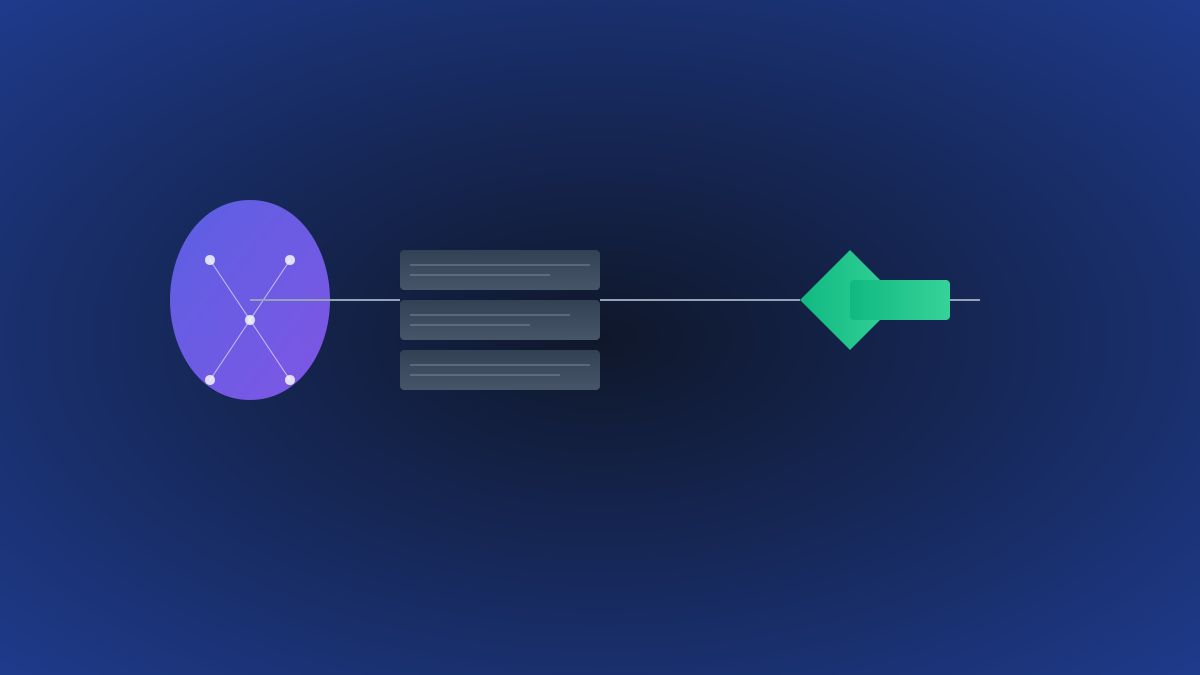
tf-agent's workflow reflects an understanding of Terraform best practices:

  1. Semantic Understanding: After the user inputs requirements, the tool extracts key information such as resource type, configuration parameters, and target environment;
  2. Context Analysis: Analyzes the current state of the target codebase (existing module structure, variable definitions, state file location, etc.) to ensure the generated code seamlessly integrates into the existing project;
  3. Code Generation: Creates Terraform code that complies with project specifications, automatically handling details like module references and variable passing;
  4. Validation: Executes terraform fmt to format the code and terraform validate for syntax validation;
  5. PR Submission: Creates a new branch on GitHub and initiates a Pull Request. The PR description automatically includes the change summary and validation results.
4

Section 04

Use Cases and Best Practices

tf-agent is suitable for three types of scenarios:

  1. Regular Resource Creation: Fixed-pattern operations such as adding EC2 instances, creating RDS databases, and configuring load balancers;
  2. Configuration Updates: Changes with clear logic such as upgrading AWS Provider versions, modifying tag policies, and adjusting resource specifications;
  3. Troubleshooting: Describe the error phenomenon of terraform plan, and the AI will analyze and attempt to fix it.

Best Practices: Provide clear and specific requests (e.g., "Add a security group allowing web traffic in the networking module of the dev environment") and avoid vague descriptions (e.g., "Optimize cloud settings").

5

Section 05

Integration Capabilities and Extensibility

tf-agent supports integration with existing toolchains:

  • Deep GitHub Integration: Automatically completes PR creation, branch management, and permission checks;
  • Ticket System Support: Can extract requirements from ticket descriptions (e.g., Jira) and associate them with projects;
  • Flexible AI Models: Integrates with mainstream large models like Claude and Bedrock, allowing users to choose as needed;
  • Adaptation to Project Structure: Automatically identifies the structure and adjusts code generation strategies, whether it's a monorepo or a multi-module project.
6

Section 06

Security and Governance Considerations

tf-agent has built-in multi-layer security mechanisms:

  • Least Privilege: Only requests the necessary GitHub permissions to complete the work (e.g., read/write access to specified repositories);
  • Manual Review: AI-generated code requires manual merging, and the PR review process ensures compliance with security policies and regulatory requirements;
  • Audit Trail: All automated operations leave traces in the PR history (original requirements, execution steps, validation results);
  • Compliance with Branch Rules: Generated PRs comply with existing branch protection rules and do not bypass quality gates.
7

Section 07

Limitations and Future Outlook

Limitations:

  • Complex architectural decisions (e.g., multi-region deployment, network topology reconstruction) require the involvement of human architects;
  • Management of sensitive information (database passwords, API keys) should follow organizational security standards and use key management services;
  • When there are existing configuration issues in the codebase, the AI cannot automatically fix them; basic issues need to be resolved first.

Outlook: tf-agent is a successful application of AI in the DevOps field. By combining semantic understanding of large language models with infrastructure automation workflows, it reduces mechanical work for Terraform users and allows teams to focus on innovation. In the future, such intelligent agent tools will play a more important role in infrastructure management.

Project URL: https://github.com/Himurab6049/tf-agent

