Zing Forum

Reading

T5Gemma-TTS: An Open-Source Multilingual Text-to-Speech Solution Based on T5Gemma

A multilingual text-to-speech application based on the T5Gemma encoder-decoder architecture, supporting voice cloning and speech rate control, providing natural and fluent speech synthesis experiences for education, entertainment, and accessibility scenarios.

TTS语音合成T5Gemma多语言语音克隆Transformer开源无障碍访问
Published 2026-03-29 23:16Recent activity 2026-03-29 23:20Estimated read 12 min
T5Gemma-TTS: An Open-Source Multilingual Text-to-Speech Solution Based on T5Gemma
1

Section 01

Introduction: Core Highlights of the T5Gemma-TTS Open-Source Solution

T5Gemma-TTS is an open-source multilingual text-to-speech solution based on the T5Gemma encoder-decoder architecture, supporting voice cloning and speech rate control. It provides natural and fluent speech synthesis experiences for scenarios such as education, entertainment, and accessibility. Combining the sequence conversion capabilities of large language models, this project aims to balance speech quality and efficiency while reducing the complexity of multilingual deployment.

2

Section 02

Technical Background: Evolution and Current Challenges of TTS

Evolution and Current State of Speech Synthesis Technology

Text-to-Speech (TTS) technology has evolved from rule-based synthesis to statistical parameter synthesis, and then to neural network end-to-end synthesis. In recent years, Transformer-based large language models have shown great potential in the TTS field, enabling more natural and expressive speech generation.

However, multilingual support, voice personalization cloning, and real-time inference efficiency remain core challenges for developers. Against this technical backdrop, the T5Gemma-TTS project attempts to combine the sequence-to-sequence modeling capabilities of the T5Gemma model with speech synthesis tasks, providing an open-source solution that balances quality and efficiency.

3

Section 03

Project Architecture: Integration of T5Gemma Encoder-Decoder and Vocoder

Project Architecture: Application of T5Gemma in Speech Synthesis

T5Gemma-TTS adopts T5Gemma as the core encoder-decoder language model architecture. T5 (Text-to-Text Transfer Transformer) was originally designed for natural language processing tasks, and its encoder-decoder structure is particularly suitable for sequence conversion tasks—which is exactly the essence of speech synthesis: converting text sequences into audio feature sequences.

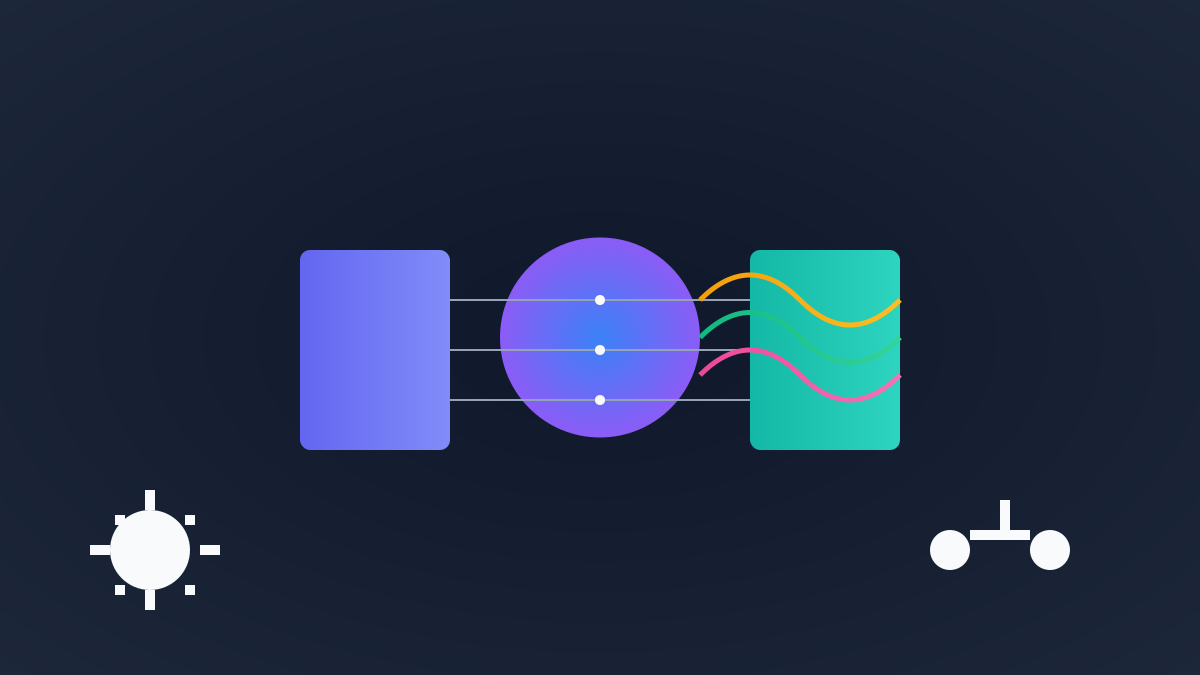
The project combines T5Gemma's text understanding capabilities with a vocoder to form a complete TTS pipeline. Text is first processed by the T5Gemma encoder to extract semantic representations, then the decoder generates corresponding acoustic features, and finally the vocoder synthesizes them into playable audio waveforms.

4

Section 04

Core Features: Multilingual Support, Voice Cloning, and Speech Rate Control

Core Feature Characteristics

Multilingual Speech Synthesis Support

A key highlight of the project is its native support for multilingual text input. Traditional TTS systems often require separate model training for each language, but T5Gemma-TTS leverages the cross-language transfer capabilities of large language models to handle speech synthesis needs for multiple languages within a single model framework. This significantly reduces deployment complexity and maintenance costs for products targeting global users.

Voice Cloning Capability

Voice cloning allows users to create personalized synthetic voices using a small amount of reference audio. T5Gemma-TTS has a built-in speaker embedding mechanism that can extract speaker features from short audio samples and apply these features during synthesis, making the output speech sound like a specific target speaker.

This feature has important application value in scenarios such as personalized assistants, audiobooks, and virtual anchors. However, the project documentation also notes that the voice cloning feature requires additional configuration to achieve optimal results, implying it may be an advanced feature that needs fine-tuning.

Fine-Grained Speech Rate Control

In addition to voice personalization, the project supports fine adjustment of the speech rate of synthesized speech. Users can adjust the playback speed according to content type and scenario requirements to ensure clarity and comfort in information delivery. This feature is particularly important for educational content and accessibility applications.

User-Friendly Interface Design

The project emphasizes that its interface design is oriented to all users, regardless of technical background, making it easy to get started. From installation to voice generation, the entire process provides clear graphical interface guidance, lowering the threshold for non-technical users to use AI speech synthesis tools.

5

Section 05

Usage Flow and System Requirements

Usage Flow and System Requirements

The project's usage flow is designed to be concise and intuitive: users download the installation package for their operating system (supporting Windows, macOS, and Linux) from GitHub Releases, install it, open the application, select a preset voice or configure voice cloning, input the text to be synthesized, adjust the speech rate parameters, and click the generate button to get the synthesized speech.

In terms of system requirements, the project recommends at least 4GB of memory and 500MB of disk space. The operating system should be Windows 10 or above, macOS, or a compatible Linux distribution. The documentation also honestly points out that slight delays in voice generation may be encountered on low-end devices, reflecting the common challenge of edge AI inference.

6

Section 06

Application Scenarios: Covering Education, Entertainment, and Accessibility

Application Scenario Analysis

In the education field, T5Gemma-TTS can provide natural voice reading for electronic textbooks and online courses, supporting accessible access to multilingual learning content. In the entertainment industry, the voice cloning feature allows game characters and virtual idols to have unique sound identities. For visually impaired users and people with reading difficulties, high-quality TTS technology is an important bridge to access digital content.

In addition, content creators can use this tool to quickly generate initial audio for podcasts and video dubbing, greatly improving content production efficiency. Enterprise customer service systems can also leverage multilingual TTS capabilities to provide localized voice service experiences for global users.

7

Section 07

Technical Limitations and Improvement Directions

Technical Limitations and Improvement Directions

From the project documentation, it can be seen that T5Gemma-TTS currently mainly provides precompiled application downloads rather than open-source training code and model weights. This means users can use the现成 speech synthesis capabilities, but it is difficult to perform in-depth customization or model fine-tuning for specific scenarios.

In addition, the optimal performance of the voice cloning feature requires additional configuration, implying that default parameters may not achieve ideal results in all scenarios. For professional users pursuing extreme speech quality, it may be necessary to invest time in parameter tuning.

8

Section 08

Conclusion: A New Choice for the Open-Source TTS Ecosystem

Conclusion: A New Choice for the Open-Source Speech Synthesis Ecosystem

T5Gemma-TTS represents the trend of open-source TTS tools migrating to large language model architectures. By leveraging T5Gemma's powerful text understanding capabilities, the project shows unique advantages in multilingual support and speech naturalness. Although there is still room for improvement in terms of model openness and ease of use of advanced features, it is a solution worth trying for developers and content creators who need to quickly deploy multilingual speech synthesis capabilities.

With the continuous progress of voice AI technology, we can expect to see more similar open-source projects, bringing lab-level speech synthesis capabilities to a wider range of developers and users.


