Zing Forum

Reading

Synapse: A Unified AI Inference Gateway Integrating LLM, Speech, and Audio Processing

Synapse is a FastAPI-based unified AI gateway that provides a single entry point for all AI workloads in a K3s cluster, supporting multiple services such as LLM embedding, chat, TTS, STT, speaker separation and verification, and audio noise reduction.

AI网关LLMTTSSTT语音处理FastAPIK3sOpenAI兼容
Published 2026-04-05 11:44Recent activity 2026-04-05 11:47Estimated read 5 min
Synapse: A Unified AI Inference Gateway Integrating LLM, Speech, and Audio Processing
1

Section 01

Synapse: Unified AI Inference Gateway — A Solution for Integrating Multimodal AI Services

Synapse is a unified AI gateway built on FastAPI, designed to provide a single entry point for all AI workloads in a K3s cluster and address the pain points of integrating multiple AI services. It supports various services including LLM embedding, chat completion, TTS, STT, speaker separation and verification, and audio noise reduction, and offers OpenAI-compatible APIs to simplify development and operation processes.


2

Section 02

Background: Challenges in AI Service Integration

In current AI application development, developers need to interface with multiple backend services (LLM, TTS, STT, etc.), each with different API formats, authentication methods, and deployment requirements, which increases development complexity and operational difficulty. Synapse was created to address this pain point.

3

Section 03

Architecture Design: Two-Layer Communication and Intelligent Routing

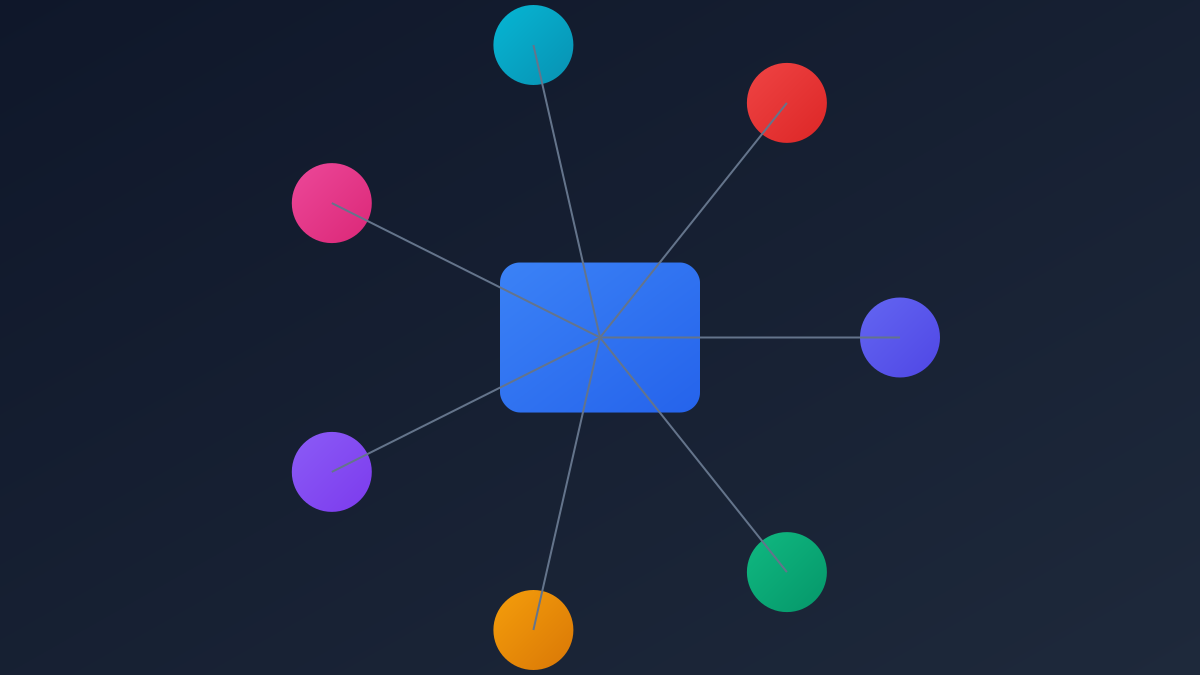
Synapse adopts a two-layer communication model: gRPC over TCP is used between clients and the gateway, and between the gateway and backend replicas to support streaming transmission. The cluster integrates six major backend services (llama-embed, llama-router, Chatterbox TTS, whisper-stt, pyannote-speaker, deepfilter-audio), and the gateway intelligently routes requests to the corresponding service based on request type.

4

Section 04

Core Features: One-Stop AI Capabilities and Convenient Management

Synapse exposes 22 OpenAPI endpoints, including OpenAI-compatible /v1/embeddings and /v1/chat/completions; it provides a web dashboard (e.g., /ui) to view health status, operate models, and access real-time logs; it supports voice library management (uploading samples, cloning voices), with data persisted via PVC.

5

Section 05

High Availability and Fault Tolerance: Ensuring System Stability

Synapse configures circuit breakers and retry mechanisms for backends, enabling automatic failover in case of failures; the aggregated health check endpoint /health returns the status of all backends; it supports Redis as a terminal log sharing bus, allowing unified visibility of log streams under multiple replicas.

6

Section 06

Deployment and Operation: Simplified Processes and Flexible Configuration

A Makefile is provided to simplify deployment (from infrastructure to backend services); it supports Forge for remote image building; configurations are mounted as ConfigMaps via YAML files, and environment variables allow customization of log levels, Redis parameters, etc.

7

Section 07

Application Scenarios and Practical Value

It is suitable for teams that manage multiple AI services uniformly in a K3s cluster, projects that need OpenAI-compatible APIs but use open-source models, and conversational AI applications that integrate speech processing. Developers can call multiple AI capabilities through a unified interface without worrying about underlying details.

8

Section 08

Conclusion: The Unified Direction of AI Infrastructure

Synapse represents the evolution direction of AI infrastructure—encapsulating heterogeneous AI capabilities through the gateway layer to provide consistent and reliable interfaces. As AI services increase, the unified gateway model will become more important, providing a reference solution for AI platform construction.

