Zing Forum

Reading

Strata-MCP: An Academic Research Engine Based on Model Context Protocol for Localized Paper Management and Intelligent Analysis

Strata-MCP is an independent MCP server that provides localized solutions for academic research. It uses SQLite+FTS5 for paper storage and full-text search, and integrates Claude Code for literature review, gap analysis, and draft writing—no remote LLM or API key required.

MCP学术研究文献管理SQLiteClaude Code本地化论文分析研究工作流
Published 2026-05-10 22:40Recent activity 2026-05-10 22:54Estimated read 7 min
Strata-MCP: An Academic Research Engine Based on Model Context Protocol for Localized Paper Management and Intelligent Analysis
1

Section 01

Strata-MCP: Core Overview of the Localized Academic Research Engine

Strata-MCP is an independent MCP server that provides localized solutions for academic research. Its core advantages include:

  • Fully Localized: Uses SQLite+FTS5 for paper storage and full-text search. All data is stored in .strata/strata.db under the project directory, and core functions are accessible without external services or network.
  • Zero API Dependency: Integrates Claude Code for literature review, gap analysis, and draft writing. Batch tasks are processed in parallel by Haiku sub-agents, no separate API key needed.
  • Protocol Standardization: Follows the Model Context Protocol (MCP) defined by Anthropic, and can work collaboratively with any AI assistant that supports MCP.

2

Section 02

Tool Dilemmas in Academic Research and Limitations of Existing Solutions

Academic researchers often rely on multiple scattered tools (Zotero/Mendeley for literature management, Notion/Obsidian for note-taking, Google Scholar for search, Overleaf for writing), leading to cognitive burden and knowledge fragmentation. Deeper issues: Most existing solutions require cloud-hosted data or depend on remote APIs, bringing privacy compliance risks, continuous service reliance, and accumulated costs—posing barriers for scholars in sensitive data scenarios or network-restricted environments.

3

Section 03

Core Concepts and Architecture Design

Strata-MCP is centered on localization first and protocol-driven:

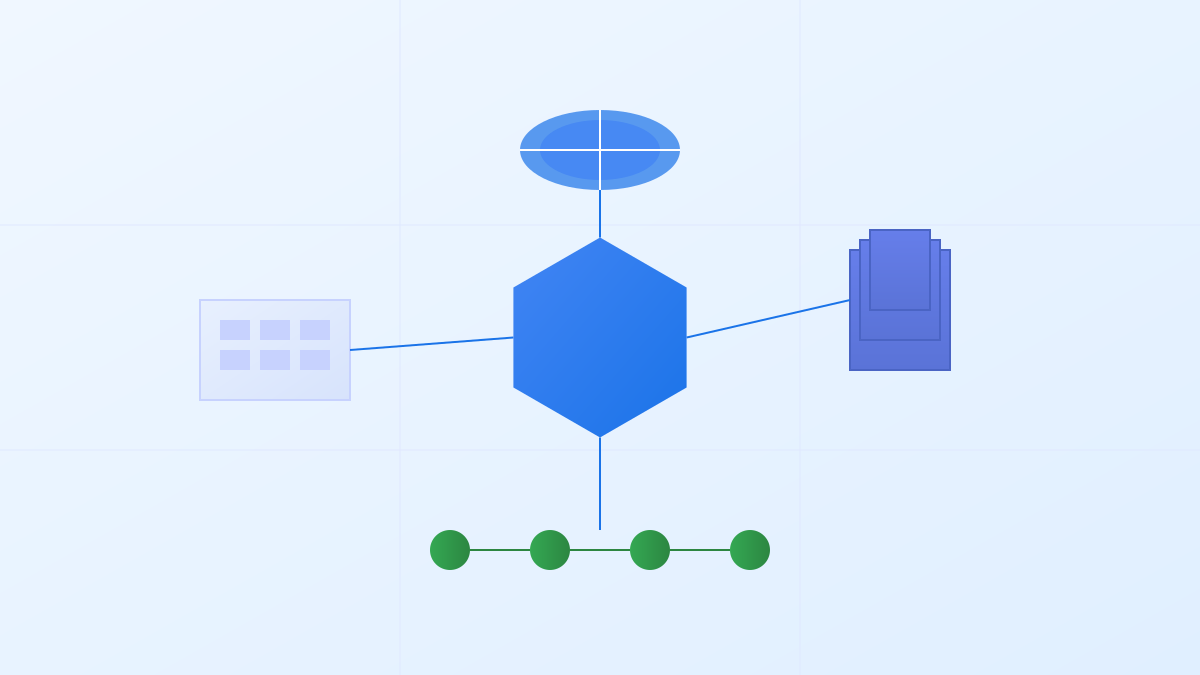
  • Architecture: Adopts hexagonal architecture (port-adapter pattern). The core domain layer defines entities, ports, and workflows; the adapter layer provides concrete implementations (e.g., sqlite_storage.py, arxiv.py, pdf_extractor.py), ensuring domain logic is decoupled from technology for easy component replacement.
  • MCP Protocol: As an MCP server, it supports collaboration with any MCP-compatible AI assistant, not limited to specific vendors.

Origin with Apex

Strata-MCP is inspired by the Apex project and reuses its architecture patterns (MCP server, skill files, slash commands), but has a different domain focus: Apex focuses on code understanding, while Strata focuses on academic paper management—they can be used complementarily.

4

Section 04

Structured Workflow: From Literature Analysis to Research Output

Two-Round Analysis Workflow

  1. First Round (Quick Screening): Haiku sub-agents process in parallel to extract metadata, summarize abstracts, identify keywords, and score relevance—quickly filtering core papers.
  2. Second Round (Deep Analysis): Led by Claude Code, it conducts method evaluation, experiment review, result interpretation, and research gap identification.

Research Phase Workflow

Covers stages including setup, library (literature collection), relevance screening, gap analysis, reconnaissance (new paper scanning), literature review, draft writing, quality assurance, export (formats like LaTeX/Markdown), and iterative revision.

5

Section 05

Applicable Scenarios and Target Users

Strata-MCP is suitable for the following scenarios:

  • Independent researchers: Focus on data privacy and long-term accessibility, unwilling to rely on commercial services.
  • Offline environments: Research environments with restricted network or cloud services (e.g., enterprise labs, institutions in specific regions).
  • Sensitive data processing: Projects involving commercial secrets, medical data, etc., that require local storage.
  • Long-term projects: Research needing years of literature library maintenance—local SQLite is more persistent.
  • Budget-constrained: Students or small teams that can't afford API call costs.
6

Section 06

Project Status and Future Roadmap

Current Status: Early development phase. Architecture design, data model, edge cases, and project layout are completed; core implementation is still ongoing (not production-ready).

Completed Components: MCP server entry, core domain model/ports, SQLite storage adapter basics, installation scripts, skill files/slash command templates, academic templates (LNCS/IEEE/ACM, etc.).

In Progress: Full implementation of arXiv/Semantic Scholar search, PDF extraction and parsing, two-round analysis automation, gap analysis algorithm development, reconnaissance periodic scanning mechanism.

7

Section 07

Open Source License and Community Contribution

Strata-MCP is open-sourced under the MIT license. Community contributions are welcome (bug reports, feature suggestions, documentation improvements, code submissions). The project provides a CONTRIBUTING.md guide and emphasizes friendly communication guidelines. Since it's in the early stage, participants have the opportunity to influence the architecture direction.


