Zing Forum

Reading

Enterprise-level RAG Chatbot: Localized Intelligent Document Q&A System Based on Llama3

A complete implementation of an enterprise-level RAG (Retrieval-Augmented Generation) chatbot built with Streamlit, LangChain, Ollama, Llama3, and ChromaDB, supporting document ingestion, vectorized retrieval, and local LLM inference.

RAG检索增强生成Llama3LangChainChromaDB企业应用文档问答
Published 2026-06-06 16:41Recent activity 2026-06-06 16:53Estimated read 8 min
Enterprise-level RAG Chatbot: Localized Intelligent Document Q&A System Based on Llama3
1

Section 01

Enterprise-level RAG Chatbot: Localized Intelligent Document Q&A System Based on Llama3 (Introduction)

This article introduces a complete implementation plan for an enterprise-level RAG chatbot, built with Streamlit, LangChain, Ollama, Llama3, and ChromaDB, supporting document ingestion, vectorized retrieval, and local LLM inference. This project provides practical references for enterprises to deploy AI chatbots, solving the "hallucination" problem of pure generative models and enabling the use of the latest private domain knowledge. The original project comes from GitHub author jbhattacherjee1998-dev, link: https://github.com/jbhattacherjee1998-dev/enterprise-rag-chatbot-genai.


2

Section 02

Background and Value of RAG Architecture

RAG (Retrieval-Augmented Generation) is a popular paradigm in current LLM application development. By combining external knowledge bases with the generative capabilities of language models, it solves the "hallucination" problem of pure generative models when answering professional questions, while allowing the system to use the latest, private, or domain-specific knowledge. The enterprise-level RAG chatbot project is based on this architecture and provides references for deployment in enterprise environments.

3

Section 03

Analysis of Core Technology Stack

The project integrates multiple open-source technical components:

  • Streamlit: Quickly build interactive web interfaces, responsible for chat interfaces, file uploads, and result display.
  • LangChain: An LLM application framework that coordinates document processing, vector retrieval, and model calling workflows.
  • Ollama: Simplifies local LLM operation and management, supporting the download and operation of models like Llama3.
  • Llama3: Meta's open-source large language model with excellent performance and relatively small size, serving as the core generative engine.
  • ChromaDB: An open-source vector database that provides efficient vector storage and similarity search for storing and retrieving document embedding vectors.
4

Section 04

System Architecture and Workflow

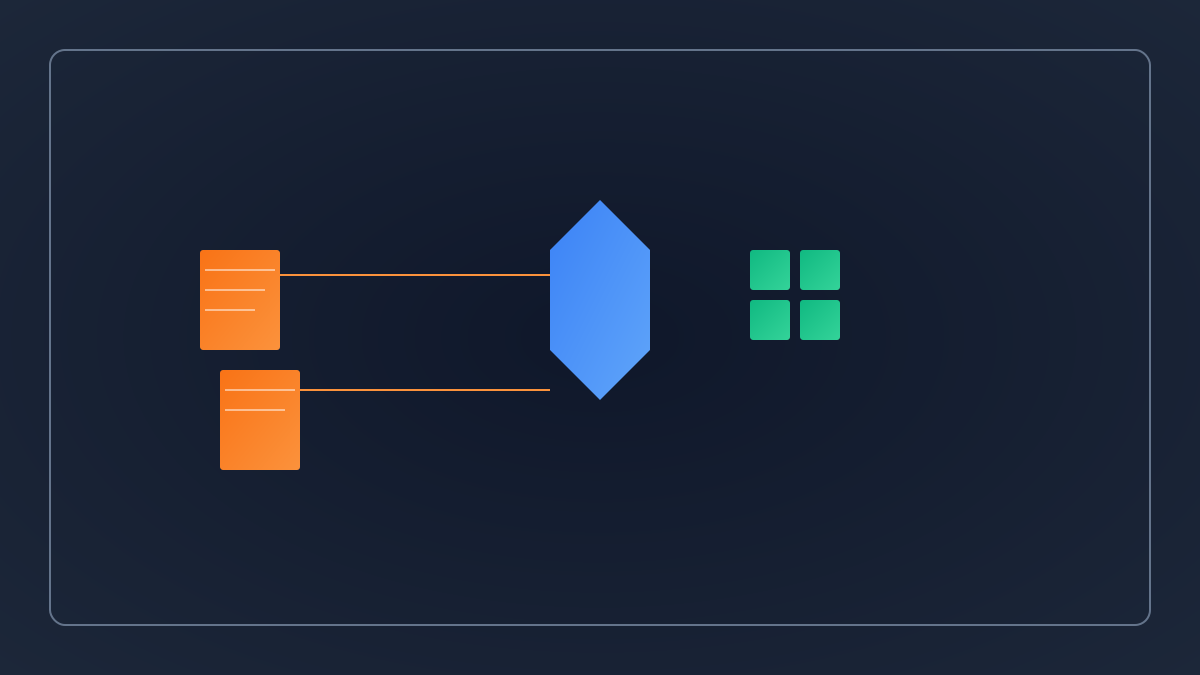
The system workflow consists of six stages:

  1. Document ingestion and processing: Supports parsing of formats like PDF, Word, TXT, and extracts text content.
  2. Text chunking: Intelligently splits documents into semantically complete text chunks to adapt to LLM input length limits.
  3. Vectorization and embedding: Converts text chunks into high-dimensional vector representations (embeddings).
  4. Vector storage and indexing: Stores vectors in ChromaDB and builds indexes to support fast retrieval.
  5. Semantic retrieval: Converts user queries into vectors and searches for the most relevant text chunks (semantic understanding rather than keyword matching).
  6. Context-enhanced generation: Combines the retrieved text chunks with the user's question and submits them to Llama3 to generate accurate answers.
5

Section 05

Advantages of Docker Containerized Deployment

The project provides full Docker support, bringing multiple benefits:

  • Environmental consistency: Ensures consistent application operation across different environments, avoiding the "works on my machine" problem.
  • Simplified deployment: One-click startup of the application stack (vector database, model services, web applications, etc.) via Docker Compose/Kubernetes.
  • Resource isolation: Process-level isolation, suitable for multi-tenant enterprise environments.
  • Scalability: Facilitates horizontal scaling, quickly starting new container instances when load increases.
6

Section 06

Enterprise Application Scenarios

The system is suitable for various enterprise scenarios:

  • Internal knowledge base Q&A: Employees query internal documents, policy manuals, etc., to improve work efficiency.
  • Customer service support: Build customer service robots based on product documents to provide 24/7 self-service.
  • Technical document assistant: Helps development teams quickly find information in technical documents and API documents.
  • Compliance and audit support: Legal teams retrieve regulatory documents and compliance policies to support decision-making.
7

Section 07

Data Privacy and Security Assurance

The system supports local deployment, allowing enterprises to have full control over data:

  • Sensitive documents do not need to be uploaded to third-party cloud services, avoiding the risk of data leakage.
  • Enterprises can implement their own security policies and access controls to meet the needs of handling confidential information.
8

Section 08

Conclusion and Outlook

This project provides a complete implementation reference for building intelligent document Q&A systems, integrating excellent open-source tools, and demonstrating a secure, efficient, and scalable way to deploy AI applications in enterprise environments. As RAG technology matures, such solutions will be applied in more enterprise scenarios.

