Zing Forum

Reading

Building a RAG Chatbot from Scratch: Complete Implementation of a Document Q&A System

This article introduces an open-source RAG chatbot project, detailing its architectural design, core components, and working principles to help developers understand how to build an intelligent document-retrieval-based Q&A system.

RAG检索增强生成聊天机器人语义搜索大语言模型文档问答向量数据库GitHub
Published 2026-05-27 00:16Recent activity 2026-05-27 00:20Estimated read 5 min
Building a RAG Chatbot from Scratch: Complete Implementation of a Document Q&A System
1

Section 01

[Introduction] Analysis of an Open-Source RAG Chatbot Project Built from Scratch

This article introduces the RAG-chatbot project open-sourced by Vishnu-MU on GitHub (link: https://github.com/Vishnu-MU/RAG-chatbot), analyzing its architectural design, core components, and working principles to help developers understand how to build an intelligent document-retrieval-based Q&A system. RAG technology combines information retrieval and text generation to solve problems such as outdated knowledge, insufficient professionalism, and hallucinations in traditional chatbots.


2

Section 02

RAG Technology Background: Addressing Pain Points of Traditional Chatbots

Retrieval-Augmented Generation (RAG) is a key breakthrough in the field of large language models, combining information retrieval and text generation. Traditional chatbots rely on pre-trained parameter knowledge and face three major problems: inability to access new information after training, lack of professional knowledge in specific domains, and easy generation of hallucinations. RAG effectively solves these issues by first retrieving relevant information from external knowledge bases before generating responses.

3

Section 03

Analysis of the Project's Core Architecture

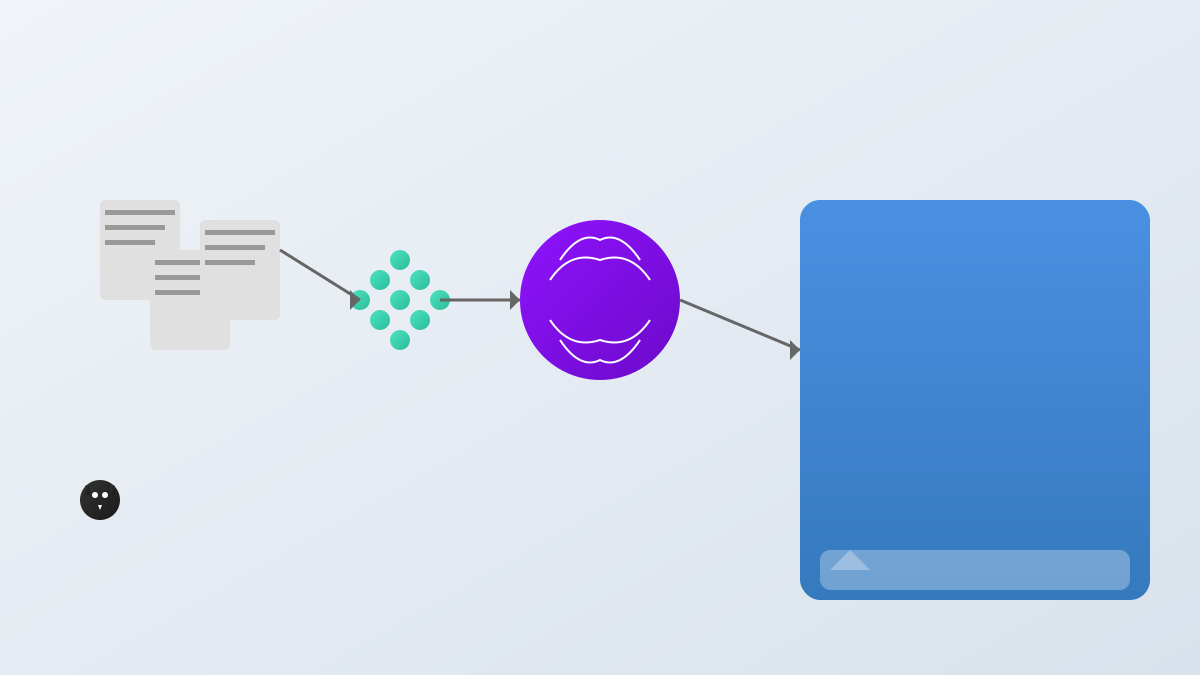
This open-source project includes four core components:

  • Document processing module (converts documents to plain text, intelligently splits them at boundaries like paragraphs while retaining overlaps)
  • Vector storage module (uses embedding models to convert text into vectors and stores them in a vector database)
  • Retrieval engine
  • Dialogue generation module
4

Section 04

Semantic Search: Core Technology of RAG Systems

Semantic search differs from keyword matching; it can understand query intent (e.g., the query "reduce server costs" can find documents related to "optimize cloud resource usage"). It relies on pre-trained embedding models (such as OpenAI text-embedding, Sentence-BERT), and models need to be selected or fine-tuned based on specific scenarios.

5

Section 05

Context-Aware Response Generation Mechanism

The generation phase is completed by LLMs (such as GPT, Claude, Llama). The key is to construct an effective prompt template: system role definition (document-based assistant), context information (retrieved document fragments), user question, and clear instructions (answer based on context; if insufficient, state that).

6

Section 06

Practical Application Scenarios of RAG Chatbots

Enterprise internal knowledge base Q&A (integrate scattered documents for employees to quickly access information), customer service automation (connect to product documents to provide accurate self-service), education and research (quickly browse literature to find relevant paragraphs).

7

Section 07

Considerations for Developing Production-Grade RAG Systems

Document quality (scanned PDFs require OCR processing), retrieval accuracy optimization (hybrid retrieval, re-ranking models), cost control (caching strategies, batch processing), data privacy and security (handling sensitive documents).

8

Section 08

Summary and Outlook: Future Directions of RAG Technology

RAG technology combines the general capabilities of large language models with domain-specific knowledge, and this project provides a starting point for developers to practice. In the future, technologies like multimodal RAG and Agentic RAG will become more intelligent. It is recommended that developers download the code and experiment with actual documents to master this technology.

