Zing Forum

Reading

Building a RAG Q&A System for Academic Literature: From Vector Retrieval to Context-Enhanced Generation

This article provides an in-depth analysis of an open-source Retrieval-Augmented Generation (RAG) system, exploring how to use semantic search, vector embedding, and large language models to enable natural language question answering for research papers. It covers system architecture, key technology selection, and implementation ideas.

RAG检索增强生成向量嵌入语义搜索学术问答大语言模型LLM研究论文信息检索自然语言处理
Published 2026-06-15 21:42Recent activity 2026-06-15 21:51Estimated read 8 min
Building a RAG Q&A System for Academic Literature: From Vector Retrieval to Context-Enhanced Generation
1

Section 01

Building an Academic Literature RAG Q&A System: Core Overview and Project Information

The open-source Retrieval-Augmented Generation (RAG) system analyzed in this article is maintained by antonypradeep54, with the source code available at GitHub. Designed for academic literature scenarios, this system combines semantic search, vector embedding, and large language models (LLMs) to address the inefficiency of traditional academic information retrieval, enabling natural language question answering and providing traceable information sources. Its core goal is to allow users to ask questions in natural language and get accurate answers with clear sources.


2

Section 02

Pain Points in Academic Retrieval and RAG Technology Solutions

Researchers need to read a large number of papers to keep up with progress, but traditional keyword search only returns a list of documents, requiring users to browse each one to find answers. It takes even longer to compare or synthesize information across papers. Retrieval-Augmented Generation (RAG) technology combines information retrieval with text generation: first retrieve relevant context from the knowledge base, then input it into an LLM to generate accurate, traceable answers, offering a new approach to this pain point.

3

Section 03

Project Overview and Key Technology Stack

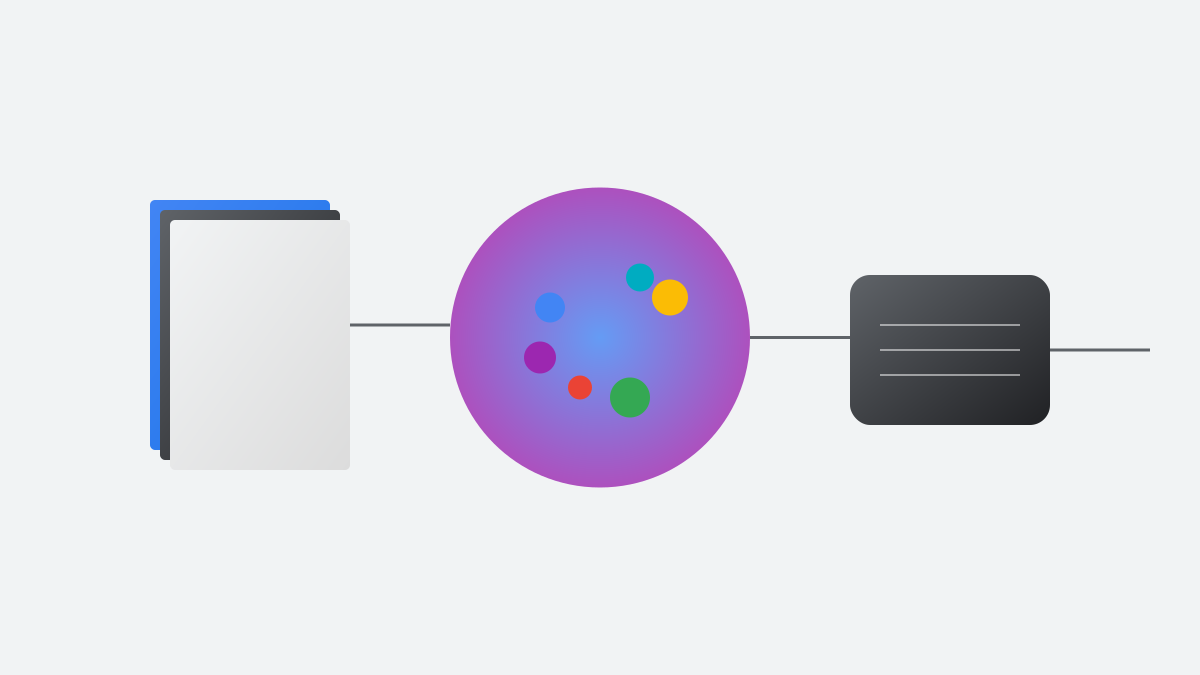
This open-source project is an end-to-end RAG Q&A system for research papers. Unlike general chatbots, it emphasizes the verifiability of answers and context relevance. The technology stack covers three layers: the semantic search layer (converts queries and documents into vectors for semantic matching), the vector storage layer (efficiently stores and retrieves high-dimensional vectors), and the generation layer (uses LLMs to generate answers based on retrieved context).

4

Section 04

Core Technical Principles: Vector Embedding and Retrieval-Generation Collaboration

Traditional search relies on keyword matching, which easily misses semantically relevant content. The RAG system uses embedding models to convert text into high-dimensional vectors, making semantically similar content closer in vector space (e.g., "deep learning" and "neural networks"). The core process has two stages: the retrieval stage (encodes the question into a vector and retrieves relevant document fragments from the index) and the generation stage (combines the retrieved fragments with the question to form an enhanced prompt, which is input into the LLM to generate answers. The advantages are that it can cite sources and handle new papers published after the LLM's training).

5

Section 05

Key Points of System Architecture Design

Document Preprocessing: Need to extract structured text, handle cross-page sentence breaks, and retain citation relationships; chunking strategies affect retrieval quality (split by paragraphs/chapters, retain overlapping regions). Vector Storage: Uses Approximate Nearest Neighbor (ANN) algorithms to balance speed and accuracy, considering vector dimensions, index update mechanisms, and metadata filtering (year/author/conference). Prompt Engineering: Structured prompts include role definitions, task descriptions, context materials, and output format requirements to reduce hallucinations and improve reliability.

6

Section 06

Application Scenarios and Scientific Research Value

The application scenarios of this system in scientific research include: literature review assistance (e.g., querying Transformer efficiency optimization methods in the past five years), cross-paper comparison (comparing the results of methods A/B on dataset X), concept explanation (meaning and application of domain terms), and method reproduction guidance (details of experimental settings).

7

Section 07

Trade-offs in Technology Selection and Current Limitations

Trade-offs in Technology Selection: Embedding models (open-source like Sentence-BERT vs. commercial APIs like OpenAI Embedding; domain fine-tuning may be needed for academic scenarios); LLM backends (local deployment ensures privacy and low cost vs. cloud APIs with strong performance, needing to handle long contexts and academic language); retrieval strategies (combining vector similarity with keyword matching, citation graph analysis). Limitations: Insufficient multi-hop reasoning ability, difficulty understanding tables and formulas, and not fine-grained enough citation tracing.

8

Section 08

Conclusion and Future Improvement Directions

RAG technology opens up new possibilities for academic information retrieval. Combining the precise positioning of vector search with the generation capabilities of LLMs improves research efficiency. This open-source project provides an end-to-end framework, offering a reference for developers. Future improvement directions: introducing Agentic RAG (autonomously deciding retrieval strategies), multi-modal support (handling charts), and finer-grained citation (locating to sentences).

