Zing Forum

Reading

QUT GenAI Lab Open-Sources inference-gateway: A Unified Inference Interface for Generative AI Widgets

The inference-gateway project launched by QUT GenAI Lab provides a unified LLM inference API for GenAI Arcade widgets, simplifying the process of multi-model integration and deployment.

LLMAPI网关生成式AIGitHub开源项目多模型集成AWS Lambda教育科技
Published 2026-06-03 20:16Recent activity 2026-06-03 20:19Estimated read 7 min
QUT GenAI Lab Open-Sources inference-gateway: A Unified Inference Interface for Generative AI Widgets
1

Section 01

[Introduction] QUT GenAI Lab Open-Sources inference-gateway: Unified LLM Inference Interface Empowers Generative AI Widgets

QUT GenAI Lab has launched the open-source project inference-gateway, which provides a unified LLM inference API for GenAI Arcade widgets. It addresses integration pain points such as varying interfaces, different authentication methods, and inconsistent response formats from different model providers, simplifies multi-model integration and deployment processes, and supports features like serverless deployment.


2

Section 02

Project Background and Positioning

Project Background and Positioning

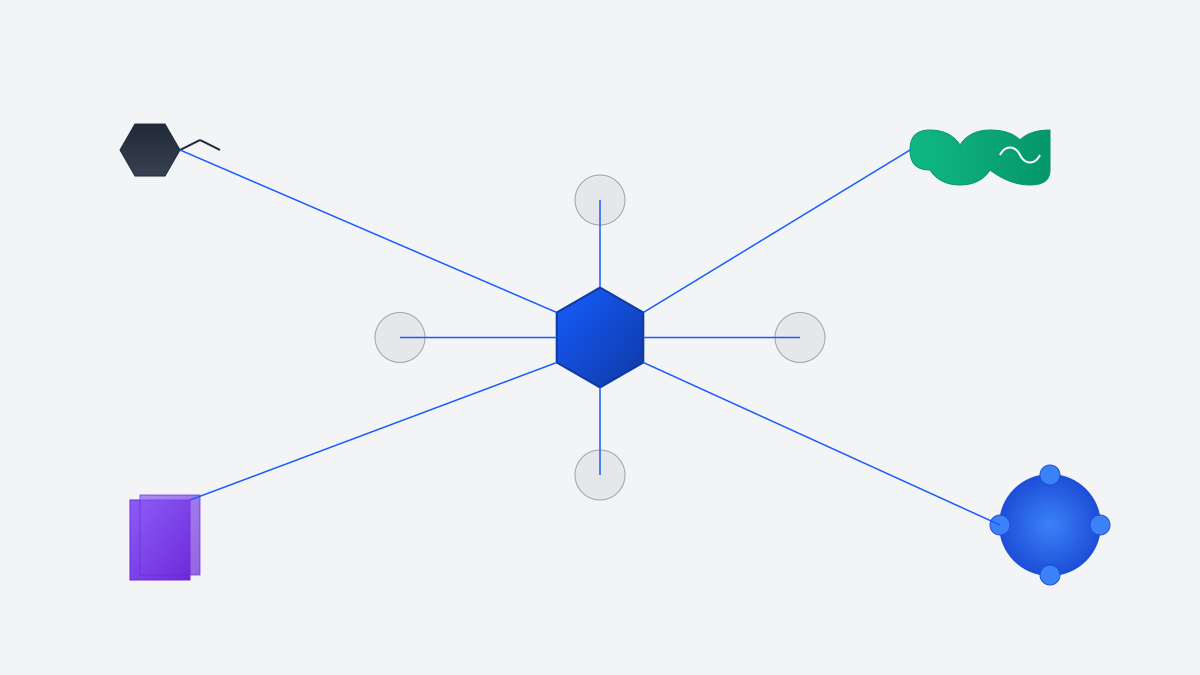
With the rapid development of Large Language Model (LLM) technology, the demand for embedding AI capabilities into interactive components has increased. However, differences in interfaces, authentication, and response formats among different model providers impose an integration burden on developers. This project is positioned as the "unified inference API for GenAI Arcade widgets". Through abstract encapsulation, developers do not need to care about underlying model differences and can access LLM capabilities via a unified interface.

3

Section 03

Core Architecture and Technical Features

Core Architecture and Technical Features

Unified API Abstraction Layer

Encapsulates interfaces of different LLM providers via the adapter pattern, exposing consistent RESTful endpoints externally. Frontends only need one integration to switch/use multiple models.

Multi-Provider Support

Flexibly specify model providers in configuration; the gateway handles authentication, format conversion, and response parsing, lowering the threshold for multi-model comparison experiments.

Widget-Oriented Optimization

Optimized for widget scenarios, supporting strategies like streaming output, context caching, and request merging to ensure a smooth experience for lightweight interactions.

4

Section 04

Typical Application Scenarios

Typical Application Scenarios

Interactive Components in Education

Suitable for educational AI widgets, such as intelligent Q&A in learning management systems, real-time error correction for code practice, and virtual lab guidance agents.

Low-Code/No-Code Platforms

Serves as a backend service to provide standardized capabilities for AI components in visual editors, lowering the threshold for non-technical users to build intelligent applications.

Multi-Model Comparison and Fallback

Configure primary and backup model strategies; automatically switch when the preferred model is unavailable to improve system reliability.

5

Section 05

Technical Implementation and Deployment Details

Technical Implementation and Deployment Details

Deployment Flexibility

Supports serverless deployment on AWS Lambda, aligning with the gateway's characteristics of request-driven, intermittent load, and rapid scaling.

Scalability Design

Plugin-based architecture; adding a new LLM provider only requires adding an adapter without modifying upstream calling code.

Development Workflow

Configure CI/CD pipelines to ensure the stability of the gateway layer and avoid impacting the operation of downstream widgets.

6

Section 06

Differentiation from Similar Projects

Comparison with Other Similar Projects

Similar projects in the open-source community include LiteLLM and LangChain's general interfaces. The differentiation of inference-gateway lies in its deep optimization for the "widget" scenario: it focuses more on response speed and resource efficiency for lightweight interactions, maintains a concise API design and low deployment complexity, making it suitable for educational institutions and small-to-medium teams.

7

Section 07

Usage Recommendations and Best Practices

Usage Recommendations and Best Practices

  1. Model Coverage Requirements: Confirm whether the supported LLM providers cover your scenario
  2. Latency Sensitivity: For scenarios with strict first-token response requirements, actual pressure testing is needed
  3. Cost Control: Evaluate the cost difference between the gateway's additional overhead and direct calls
  4. Self-Hosting Capability: Consider the team's ability to maintain serverless infrastructure
8

Section 08

Summary and Future Outlook

Summary and Outlook

inference-gateway shields underlying complexity through the gateway layer, allowing upper-layer applications to focus on business logic, which aligns with the evolution direction of LLM application architecture. QUT GenAI Lab's open-source contribution provides a practical tool for AI applications in the education field. With more models integrated and features improved in the future, it is expected to become one of the standard backend choices for widget-type AI applications.

