Zing Forum

Reading

PRISM: Breaking Modal Boundaries — How a Unified Architecture Handles ECG, Images, and Continuous Signals

An in-depth interpretation of the PRISM project, exploring how to build a truly modality-agnostic sequence model using the S4D-Complex structure and gated Delta rule, enabling unified processing of ECG, images, and continuous signals, and opening up new paths for multimodal AI infrastructure.

多模态AI状态空间模型S4D序列建模心电图分析信号处理统一架构跨模态学习
Published 2026-05-10 23:43Recent activity 2026-05-10 23:52Estimated read 5 min
PRISM: Breaking Modal Boundaries — How a Unified Architecture Handles ECG, Images, and Continuous Signals
1

Section 01

PRISM Project Introduction: A Unified Sequence Model Breaking Modal Boundaries

The PRISM project aims to build a truly modality-agnostic sequence model using the S4D-Complex structure and gated Delta rule, enabling unified processing of ECG, images, and continuous signals. It challenges the traditional paradigm of 'one model per modality' in deep learning and opens up new paths for multimodal AI infrastructure.


2

Section 02

Background: Limitations of the AI Specialization Paradigm and the Proposal of PRISM

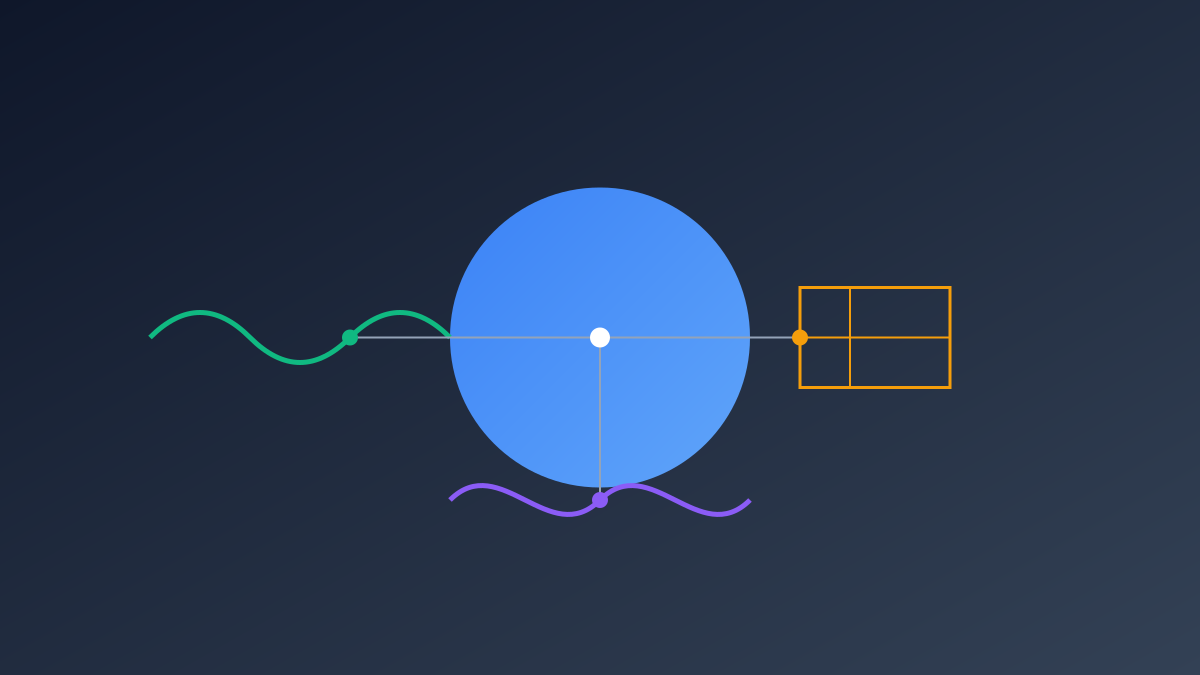
In the development of deep learning, specialized designs (CNN for images, Transformer for text, RNN/LSTM for time series) lead to high R&D costs and a fragmented technical ecosystem. PRISM addresses this situation with a question: Can we design a single architecture to handle ECG, images, and continuous signals? Its core insight is that different data types are essentially spatiotemporal sequences, requiring a suitable unified modeling tool.

3

Section 03

Technical Approach: Innovative Combination of S4D-Complex and Gated Delta Rule

PRISM's core components include:

  1. S4D-Complex: A state space model extended to the complex domain, efficiently capturing long-range dependencies and naturally adapting to oscillatory and phase characteristics of periodic signals (e.g., ECG);
  2. Gated Delta Rule: An adaptive state update mechanism that controls the fusion ratio of new information and historical states via gating weights, with the Delta rule calculating update increments; Unified process: Serialization encoding → S4D-Complex processing → Gated state update → Task-specific decoding.
4

Section 04

Application Scenarios: Modality-Agnostic Processing Practices Across Multiple Domains

PRISM's modality-agnostic特性 applies to multiple domains:

  • Healthcare: Unified processing of multi-source physiological signals (ECG, blood oxygen, blood pressure, etc.) for integrated diagnosis; long-range modeling to identify long-term trends of chronic diseases;
  • Industrial IoT: Natively processing heterogeneous sensor data (temperature, vibration, vision, etc.) to simplify predictive maintenance;
  • Scientific Research: Unified processing of cross-domain data (climate, ocean, ecology) to facilitate pattern discovery and causal inference.
5

Section 05

Technical Advantages and Challenges: Opportunities and Trade-offs of a Unified Architecture

Advantages: High parameter efficiency (replacing multiple specialized models), cross-modal transfer learning, simplified deployment, elegant theory; Challenges: Slightly inferior performance on specific tasks compared to specialized models, poor interpretability, high training complexity (requiring large datasets and complex strategies), difficulty in modal balance (avoiding dominance by a single modality).

6

Section 06

Future Outlook: Directions Toward a General-Purpose Perception Architecture

PRISM's future evolution directions:

  • Incorporate more modalities (text, audio, point clouds, graph structures, etc.);
  • Ultra-large-scale multimodal pre-training to learn general world representations;
  • Integration of neural symbols (perception + logical reasoning);
  • Edge deployment optimization to adapt to mobile/embedded systems.
7

Section 07

Conclusion: The Beauty of Unification — Insights from PRISM's Philosophy

The value of PRISM is not only as a technical tool but also as a carrier of the philosophy that 'unification is more powerful than division'. By finding common patterns behind data, it simplifies engineering implementation and deepens the understanding of the essence of intelligence. Like a prism, it refracts colorful data into a unified spectrum of intelligence, serving as an important milestone toward general artificial intelligence.

