Zing Forum

Reading

New Breakthrough in PPG Non-Invasive Blood Pressure Monitoring: BP-Inference-EVOLVE and Stochastic Experiment Loop Framework

The BP-Inference-EVOLVE project, via the LLM-driven evolutionary discovery framework called Stochastic Experiment Loop, achieves cuffless blood pressure monitoring using only PPG signals, meeting the AAMI/BHS standards on the PulseDB v2.0 dataset.

PPG血压监测无创血压随机实验循环可穿戴设备医疗AIPulseDBAAMI标准大语言模型科研
Published 2026-06-03 10:14Recent activity 2026-06-03 10:21Estimated read 6 min
New Breakthrough in PPG Non-Invasive Blood Pressure Monitoring: BP-Inference-EVOLVE and Stochastic Experiment Loop Framework
1

Section 01

[Introduction] New Breakthrough in PPG Non-Invasive Blood Pressure Monitoring: Core Highlights of the BP-Inference-EVOLVE Project

This article introduces the open-source BP-Inference-EVOLVE project by the vignankamarthi team. Using an LLM-driven "Stochastic Experiment Loop" framework, the project achieves cuffless blood pressure monitoring with only PPG signals and meets the international medical standards of AAMI/BHS on the PulseDB v2.0 dataset. Key highlights include pure PPG single-signal inference, dual modes (calibration-free/calibration-required), and an innovative scientific research automation framework, bringing significant progress to wearable health monitoring.


2

Section 02

[Background] Technical Challenges of Non-Invasive Blood Pressure Monitoring and the Potential of PPG

Traditional cuff-based blood pressure monitors are less portable and cannot perform continuous monitoring; invasive arterial monitoring is only suitable for intensive care. While PPG-based solutions are convenient, they have accuracy issues: large individual physiological differences, sensor position/pressure affecting signal quality, motion artifact interference, and the need for individual calibration. Theoretically, PPG can estimate blood pressure via pulse waveforms, but practical applications face multiple obstacles.

3

Section 03

[Core Innovation] Key Breakthroughs of BP-Inference-EVOLVE

BP-Inference-EVOLVE achieves blood pressure estimation using pure PPG single signals, expanding application scenarios (supported by ordinary smartwatches); verified on the PulseDB v2.0 dataset to meet AAMI/BHS standards, with clinical application value; and supports dual modes: calibration-free (for universal screening) and calibration-required (higher accuracy for long-term monitoring).

4

Section 04

[Methodology] Stochastic Experiment Loop: An LLM-Driven Evolutionary Discovery Framework

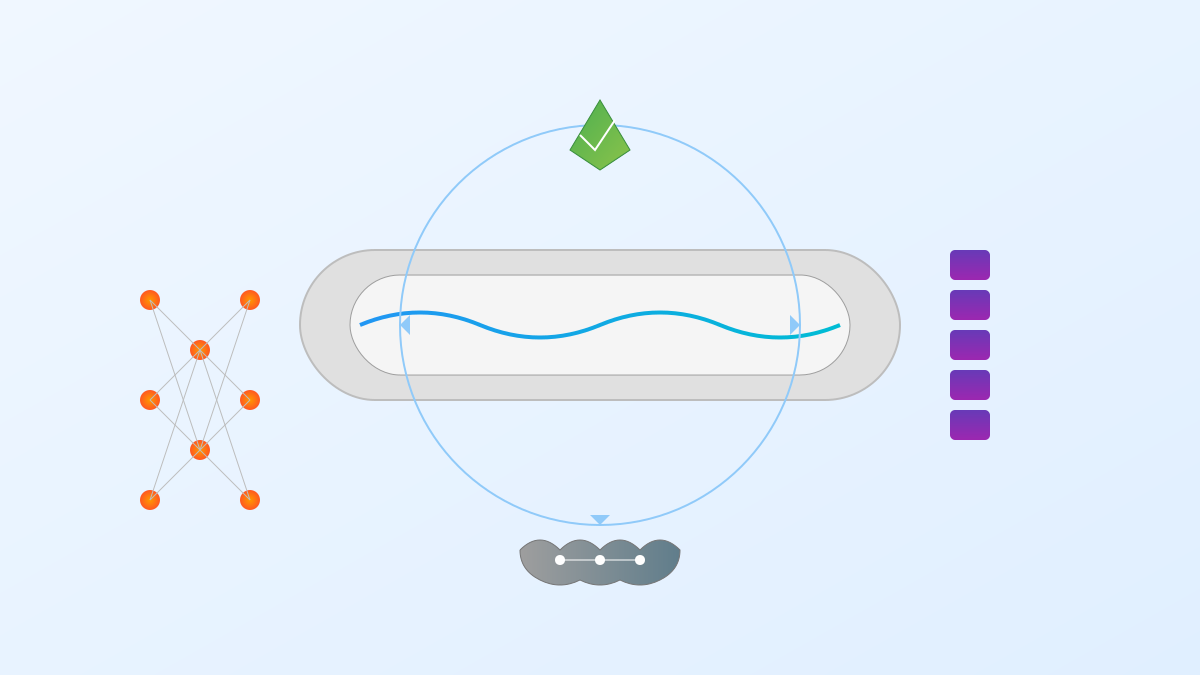
This framework combines LLM with evolutionary algorithms: 1. Automated hypothesis generation (LLM proposes model architecture hypotheses); 2. Intelligent experiment design; 3. Evolutionary optimization (iterative improvement); 4. Knowledge accumulation. LLM acts as a research assistant: reading literature, analyzing results, providing suggestions, and writing code. Compared to manual design, its advantages include a large exploration space, reduced bias, continuous learning, and strong interpretability.

5

Section 05

[Evidence] PulseDB v2.0 Dataset and Standard Validation

The project uses the PulseDB v2.0 dataset for validation, which features large-scale diversity (thousands of subjects covering different ages, genders, health statuses, various activity states, and synchronized gold-standard blood pressure measurements). The AAMI standard requires an average error ≤5mmHg and standard deviation ≤8mmHg; the BHS Class A standard requires the proportion of errors ≤5mmHg to be ≥60%, ≤10mmHg ≥85%, and ≤15mmHg ≥95%—the project meets these standards.

6

Section 06

[Application Prospects] Value for Consumer Health and Chronic Disease Management

Application scenarios include: consumer health monitoring (continuous blood pressure tracking via smartwatches, nighttime monitoring, post-exercise assessment); chronic disease management (reducing patients' medical burden, optimizing treatment plans, timely detection of abnormalities); and scientific research value (providing methodological references for medical AI and promoting the development of AI for Science).

7

Section 07

[Limitations and Future] Current Shortcomings and Research Directions

Current limitations: skin color affects accuracy, accuracy needs improvement during intense exercise, and limited extrapolation ability for extreme blood pressure values. Future directions: multi-modal fusion (combining accelerometers, etc.), federated learning (using more data under privacy protection), causal reasoning (understanding the causes of blood pressure changes), and large-scale clinical validation.

