Zing Forum

Reading

Multimodal-RAG: Design and Implementation of a Multimodal Retrieval-Augmented Generation System

This article introduces the Multimodal-RAG project, a multimodal Retrieval-Augmented Generation (RAG) chatbot system that combines large language models (LLMs) with vector retrieval. It analyzes the system's architectural design, core technical principles, and application scenarios in multimodal document understanding.


RAG多模态大语言模型向量检索文档问答知识管理GitHub
Published 2026-06-09 04:12Recent activity 2026-06-09 04:18Estimated read 5 min
Multimodal-RAG: Design and Implementation of a Multimodal Retrieval-Augmented Generation System
1

Section 01

Introduction: Overview of the Multimodal-RAG Multimodal Retrieval-Augmented Generation System

Multimodal-RAG is a multimodal Retrieval-Augmented Generation (RAG) chatbot system that combines large language models (LLMs) with vector retrieval. Maintained by Nakul-28, the source code is hosted on GitHub (link: https://github.com/Nakul-28/Multimodal-RAG) and was released on June 8, 2026. This article will introduce its architectural design, core technical principles, and application scenarios in multimodal document understanding.

2

Section 02

RAG Technical Background: From Traditional LLMs to Multimodal Expansion

Retrieval-Augmented Generation (RAG) is a key innovation in LLM applications, addressing the knowledge cutoff and hallucination issues of traditional LLMs. Its core is to retrieve relevant fragments from external knowledge bases as context before generation. Multimodal RAG extends to multiple modalities such as text, images, and audio, making it suitable for scenarios like enterprise knowledge management.

3

Section 03

System Architecture Analysis: Layered Design and Core Components

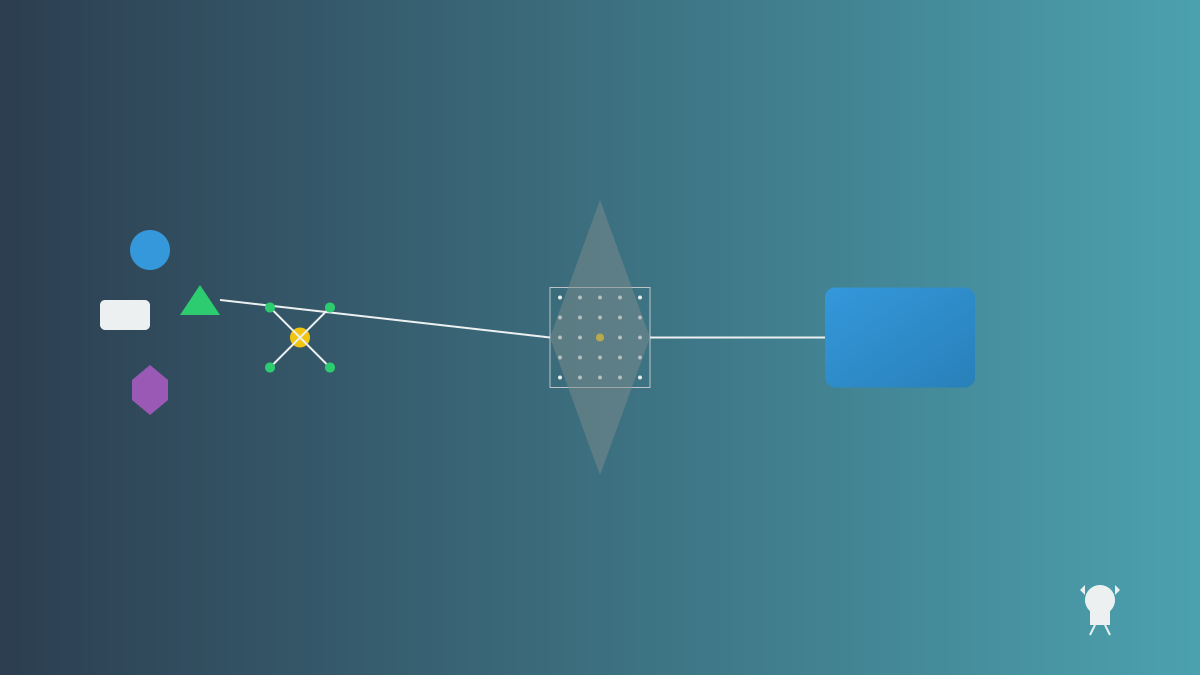
Multimodal-RAG adopts a layered architecture:

  1. Data ingestion layer: Processes multimodal documents and extracts semantic features of text and images;
  2. Vector index layer: Converts content into high-dimensional vectors and builds similarity indexes;
  3. Retrieval engine layer: Performs semantic search and matches queries with document fragments;
  4. Generation layer: Combines retrieved context with LLMs to generate answers, and designs prompt templates to ensure fluency.
4

Section 04

Challenges and Solutions in Multimodal Processing

The core challenge of multimodal processing is heterogeneous data integration:

  • Images: Use CLIP to extract semantic embeddings and achieve cross-modal alignment;
  • Tables: Preserve structural information, either flatten to text or use specialized models;
  • Audio/Video: First convert to text/key frames, requiring a trade-off between information loss.
5

Section 05

Application Scenarios and Value: Applications in Enterprise Knowledge Management and Other Fields

Application scenarios include:

  1. Enterprise knowledge management: Precisely retrieve multimodal materials to improve efficiency;
  2. Intelligent customer service: Provide accurate answers based on product documents/FAQs;
  3. Educational assistance: Integrate textbook resources to answer complex questions with charts.
6

Section 06

Technical Selection Considerations: Choice of Vector Databases, Embedding Models, and LLMs

Technical selection requires trade-offs:

  • Vector databases: Pinecone (managed), FAISS (local), etc., considering scale and cost;
  • Embedding models: Text uses text-embedding-ada-002/BGE, multimodal uses CLIP;
  • LLMs: GPT-4 (strong capability but high cost) or open-source models (Llama/Qwen, privacy-friendly).
7

Section 07

Summary and Outlook: Project Value and Future Directions

Multimodal-RAG provides a reference implementation for multimodal RAG systems. In the future, with the development of multimodal LLMs, cross-modal understanding and reasoning will make breakthroughs. Developer suggestions: Clarify scenarios and metrics, iteratively optimize components, and establish an evaluation system (offline + online testing).
