Zing Forum

Reading

Multi-Agent Setup: A 13-Agent Collaborative Development Workflow System for Claude Code

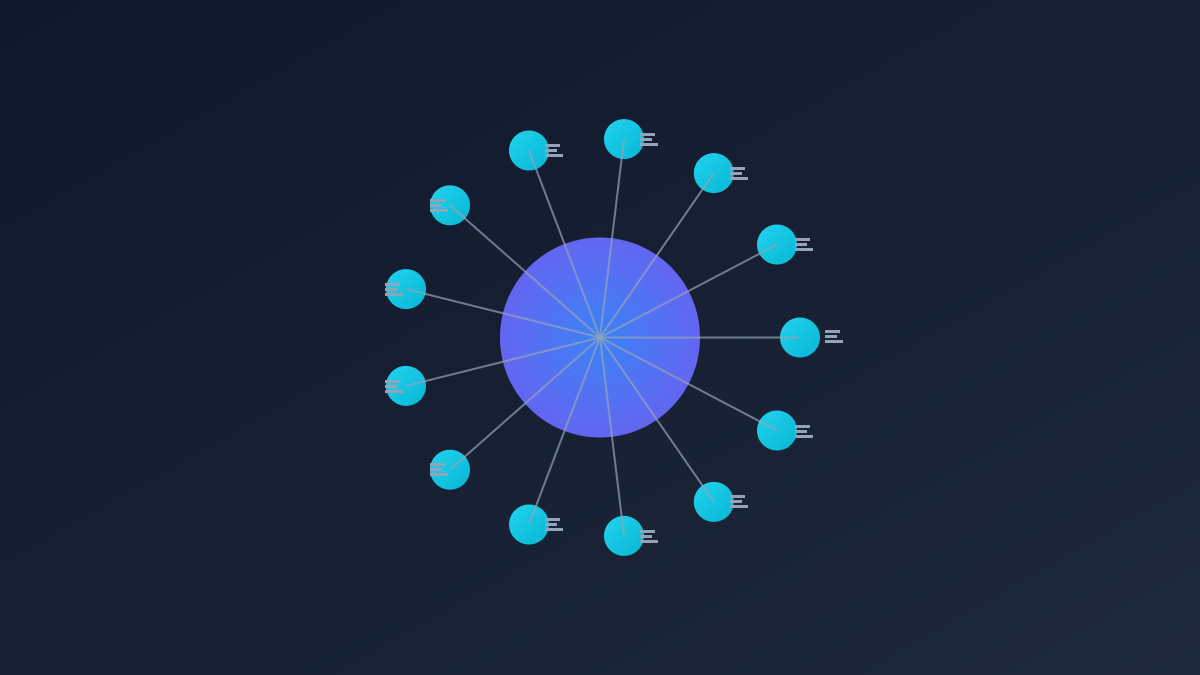
Multi-Agent Setup builds a complete multi-agent development workflow for Claude Code. Through 13 specialized agents, a hook-based memory system, and an autonomous improvement loop, it achieves a leap in AI-assisted programming efficiency.

多智能体系统Claude CodeAI辅助编程智能体协作开发工作流代码生成软件工程
Published 2026-04-02 03:15Recent activity 2026-04-02 03:23Estimated read 8 min
Multi-Agent Setup: A 13-Agent Collaborative Development Workflow System for Claude Code
1

Section 01

[Introduction] Multi-Agent Setup: Core Analysis of the 13-Agent Collaborative Development System for Claude Code

Multi-Agent Setup is a multi-agent collaborative development workflow system built for Claude Code. Its core lies in resolving the limitations of single-agent AI-assisted programming (such as role conflicts and inconsistent quality) through the division of labor among 13 specialized agents, a hook-based memory system, and an autonomous improvement loop, thereby achieving a leap in development efficiency and code quality. This article will analyze the system from dimensions including background, architecture, mechanisms, and effects.


2

Section 02

Background: Evolution of AI-Assisted Programming from Single-Agent to Multi-Agent

With the popularization of large models like Claude and GPT-4 in code generation, the single-agent model has gradually exposed limitations: an AI has to take on multiple roles such as architect, programmer, and tester simultaneously, which easily leads to neglecting some aspects and makes it difficult to maintain code quality and design consistency in complex projects. Multi-Agent Setup draws on the division of labor concept in software engineering teams, breaking down development tasks into multiple specialized agents to complete collaboratively, thus improving professionalism and output quality.

3

Section 03

Methodology: Collaborative Architecture Design of 13 Specialized Agents

The system's core is a collaborative network of 13 specialized agents, divided into four layers:

Requirements Analysis and Design Layer

  • ProductAgent: Requirements analysis and product definition
  • ArchitectAgent: System architecture design
  • UXAgent: User experience design

Code Implementation Layer

  • FrontendAgent: Frontend development (React/Vue, etc.)
  • BackendAgent: Backend development (API/database)
  • DevOpsAgent: Operations and maintenance (CI/CD, containerization)
  • SecurityAgent: Security auditing

Quality Assurance Layer

  • TestAgent: Test case writing
  • ReviewAgent: Code review
  • PerfAgent: Performance optimization

Documentation and Delivery Layer

  • DocAgent: Technical documentation writing
  • ReleaseAgent: Release management

Coordination and Management Layer

  • OrchestratorAgent: Task allocation, progress tracking, and conflict coordination
4

Section 04

Methodology: Hook-Based Memory System Ensures Context Coherence

The key challenge in multi-agent collaboration is context sharing, which the system addresses using a hook-based memory mechanism:

Memory Hierarchy Architecture

  • Short-term memory: Records real-time context of the current session (file location, conversation history, to-do items), archived after the session ends.
  • Project memory: Stores cross-session persistent information (architecture decisions, code standards, problem libraries), structured for sharing.
  • Organizational memory: Cross-project knowledge precipitation (code templates, best practices).

Hook Mechanism

Uses a publish-subscribe model where agents subscribe to memory hooks they care about (e.g., FrontendAgent subscribes to UI component library updates), avoiding information overload and ensuring precise information distribution.

5

Section 05

Methodology: Autonomous Improvement Loop Enables Continuous System Evolution

The system continuously optimizes through an autonomous improvement loop:

Feedback Collection

  • Execution result feedback: Task completion time, code quality metrics (test pass rate, lint errors), user satisfaction.
  • Collaboration efficiency feedback: Smoothness of task handover, accuracy of information transmission, conflict resolution efficiency.
  • Learning signals: Extract common errors, design impacts, and technical debt from code reviews and test failures.

Strategy Optimization

  • Agent configuration: Dynamically adjust prompts, collaboration processes, task priorities.
  • Memory system: Optimize storage structure, clean up outdated content, refine best practices.
  • Workflow: Optimize development processes, automate repetitive tasks, adjust agent roles.
6

Section 06

Practical Effects: Significant Improvement in Development Efficiency and Quality

Practical application effects are significant:

  • Development efficiency: Complex task completion time reduced by 30-50%, parallel collaboration accelerates serial work.
  • Code quality: Multiple rounds of review reduce defect rates, security issues detected early.
  • Knowledge precipitation: Structured memory helps new members get up to speed quickly.
  • Scalability: Modular design supports adding/adjusting agents without system refactoring.
7

Section 07

Limitations and Future Outlook

Limitations

  • Context overhead: Coordination among 13 agents consumes a large context window, limiting task complexity.
  • Increased latency: Multi-round collaboration introduces additional latency compared to single-agent generation.
  • Configuration complexity: New users need time to learn.

Future Outlook

  • Dynamic scheduling algorithm: Determine when multi-agent collaboration is needed.
  • Deep IDE integration: Enhance development experience.
  • Multi-model support: Not limited to Claude.

