Zing Forum

Reading

MCP MindMesh: A Quantum-Inspired Swarm Intelligence Orchestration System for Claude 3.7

A multi-agent collaboration framework based on the Model Context Protocol (MCP), which coordinates multiple Claude 3.7 expert instances through quantum field coherence effects to achieve the organic integration of pattern recognition, information theory, and reasoning capabilities.

MCP多智能体Claude 3.7群体智能量子启发模型编排场相干
Published 2026-03-29 14:36Recent activity 2026-03-29 14:55Estimated read 11 min
MCP MindMesh: A Quantum-Inspired Swarm Intelligence Orchestration System for Claude 3.7
1

Section 01

Introduction: Core Overview of the MCP MindMesh Project

MCP MindMesh is a multi-agent collaboration framework based on the Model Context Protocol (MCP). It coordinates multiple Claude 3.7 expert instances through quantum field coherence effects to achieve the organic integration of pattern recognition, information theory, and reasoning capabilities. This project aims to address the bottleneck of single models in handling complex tasks and surpass the comprehensive capabilities of individual models through swarm intelligence collaboration.


2

Section 02

Project Background and Trends in Multi-Agent Collaboration

As the capabilities of large language models improve, single models still face bottlenecks in complex tasks such as ultra-long text understanding, multi-dimensional reasoning, and cross-domain knowledge integration. Multi-agent collaboration architectures have emerged, decomposing tasks into specialized agents and integrating their outputs.

The MCP MindMesh project is built based on Anthropic's MCP standard, drawing on the quantum mechanics concept of 'field coherence' to enable multiple Claude 3.7 Sonnet instances to produce synergistic effects similar to quantum entanglement, resulting in integrated outputs that are superior to simple voting or concatenation.

3

Section 03

Core Concept: Quantum-Inspired Field Coherence Effect

Core Concept: Field Coherence Effect

From Quantum Physics to AI Collaboration

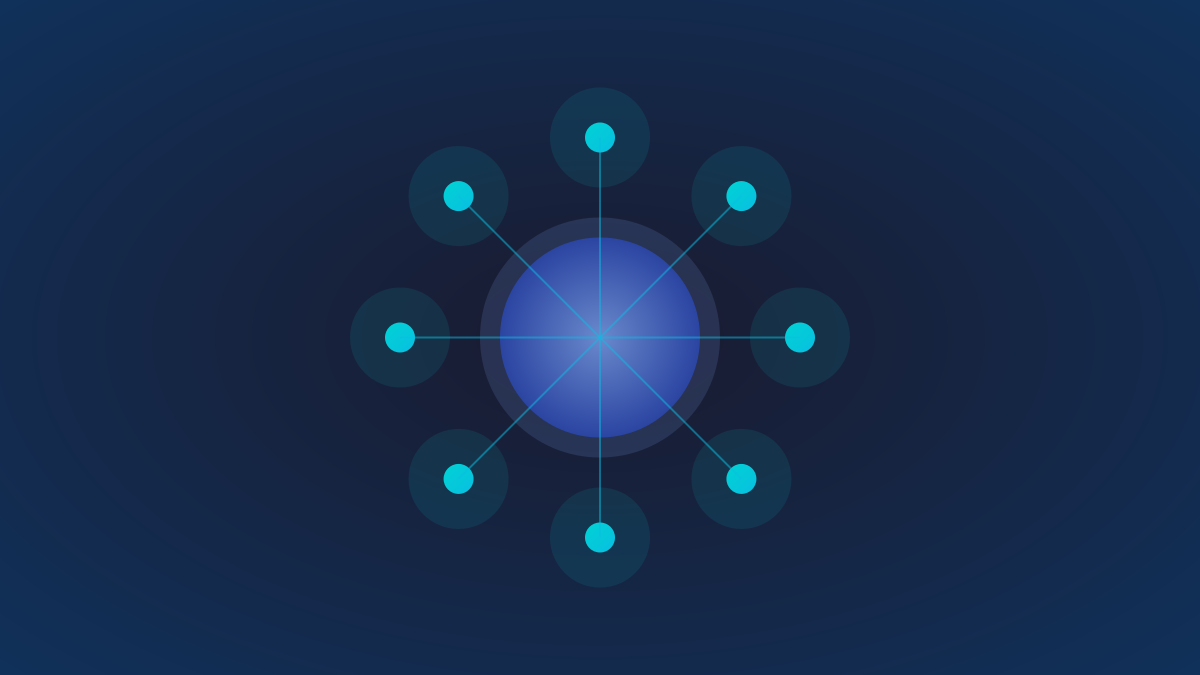
In quantum mechanics, a coherent state describes a state where multiple particles have consistent phases and their interference is enhanced. MindMesh abstractly applies this concept to AI collaboration:

Coherence Refers to the degree of consistency among multiple agents in problem understanding, reasoning paths, and output styles. High coherence promotes mutual complementation and reinforcement.

Field Effect Analogous to physical fields, the system has an implicit 'semantic field' where agent outputs interact: similar insights are enhanced, conflicting views are reconciled, and convergence to the optimal consensus occurs.

Swarm Intelligence Agents collaborate dynamically, sharing intermediate reasoning states, questioning and verifying each other, forming a self-correcting reasoning network.

4

Section 04

System Architecture and Technical Implementation Details

System Architecture and Technical Implementation

Foundation of the MCP Protocol

The Model Context Protocol is an open standard by Anthropic that unifies the interaction between AI and external tools/data sources: standardized interfaces for easy expansion and maintenance, compatibility with the MCP tool ecosystem, and a design that allows future integration of other compatible models.

Specialized Agent Roles

  • Pattern Recognition Expert: Extracts structures, discovers patterns, identifies anomalies (code patterns, text structures, data trends).
  • Information Theory Expert: Analyzes information quality, redundancy, and gaps from perspectives like information entropy and compression rate.
  • Reasoning Expert: Performs logical deduction, causal analysis, hypothesis verification, and organizes argument chains.
  • Metacognitive Coordinator: Monitors collaboration, identifies disagreements, triggers re-discussions, and integrates viewpoints.

Quantum-Inspired Coordination Algorithm

  • Initialization: Agents receive the same input and form initial states based on their roles.
  • Evolution: Independent reasoning generates intermediate results, which interact in the semantic field (similarity enhancement, conflict reconciliation).
  • Measurement: After multiple iterations, convergence to a coherent state occurs, and the coordinator outputs the consensus.
  • Decoherence Handling: When convergence is not possible, multiple reasonable viewpoint branches are presented.
5

Section 05

Application Scenarios and Practical Value

Application Scenarios and Practical Value

  • Complex Problem Diagnosis: Multi-dimensional analysis (anomaly patterns, evidence quality, causal chains) to discover clues missed by a single perspective.
  • Creative Content Generation: Collaborative structural planning, information density optimization, and logical checking to ensure harmony and unity.
  • Code Review and Architecture Design: Identifies design patterns/issues, evaluates API simplicity/documentation completeness, and verifies architectural rationality.
  • Research Literature Review: Topic clustering, quality assessment, viewpoint integration, and discovery of implicit connections among literature.
6

Section 06

Technical Advantages and Innovation Points

Technical Advantages and Innovation Points

  • Synergistic Effect: The field coherence mechanism achieves true collaboration, with intermediate states influencing each other to produce an emergent effect of 1+1+1>3.
  • Dynamic Load Balancing: Adjusts the depth of agent participation based on task complexity to balance quality and cost.
  • Enhanced Interpretability: Clear roles, outputs are accompanied by analysis basis from various dimensions, and the source of viewpoints can be traced.
  • Fault Tolerance and Robustness: Cross-validation corrects biases and improves stability in edge cases.
7

Section 07

Limitations, Challenges, and Future Development Directions

Limitations and Challenges

  • Latency and Cost: Multiple model calls increase latency and cost, making it unsuitable for real-time scenarios.
  • Coordination Complexity: As the number of agents/task complexity increases, coordination overhead grows non-linearly.
  • Model Lock-in: Deeply dependent on Claude 3.7; migration requires re-tuning.
  • Risk of Over-Consistency: Pursuing consistency may weaken the value of scenarios requiring diverse viewpoints (e.g., debates).

Future Development Directions

  • Adaptive Role Generation: Dynamically generate agent configurations suitable for the task.
  • Cross-Model Collaboration: Collaboration among different models like Claude, GPT, and Gemini.
  • Continuous Learning and Memory: Introduce long-term memory to optimize coordination strategies.
  • Visual Debugging Tools: Display interaction processes and the evolution trajectory of viewpoints.
8

Section 08

Conclusion: A New Direction for Swarm Intelligence Collaboration

MCP MindMesh is a bold exploration of multi-agent collaboration architectures. It is not just a pile of technologies but an interdisciplinary thinking experiment (introducing quantum physics insights into AI design). Although in the early stage, its core concept (achieving swarm intelligence through coherence effects) provides new ideas for AI architectures.

In the future, organizing efficient collaboration among multiple agents is a key issue. The MindMesh practice shows that deep collaboration is the way forward. As technology matures, more AI architectures inspired by natural laws will serve humanity.

