Zing Forum

Reading

Manzanal-Hub: A Centralized Exploration of Multi-Agent AI Platforms

Manzanal-Hub is a multi-agent AI platform designed to centrally manage various AI tools, models, and workflows, providing developers and teams with a more efficient environment for AI application development.

Manzanal-Hub多智能体AI平台模型管理工作流编排开源项目AI工具集成
Published 2026-05-20 01:45Recent activity 2026-05-20 01:49Estimated read 7 min
Manzanal-Hub: A Centralized Exploration of Multi-Agent AI Platforms
1

Section 01

Introduction: Manzanal-Hub - A Centralized Exploration of Multi-Agent AI Platforms

Manzanal-Hub is a multi-agent AI platform aimed at solving the management complexity issues brought about by the rich AI tool ecosystem. Its core vision is to create a centralized hub that allows users to manage various AI tools, models, and workflows in a unified interface, lowering the threshold for multi-model collaborative development and providing developers and teams with an efficient environment for AI application development.


2

Section 02

Background: Management Challenges in the AI Tool Ecosystem

With the rapid development of artificial intelligence technology, developers and teams often need to use multiple AI models, tools, and frameworks simultaneously (such as OpenAI's GPT series, open-source Llama, image generation, speech recognition, etc.). The AI tool ecosystem is increasingly rich but also brings management complexity, and Manzanal-Hub is a multi-agent AI platform designed to address this issue.

3

Section 03

Methodology: Design Philosophy and Advantages of Multi-Agent Architecture

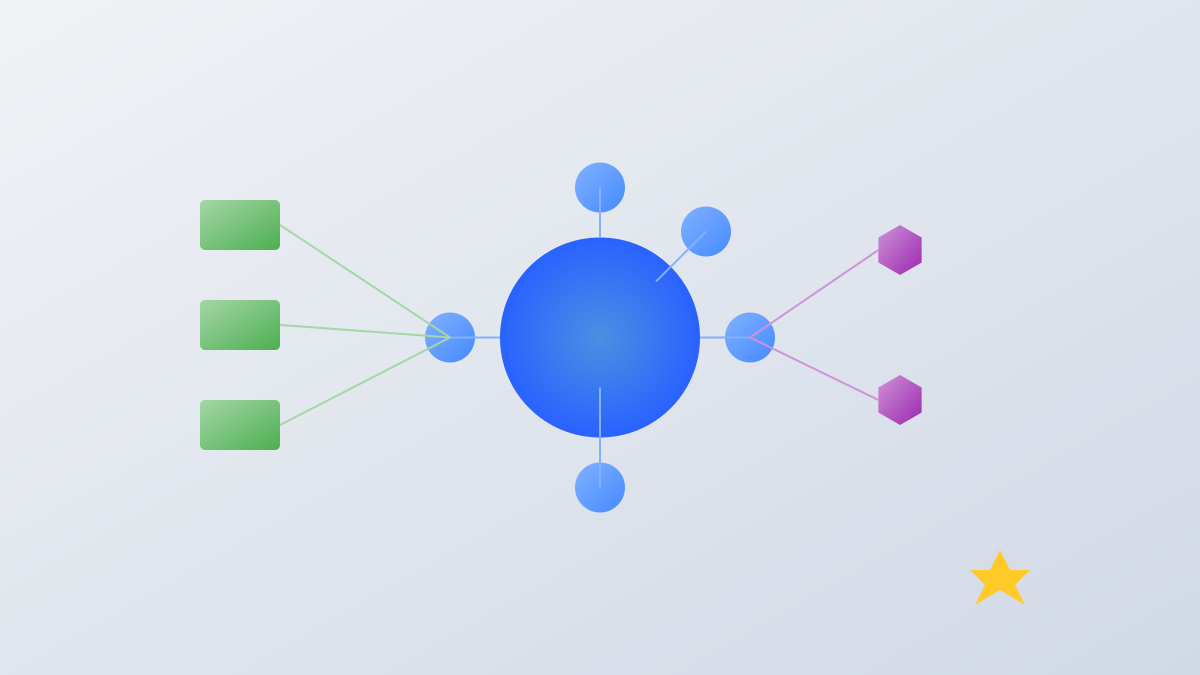
A single large language model has limitations when facing complex tasks. A multi-agent system decomposes complex problems into subtasks, which are handled by specialized agents and then integrates the results. It has advantages such as specialized division of labor, parallel processing, enhanced fault tolerance, and scalability. Manzanal-Hub adopts a modular design: the Tool Center integrates various AI tools and APIs to provide a unified interface; Model Management supports switching and configuration between local/cloud models; Workflow Orchestration allows defining complex task flows to achieve agent collaboration; Open Plugin Architecture supports community contributions of new features.

4

Section 04

Technical Implementation: Model Integration and Workflow Engine Design

Model integration faces challenges such as interface standardization (unifying different API formats, input/output conversion, error handling), authentication and security management (secure storage of API keys, ensuring data transmission and storage security), and performance optimization (load balancing and request scheduling). The workflow engine needs to support conditional branching, parallel execution, state management (tracking the status of long-term tasks, supporting pause and resume), and error handling (gracefully handling agent failures and providing degradation strategies).

5

Section 05

Evidence: Application Scenario Value of Manzanal-Hub

Enterprise AI application development scenarios: unified management and monitoring of AI service calls, cross-departmental sharing and reuse of AI capabilities, lowering the threshold for new members to get started; Individual developer scenarios: rapid experimentation with different model combinations, building personalized AI workflows, avoiding switching between tools; Education and learning scenarios: intuitive model comparison and evaluation environment, visual workflow design interface, community-shared templates and best practices.

6

Section 06

Comparison: Differences from Existing Multi-Model Management Tools

There are similar tools on the market such as LangChain and LlamaIndex. Manzanal-Hub's positioning emphasizes more on centralization (hub concept), user experience first (friendly graphical interface rather than relying only on code), and community-driven (open-source features allow community contributions and customization).

7

Section 07

Outlook: Opportunities and Challenges

Opportunities: The AI ecosystem continues to grow, and the demand for unified management platforms increases. If it can provide a seamless multi-model experience, Manzanal-Hub is expected to occupy a place. Challenges: Ecosystem integration (need to cooperate with many model providers or maintain integrations), performance and cost control (latency and costs of multi-model calls), and changing user habits (need to provide significant value proof to change developers' tool preferences).

8

Section 08

Conclusion: Exploration Significance and Value of Manzanal-Hub

Manzanal-Hub represents an interesting exploration direction in the AI infrastructure layer. In today's era of rapid model capability iteration, efficient management and orchestration of AI capabilities are key issues. Although information is limited currently, its multi-agent centralization concept is worth paying attention to, and it may significantly improve development efficiency for AI application developers and teams.

