Zing Forum

Reading

Logic RAG Foundation: A Formal Reasoning Enhancement System for Classical Logic

Introduces the ajunaid0/logic-rag-foundation project, a RAG pipeline specifically designed for the classical logic axiom system, enabling researchers to query formal logic corpora using local large language models.

RAG形式化逻辑经典逻辑本地LLM定理证明知识检索逻辑推理
Published 2026-04-28 00:11Recent activity 2026-04-28 00:25Estimated read 11 min
Logic RAG Foundation: A Formal Reasoning Enhancement System for Classical Logic
1

Section 01

Logic RAG Foundation: A Formal Reasoning Enhancement System for Classical Logic

Logic RAG Foundation: A Formal Reasoning Enhancement System for Classical Logic

Abstract: Introduces the ajunaid0/logic-rag-foundation project, a RAG pipeline specifically targeting the classical logic axiom system, which allows researchers to query formal logic corpora using local large language models.

Keywords: RAG, formal logic, classical logic, local LLM, theorem proving, knowledge retrieval, logical reasoning

This project aims to provide intelligent knowledge query and reasoning assistance tools for logic researchers. Its core advantages include local model support, precision priority, and interpretable output, among others.

2

Section 02

Research Background

Research Background

As the foundation of mathematics and computer science, formal logic has accumulated a large number of classical axioms and theorems. However, this knowledge is scattered across numerous literatures, making retrieval and integrated use a high-threshold task. Traditional search engines struggle to handle the precise matching requirements of logical expressions, while general-purpose large language models often have comprehension biases when dealing with formal symbols.

3

Section 03

Project Overview and System Architecture

Project Overview

logic-rag-foundation is a Retrieval-Augmented Generation (RAG) system specifically for the field of classical logic. Developed by ajunaid0, this project aims to provide an intelligent knowledge query and reasoning assistance tool for logic researchers. The system supports locally deployed large language models, offering high-quality logical reasoning support while ensuring data privacy.

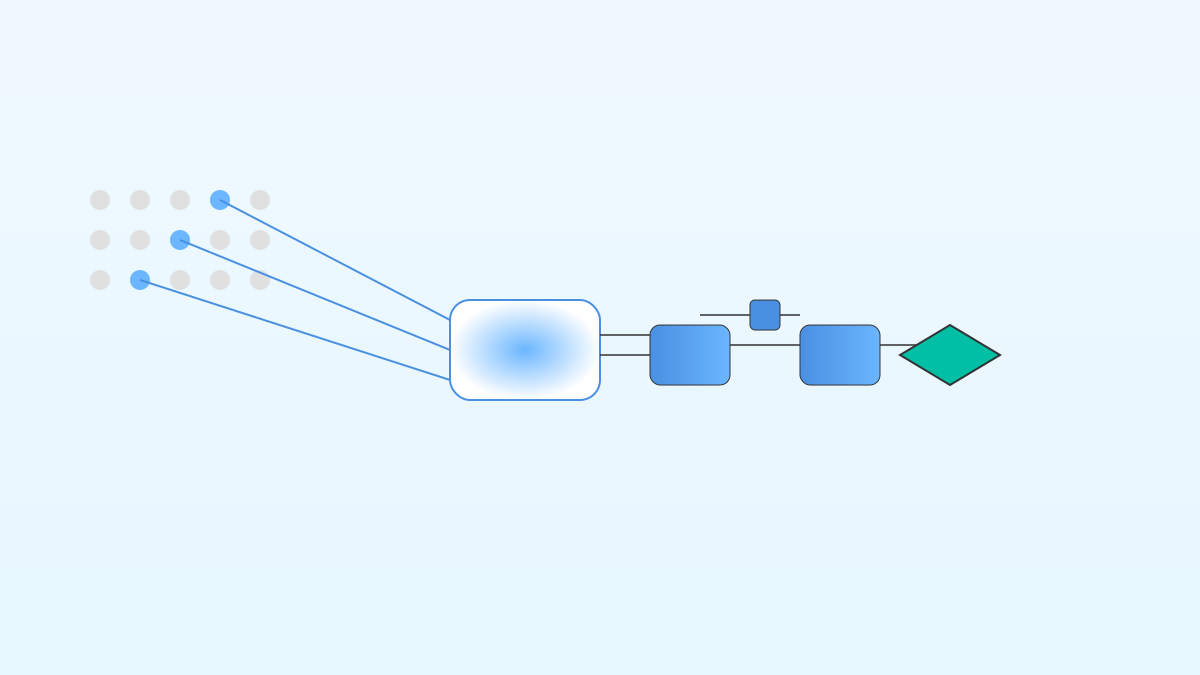
System Architecture

Knowledge Base Construction

The project first builds a carefully curated classical logic corpus covering:

  • Propositional Logic: Basic connectives, truth tables, normal form theory
  • First-order Logic: Quantifiers, predicates, model-theoretic semantics
  • Modal Logic: Necessity, possibility, epistemic logic
  • Higher-order Logic: Type theory, foundations of set theory

Each knowledge point is structurally annotated, including formal expressions, natural language explanations, related theorems, and application scenarios.

Retrieval Mechanism

The system adopts a hybrid retrieval strategy, combining multiple matching techniques:

  1. Symbol Matching: Structured matching based on Abstract Syntax Trees (AST) to ensure precise correspondence of logical expressions
  2. Semantic Embedding: Using specially trained embedding models to capture semantic associations of logical concepts
  3. Hierarchical Navigation: Organizing retrieval paths according to the hierarchical structure of the logic system (from basic axioms to derived theorems)

Generation Enhancement

The retrieved relevant axioms and theorems are injected into prompts to guide the local LLM to generate:

  • Step-by-step derivation of theorem proofs
  • Explanations of logical equivalence relations
  • Correlation analysis between concepts
  • Translation from formal to natural language
4

Section 04

Core Features

Core Features

Local Model Support

The project emphasizes local deployment capabilities, supporting open-source models including Llama, Mistral, Qwen, etc. This design ensures:

  • Data Privacy: Sensitive research questions do not leave the local environment
  • Cost Control: No need to pay API call fees
  • Customizability: Models can be fine-tuned for specific logic domains

Precision Priority

Unlike general-purpose RAG systems, Logic RAG Foundation prioritizes precision:

  • Strictly distinguishes between syntactic and semantic level matching
  • Provides citation sources for formal verification
  • Marks hypothetical premises in the reasoning chain

Interpretable Output

Each conclusion generated by the system is accompanied by a detailed reasoning path, including:

  • The specific axiom numbers cited
  • The reasoning rules applied
  • Intermediate derivation steps
5

Section 05

Application Value and Technical Challenges

Application Value

Academic Research

For researchers in logic and mathematical foundations, the system can:

  • Quickly locate relevant theorems and proof methods
  • Discover connections between different logic systems
  • Assist in verifying new conjectures and propositions

Computer Science Education

In courses on formal methods and program verification, the system can serve as:

  • An interactive learning tool
  • A homework aid and concept explanation assistant
  • Automatic grading support for theorem proving exercises

Formal Verification

In the field of software engineering, logical reasoning is the foundation of formal verification. The system can help verification engineers:

  • Understand complex specification logic
  • Construct correct loop invariants
  • Verify the logical expression of safety properties

Technical Challenges and Solutions

Ambiguity in Symbol Parsing

Different literatures may use different symbol conventions. The project addresses this issue by establishing symbol mapping tables and context-aware parsing.

Balance of Retrieval Granularity

Too fine a granularity leads to information fragmentation, while too coarse loses key details. The system uses a multi-level indexing strategy to support flexible retrieval from the concept level to the theorem level.

Suppression of Model Hallucinations

Even locally deployed LLMs may have hallucinations in logical reasoning. The project reduces this risk through strict retrieval constraints and verification feedback mechanisms.

6

Section 06

Usage Recommendations and Future Directions

Usage Recommendations and Future Directions

Usage Recommendations

  1. Corpus Expansion: Continuously expand logic knowledge in specific domains according to research needs
  2. Model Selection: For complex reasoning tasks, it is recommended to use models specifically trained on mathematical and logical data
  3. Result Verification: Key reasoning conclusions should be reviewed using independent formal verification tools

Future Development Directions

The project has the potential to evolve in the following directions:

  • Multi-logic System Support: Expand to non-classical logics (intuitionistic logic, fuzzy logic, etc.)
  • Automatic Proof Generation: Integrate automatic theorem provers to realize the conversion from natural language descriptions to formal proofs
  • Collaborative Research Platform: Support research teams to share and collaboratively edit logic knowledge bases
7

Section 07

Conclusion

Conclusion

logic-rag-foundation represents a valuable attempt at domain-specific RAG systems, demonstrating how to deeply integrate general AI technology with specific disciplinary knowledge. For developers engaged in logic research or formal methods applications, this is an open-source project worth paying attention to and contributing to.


