Zing Forum

Reading

LocalRouter: A Unified Private LLM Inference Endpoint Management Solution

LocalRouter is an open-source local computing and endpoint management tool that integrates local GPUs, Vast.ai rented GPUs, and managed APIs like Together AI into a single private LLM inference center via a unified TUI interface and transparent proxy.

LLM推理私有部署GPU租赁llama.cppVast.aiTogether AI开源工具TUI代理服务器
Published 2026-05-04 19:45Recent activity 2026-05-04 19:52Estimated read 5 min
LocalRouter: A Unified Private LLM Inference Endpoint Management Solution
1

Section 01

LocalRouter: Introduction to the Unified Private LLM Inference Endpoint Management Solution

LocalRouter is an open-source local computing and endpoint management tool that integrates local GPUs, Vast.ai rented GPUs, and Together AI managed APIs into a single private LLM inference center via a unified TUI interface and transparent proxy. Its core value lies in solving the fragmentation problem of LLM inference deployment and enabling backend hot-swapping without modifying client code.


2

Section 02

Background: Fragmentation Challenges in LLM Inference Deployment

With the development of LLM technology, developers face multiple options such as local GPUs (privacy/cost advantages), cloud APIs (convenience), and Vast.ai rentals (flexibility). However, they need to maintain multiple CLI tools, configuration files, and tunnels, and switching backends requires code modifications, increasing operational burden and hindering iteration.

3

Section 03

Core Design Philosophy and Key Advantages

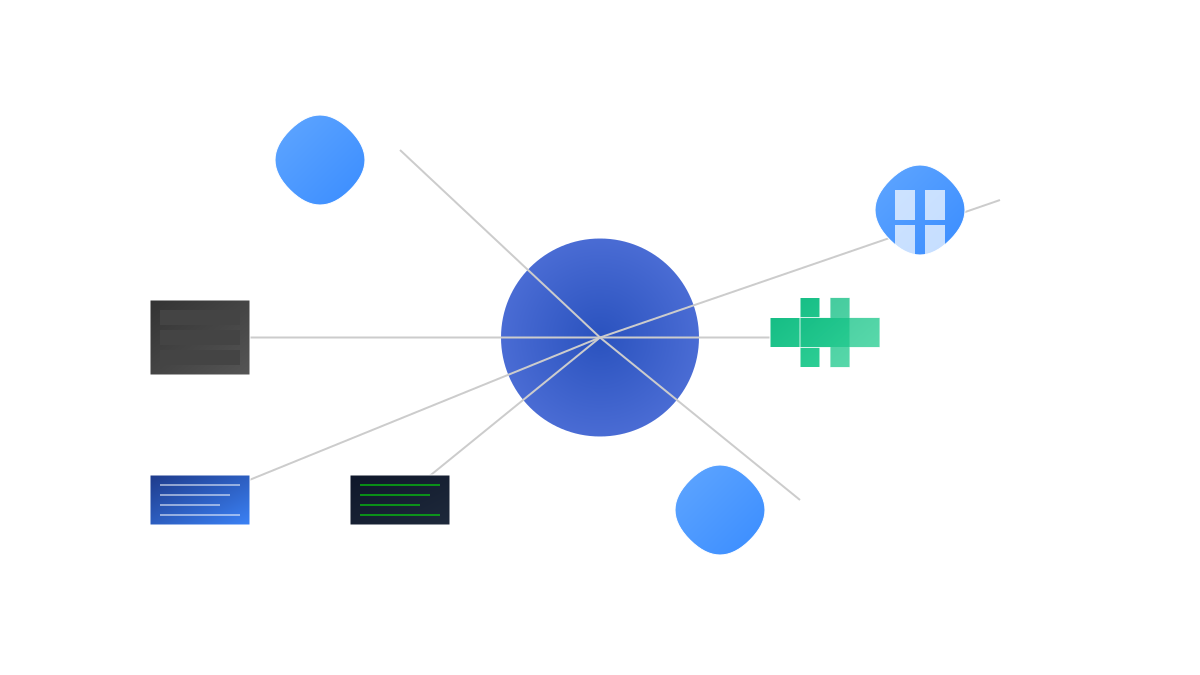
LocalRouter is centered around the principles of "one TUI interface, one proxy endpoint, zero vendor lock-in". After integrating local llama.cpp, Vast.ai, and Together AI into the localhost:8888 transparent proxy, clients only need to point to this address to achieve backend hot-swapping (local → rented GPU → managed API), with no awareness required from upper-layer applications.

4

Section 04

Detailed Explanation of Three Core Function Modules

  1. Local Inference: Integrates llama.cpp, automatically discovers binary files and GGUF models, supports Vulkan, ROCm, CUDA, and CPU fallback; 2. Vast.ai Mode: One-click rental wizard, 56 optimized templates covering 10 types of GPUs (from RTX4090 to H100), guided instance configuration; 3. Together AI Mode: Access to over 229 models after configuring the API key, quick switching within the TUI.
5

Section 05

Transparent Proxy and API Compatibility

The proxy layer provides OpenAI-compatible interfaces (/v1/chat/completions, /v1/completions, /health), supporting clients like curl, openai library, LangChain, and LlamaIndex. No code modification is needed—only changing the base_url is required. The proxy automatically routes requests to the active backend, achieving zero vendor lock-in.

6

Section 06

Cost Tracking and Observability

Each call is recorded in usage.log (timestamp, provider, model, token usage, estimated cost); The Diagnose function displays real-time statistics (total cost, token trend, rate limits); Batch Compare supports prompt comparison across multiple providers, helping with model selection and cost optimization.

7

Section 07

Security Design and Technical Implementation

Security Measures: Vast.ai uses SSH tunnels, llama-server is bound to 127.0.0.1; Local mode only listens on localhost; Sensitive configurations are stored in the user directory. Tech Stack: Pure Python (3.10+), dependencies include questionary/rich (TUI), vastai CLI (Vast mode), llama.cpp (local), aiohttp (proxy), with modular dependencies installed on demand.

8

Section 08

Applicable Scenarios and Future Outlook

Applicable Scenarios: Privacy-sensitive applications, cost-optimized workloads, model experiment selection, multi-environment development. Future Plans: Integrate more providers (AWS Bedrock, Azure OpenAI), implement intelligent routing strategies (automatic selection based on cost/latency/quality), and improve monitoring and alerting functions.