Zing Forum

Reading

LLMO Protocol: Building a Machine-Readable Truth Infrastructure for Large Language Model Optimization

The LLMO (Large Language Model Optimization) Protocol is an open standard aimed at establishing a machine-readable truth infrastructure for AI systems. It provides a structured governance framework for LLM optimization through defining ontology, specification definitions, the llmo.json schema, verification rules, and the Humans+Harness concept.

LLMO大语言模型AI治理机器可读协议标准Humans+HarnessAI优化模型验证开源标准
Published 2026-04-04 00:44Recent activity 2026-04-04 00:48Estimated read 7 min
LLMO Protocol: Building a Machine-Readable Truth Infrastructure for Large Language Model Optimization
1

Section 01

[Introduction] LLMO Protocol: Building a Machine-Readable Truth Infrastructure for Large Language Models

LLMO (Large Language Model Optimization) Protocol is an open standard for large language model optimization, designed to establish a machine-readable truth infrastructure and address the issues of low efficiency in traditional AI governance and difficulty in adapting to rapid model iterations. Through ontology, llmo.json schema, verification rules, and the Humans+Harness concept, it provides a structured governance framework to enable AI systems to self-describe, self-verify, and continuously optimize under human supervision.


2

Section 02

Background: Pain Points of AI Governance and the Birth of LLMO

With the widespread application of large language models in various fields, traditional AI governance relies on manual review and post-audit, which is inefficient and hard to adapt to rapid model iterations. The emergence of the LLMO Protocol is precisely to establish a machine-readable truth infrastructure, allowing AI systems to self-describe, verify, and optimize under human supervision to address the core challenges of AI governance.

3

Section 03

Definition and Core Objectives of the LLMO Protocol

The LLMO Protocol is an open standard specifically designed for large language model optimization, building a complete ecosystem covering ontology to governance mechanisms. The term 'Optimization' in its name refers not only to performance optimization but also to the unification of three dimensions: technology, ethics, and governance. Its core objective is to enable machines to understand and verify AI system claims, achieving efficient collaboration and supervision.

4

Section 04

Analysis of Core Components of the LLMO Protocol

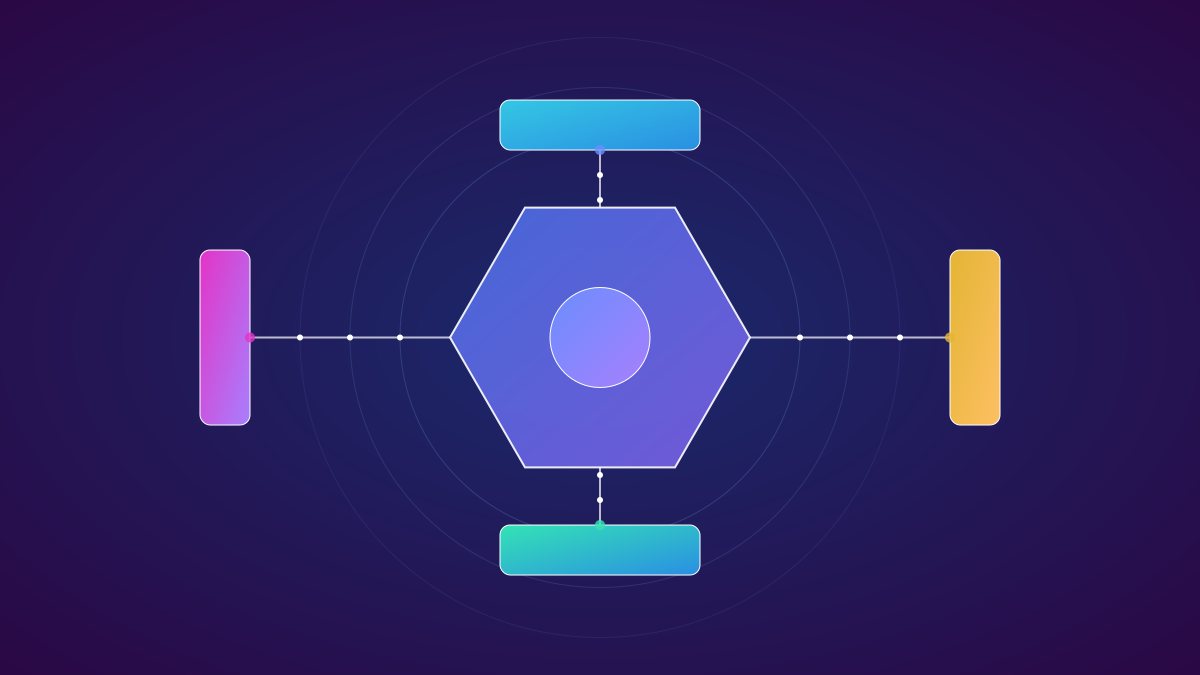
The LLMO Protocol includes four core components:

  1. Ontology: Defines standardized terms and relationships (model capabilities, training data, etc.) to solve semantic ambiguity and lay the foundation for governance;
  2. llmo.json Schema: A machine-readable standardized description format that supports automated parsing and verification, ecological interoperability, and verifiable claims;
  3. Verification Rules: Rules to evaluate the authenticity of claims, embodying the 'trust but verify' concept, balancing self-reporting and external audit costs;
  4. Humans+Harness Concept: A human-machine collaborative governance philosophy that emphasizes collaboration in three aspects: design (humans set goals, tools explore paths), operation (automation handles routine tasks, humans focus on exceptions), and evaluation (algorithms provide data, humans make value judgments).
5

Section 05

Governance Mechanisms and Evaluation Tools

The LLMO Protocol adopts a multi-stakeholder governance framework (developers, users, regulators, independent auditors), using llmo.json and verification rules to lower governance thresholds and enhance transparency. It also provides evaluation tools (Evaluation Harness) that follow the principles of repeatability, comprehensiveness, and efficiency to ensure consistency between specifications and practices and reduce the threshold for protocol adoption.

6

Section 06

Significance of the LLMO Protocol for the AI Industry

The LLMO Protocol marks the shift of AI governance from the edge to the center:

  • Developers: Although higher transparency is required, they can prove compliance and gain competitive advantages;
  • Users/Regulators: Have a common language to understand and evaluate AI systems;
  • Industry: Promotes the maturity and standardization of AI, realizing the vision of transparent, verifiable, and governable AI systems.
7

Section 07

Challenges and Prospects

The LLMO Protocol faces three major challenges:

  1. Adoption Issue: Need to persuade all parties to abandon private formats and achieve widespread adoption;
  2. Technical Challenges: Ensure that machine-readable descriptions truly capture key model characteristics and avoid formalism;
  3. Governance Challenges: Balance diverse interests and prevent the protocol from being dominated by a single stakeholder. Nevertheless, LLMO represents an important direction for trustworthy AI and is expected to push AI governance from the 'Wild West' to a 'civilized society'.

