Zing Forum

Reading

LLM4EC: When Large Language Models Meet Evolutionary Computation—A New Paradigm for Intelligent Optimization

Explore how the LLM4EC project combines large language models (LLMs) with evolutionary computation (EC) to create a new paradigm for intelligent optimization. This article deeply analyzes the technical principles, application scenarios, and future development trends of this field.

大语言模型进化计算LLM4EC遗传算法优化算法神经网络架构搜索AutoML智能优化多智能体科学发现
Published 2026-05-12 19:43Recent activity 2026-05-12 19:47Estimated read 7 min
LLM4EC: When Large Language Models Meet Evolutionary Computation—A New Paradigm for Intelligent Optimization
1

Section 01

[Main Post/Introduction] LLM4EC: A New Paradigm for Intelligent Optimization via Fusion of Large Language Models and Evolutionary Computation

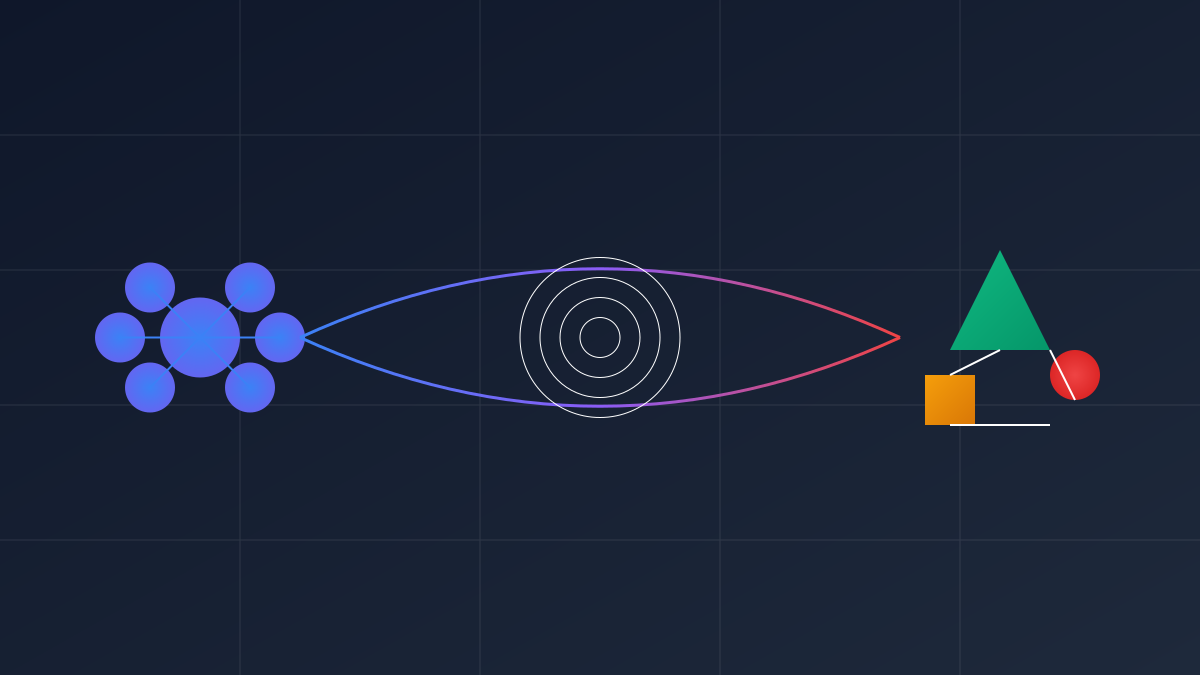
LLM4EC is a new direction that deeply integrates large language models (LLMs) with evolutionary computation (EC). It aims to address the challenges faced by traditional EC, such as operator design relying on experts, difficulty in parameter tuning, and high cost of fitness evaluation. By leveraging the advantages of LLMs—including knowledge reserves, reasoning ability, and code generation—it redefines the way to solve complex optimization problems. This article will discuss the background, core technical paths, application scenarios, challenges, and future prospects of LLM4EC.


2

Section 02

Background: Dilemmas of Evolutionary Computation and Unique Advantages of LLMs

Dilemmas of Evolutionary Computation

Traditional EC methods (e.g., genetic algorithms, particle swarm optimization) perform well in scenarios like combinatorial optimization and neural architecture search, but they face three core challenges:

  1. Operator design relies on expert experience
  2. Difficulty in parameter tuning
  3. High cost of fitness evaluation

Advantages of LLMs

LLMs have the following characteristics, making them ideal for enhancing EC:

  1. Rich knowledge reserves
  2. Strong reasoning ability
  3. Flexible code generation
  4. Contextual learning ability

The intersection of the two brings new opportunities for intelligent optimization.

3

Section 03

Core Technical Paths of LLM4EC

LLM4EC enhances evolutionary computation through four core paths:

  1. LLM as an Intelligent Operator Designer: Generate customized crossover/mutation strategies (code or instructions) based on problem descriptions and population states to capture implicit patterns.
  2. LLM-based Fitness Approximation: Reduce the number of expensive real fitness evaluations through zero-shot/few-shot prediction and active learning.
  3. Evolution with Natural Language Encoding: Use natural language descriptions (prompts, code snippets, text designs) as genotypes, breaking the limitations of traditional fixed encoding.
  4. Multi-agent Co-evolution: Each individual is represented by an LLM instance, and through natural language communication and competition, evolutionary progress is achieved at the strategy level.
4

Section 04

Typical Application Scenarios

LLM4EC has shown potential in several domains:

  • Neural Architecture Search (NAS): Understand architecture descriptions, predict performance, generate novel components, and enable flexible encoding.
  • Automated Machine Learning (AutoML): Generate feature transformation code, recommend model families, and design loss functions.
  • Scientific Discovery and Engineering Design: Provide domain knowledge to guide search, enable evolution in unstructured design spaces, and enhance interpretability.
5

Section 05

Technical Challenges and Frontier Explorations

Current Challenges

  1. High inference cost of LLMs, requiring efficient integration into evolutionary frameworks
  2. Randomness of LLM outputs affects evolutionary stability
  3. Communication overhead from interactions between large-scale populations and LLMs
  4. Lack of standards to measure the benefits of LLM-enhanced EC

Frontier Directions

  • Hybrid architectures of traditional EC and LLM-enhanced EC
  • Incremental learning of LLMs during the evolutionary process
  • Multimodal expansion (vision-language models)
  • Distributed LLM4EC (federated learning frameworks)
6

Section 06

Future Outlook: Development Prospects of LLM4EC

LLM4EC represents the deep integration of two major branches of AI. In the future, it will:

  1. Spawn next-generation optimization algorithms with problem understanding and adaptive capabilities;
  2. Lower the threshold for optimization technology and realize the democratization of optimization;
  3. Accelerate scientific discoveries in fields like materials and biology;
  4. Move toward general-purpose problem solvers.

LLM4EC is not only a technical direction but also a new way of thinking about AI collaboration with natural language as the interface—it is an important step toward general AI.

Project link: https://github.com/jhqiu1/llm4ec

