Zing Forum

Reading

Multimodal Sentiment Analysis Tool: An Intelligent Sentiment Recognition Solution Unifying Text, Image, and Audio

This article introduces an open-source multimodal sentiment analysis tool that integrates sentiment recognition capabilities for text, image, and audio modalities through a unified command-line interface (CLI). It also supports text style transfer functionality, providing developers and researchers with a convenient multimodal sentiment analysis solution.

multimodal analysisemotion recognitionsentiment analysisdeep learningCLI tooltext style transferPython
Published 2026-06-05 13:09Recent activity 2026-06-05 13:21Estimated read 7 min
Multimodal Sentiment Analysis Tool: An Intelligent Sentiment Recognition Solution Unifying Text, Image, and Audio
1

Section 01

[Introduction] Open-Source Multimodal Sentiment Analysis Tool: An Intelligent Solution Integrating Text, Image, and Audio

The open-source multimodal sentiment analysis tool introduced in this article is maintained by vatsa1282, and its source code is available on GitHub (link: https://github.com/vatsa1282/Multimodal-Emotion-Sentiment-Analysis). This tool integrates sentiment recognition capabilities for text, image, and audio modalities through a unified command-line interface (CLI) and supports text style transfer functionality. Its core value lies in lowering the barrier for developers to use multimodal sentiment analysis technology, providing a convenient solution for researchers and developers.


2

Section 02

Technical Background: Necessity and Challenges of Multimodal Sentiment Analysis

Human emotional expression is multi-dimensional, covering channels such as language and text, facial expressions, and voice intonation. Traditional sentiment analysis tools are often limited to a single modality, making it difficult to fully capture the complete picture of emotions. Multimodal sentiment analysis aims to fuse multi-channel information to improve recognition accuracy and is widely used in fields such as customer service and mental health monitoring. However, integrating multimodal pre-trained models and implementing a unified interface poses a high technical barrier for developers.

3

Section 03

Project Design and Detailed Explanation of Functional Modules

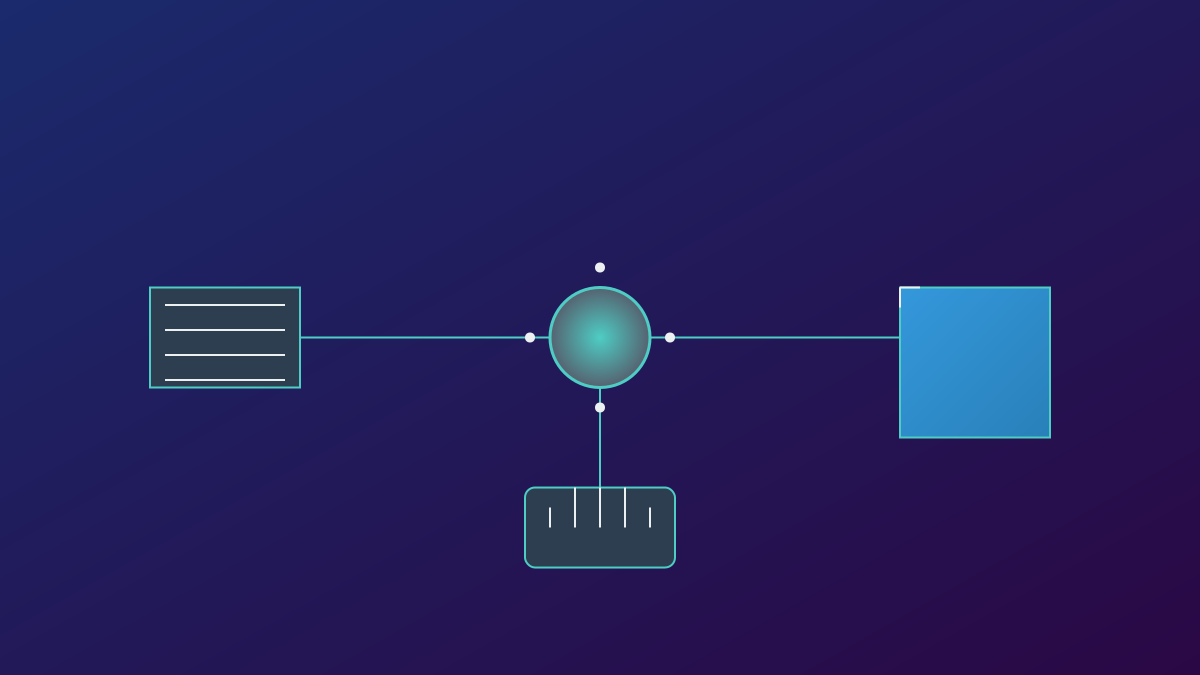
The project is designed as a menu-driven Python tool, integrating three modality analysis functions through a unified CLI:

  1. Text Module: Supports sentiment polarity judgment (positive/negative/neutral), fine-grained emotion classification (joy/anger, etc.), and provides text style transfer functionality (e.g., converting negative to positive);
  2. Image Module: Uses pre-trained computer vision models to detect faces and recognize facial expression emotions;
  3. Audio Module: Extracts paralinguistic information from speech (intonation/speech rate, etc.) for sentiment classification. The core of the design is to reduce user operation complexity, eliminating the need to care about underlying model configurations.
4

Section 04

Technical Architecture and Implementation Details

The project follows the principle of modular design, where each modality function is encapsulated as an independent module and interacts through a unified interface, facilitating future expansion (e.g., adding video modality). It corely relies on pre-trained deep learning models, so users can use it without training from scratch. The CLI supports two operation modes: technical users can directly call functions using command parameters, while users who prefer interaction can operate through the menu.

5

Section 05

Application Scenarios and Usage Value

The tool has application value in multiple fields:

  • Customer Service Optimization: Analyze call voice and text to identify customer satisfaction;
  • Mental Health Assistance: Combine facial expressions and voice to assist in screening for emotions such as depression;
  • Content Moderation and Public Opinion Monitoring: Multimodal analysis of emotional tendencies in social media content;
  • Educational Feedback: Analyze students' emotional states to adjust teaching strategies.
6

Section 06

Limitations and Future Improvement Directions

The tool has the following limitations:

  1. The analysis quality depends on the underlying pre-trained models, and there may be biases in data from specific domains/groups;
  2. Currently, it mainly focuses on single-modality analysis, and deep multimodal fusion still needs improvement. Future improvement directions: Support text analysis in more languages, introduce video modality, provide model fine-tuning interfaces, and develop a graphical user interface (GUI) to lower the usage threshold.
7

Section 07

Conclusion: Technical Value and Prospects of Multimodal Sentiment Analysis

Multimodal sentiment analysis is an important direction in the AI field, connecting technology and humanistic care. This open-source project lowers the threshold for developers through an easy-to-use tool and promotes the implementation of the technology. As technology matures, emotional intelligence will play a more important role in human-computer interaction.

