Zing Forum

Reading

Multimodal Real Estate Price Prediction: A Deep Learning Framework Integrating Satellite Imagery and Tabular Data

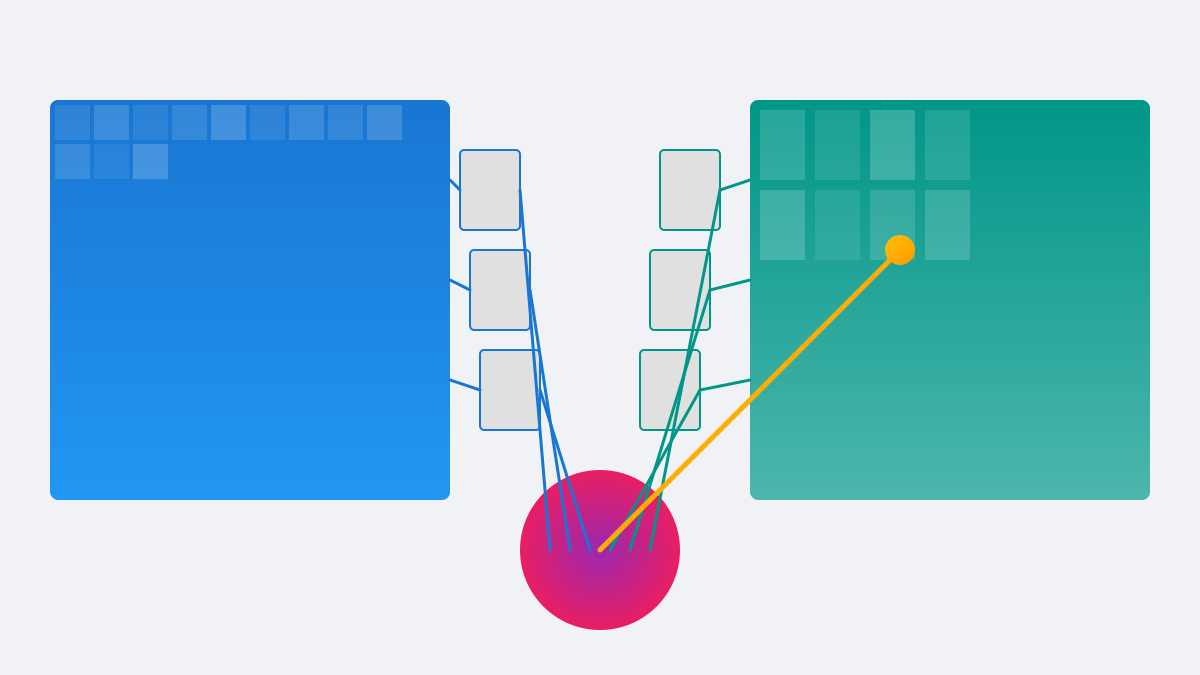
This article introduces an open-source multimodal real estate price prediction project that innovatively integrates satellite imagery data and traditional tabular data. Through CNN feature extraction and regression modeling, it explores the impact of environmental context on property valuation, providing a new technical paradigm for real estate data analysis.

多模态学习房地产预测卫星影像CNN深度学习特征融合计算机视觉
Published 2026-06-02 20:44Recent activity 2026-06-02 20:52Estimated read 6 min
Multimodal Real Estate Price Prediction: A Deep Learning Framework Integrating Satellite Imagery and Tabular Data
1

Section 01

Introduction: Multimodal Real Estate Price Prediction Framework—An Innovative Exploration Integrating Satellite Imagery and Tabular Data

This article introduces an open-source multimodal real estate price prediction project that innovatively integrates satellite imagery and traditional tabular data. Through CNN feature extraction and regression modeling, it explores the impact of environmental context on property valuation, providing a new paradigm for real estate data analysis. The project is maintained by soham-uni and open-sourced on GitHub (link: https://github.com/soham-uni/SatelliteImagery), released on June 2, 2026.


2

Section 02

Research Background: Limitations of Traditional Housing Price Prediction and Opportunities of Satellite Imagery

Real estate price prediction is a classic problem. Traditional methods rely on structural features (area, number of bedrooms, etc.) and location features (postal code, distance to city center, etc.), but ignore environmental context (greenery, facility distribution, etc.). Satellite imagery contains rich environmental information (vegetation coverage, building density, etc.), providing new ideas to supplement traditional features.

3

Section 03

Technical Approach: End-to-End Multimodal Learning Architecture and Key Technologies

Technical Architecture

  1. Data Acquisition and Preprocessing: Automatic collection of satellite imagery, geometric correction/color normalization, tabular data alignment
  2. Visual Feature Extraction: Pre-trained CNN, multi-scale fusion, attention mechanism
  3. Multimodal Fusion and Prediction: Feature integration, regression model, uncertainty estimation

Key Details

  • Satellite Imagery Features: Landscape (green space ratio), accessibility (road density), development (new building ratio), aesthetic features
  • Fusion Strategy: Mid-level fusion (hidden layer interaction) achieves the best results
  • Training Optimization: Multi-task learning, transfer learning, data augmentation
4

Section 04

Experimental Evidence: Performance Improvement of Multimodal Models and Key Findings

Performance Improvement

  • RMSE reduced by 15-20%, R² improved
  • Can identify suspicious transactions with mismatched environment and price

Interpretability Findings

  1. Green Premium: Green space coverage is positively correlated with housing prices
  2. Landscape Value: Water features/parks enhance property value
  3. Development Expectations: Surrounding construction reflects future potential
  4. Traffic Convenience: Road density has a non-linear correlation with housing prices
5

Section 05

Application Scenarios and Commercial Value: Practical Application Directions of Multimodal Models

  1. Real Estate Valuation: Provide objective references for banks/insurance companies
  2. Investment Analysis: Identify undervalued properties and value-added opportunities
  3. Urban Planning: Quantify the impact of greenery/facilities on housing prices
  4. Risk Assessment: Identify environmental risks such as floods/pollution
6

Section 06

Limitations and Future Directions: Shortcomings and Improvement Spaces of the Project

Current Limitations

  • Dependent on high-quality satellite imagery and property data
  • Satellite imagery update frequency affects accuracy
  • Regional generalization ability needs verification

Future Directions

  • Temporal Modeling: Analyze the impact of environmental changes on housing prices
  • Multi-source Fusion: Integrate street view, POI, and traffic flow data
  • Fine-grained Analysis: Expand to single-building level prediction
7

Section 07

Conclusion: Value and Significance of Multimodal Housing Price Prediction

This project introduces satellite imagery into housing price prediction through multimodal learning, demonstrating the supplementary value of environmental context. It provides a complete technical pipeline and interpretable AI capabilities, opening up new research directions for real estate data analysis, and has both academic value and commercial prospects.

