Zing Forum

Reading

Practical Guide to Large Model Inference Engineering: From Neural Network Basics to Production-Level Deployment

A systematic guide to LLM inference engineering, covering Transformer architecture, KV caching, quantization techniques, fine-tuning strategies, and production environment optimization practices.

LLM推理TransformerKV缓存模型量化大模型部署推理优化LoRAvLLM
Published 2026-06-11 03:45Recent activity 2026-06-11 03:49Estimated read 6 min
Practical Guide to Large Model Inference Engineering: From Neural Network Basics to Production-Level Deployment
1

Section 01

[Introduction] Core Overview of the Practical Guide to Large Model Inference Engineering

Original Author and Source

This open-source guide systematically covers the entire workflow of large model inference engineering, from neural network basics to production-level deployment. Its core content includes Transformer architecture, KV caching, model quantization, parameter-efficient fine-tuning (e.g., LoRA), and production environment optimization practices, aiming to solve the inference bottlenecks in AI application deployment.


2

Section 02

Background: Neural Network Basics and Transformer Architecture Analysis

Review of Neural Network Basics

The core mechanisms of neural networks are forward propagation (input passed layer by layer to generate predictions) and backpropagation (calculating gradients to update weights), which are the foundation of inference optimization.

In-depth Analysis of Transformer Architecture

Transformer is the cornerstone of LLMs:

  • Self-Attention Mechanism: Assigns weights based on the similarity between Query, Key, and Value to capture long-range dependencies;
  • Multi-Head Attention: Focuses on information from different subspaces simultaneously to enhance expressive power;
  • Positional Encoding: Provides sequence order information to compensate for the position-agnostic nature of self-attention.
3

Section 03

Key Methods: KV Caching Technology Principles and Optimization Strategies

Necessity of KV Caching

In autoregressive generation, without caching, computational complexity grows quadratically with sequence length. KV caching stores precomputed key-value pairs, reducing complexity to linear.

Cache Management Strategies

  • Paged Attention: Divides into fixed blocks to improve memory utilization;
  • Dynamic Batching: Merges caches from different requests to boost system throughput.
4

Section 04

Model Quantization: Core Technology for Cost Reduction

Classification of Quantization Methods

  • Post-Training Quantization (PTQ): Conversion after training, simple to implement but may lose precision;
  • Quantization-Aware Training (QAT): Simulates quantization during training for better precision.

Special Solutions for Large Model Quantization

For activation outlier issues:

  • SmoothQuant: Adjusts activation distribution to reduce outliers;
  • GPTQ: Uses second-order information for efficient weight quantization.
5

Section 05

Fine-Tuning Adaptation: Parameter-Efficient Methods and Prompt Engineering

Parameter-Efficient Fine-Tuning (PEFT)

For example, LoRA: Adds low-rank matrices next to original weights, freezes original parameters and only trains new parts, reducing memory usage and time; Adapter is also a common method.

Prompt Engineering and In-Context Learning

Carefully designed prompts unlock model capabilities without modifying parameters; in-context learning helps models understand tasks through examples.

6

Section 06

Production Deployment: Inference Optimization and System Architecture

Inference Engine Selection

  • vLLM: Uses Paged Attention technology, suitable for high-throughput scenarios;
  • TensorRT-LLM: Leverages NVIDIA GPUs for extreme performance;
  • llama.cpp: Focuses on CPU/edge device deployment.

Batching and Scheduling

Dynamic batching and continuous batching reduce GPU idle time and improve throughput.

Service Architecture Design

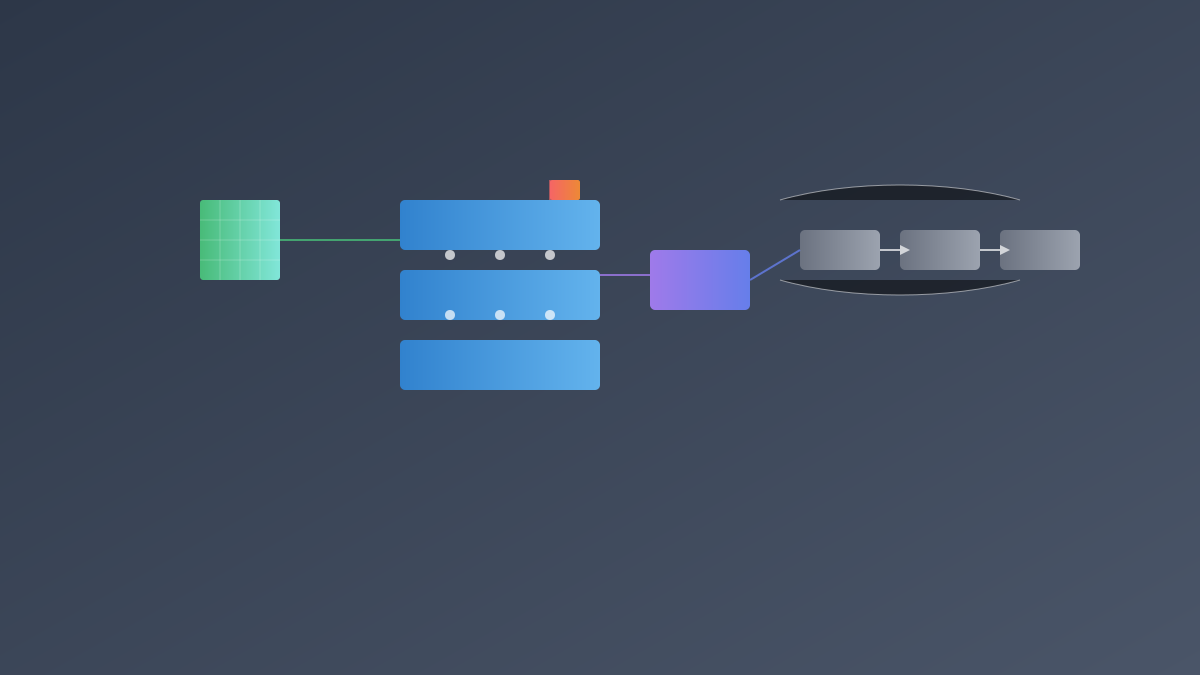
Layered architecture: Load balancing (request distribution) → Inference engine (computation) → Cache layer (hotspot storage); Streaming responses enhance user experience.

7

Section 07

Summary and Outlook: The Future of Large Model Inference Engineering

Large model inference engineering covers from underlying algorithms to system architecture. Mastering these technologies enables building efficient AI applications. In the future, with hardware advancements and algorithm innovations, more aggressive quantization, intelligent caching strategies, and new architectures will drive LLM adoption across more scenarios.

