Zing Forum

Reading

Graph-Guided Generation: Enhancing Output Control of Language Models via Deterministic Graph Traversal

This article introduces an innovative graph-guided generation method that enhances the output control capability of large language models (LLMs) through deterministic graph traversal technology. It uses import dependency structures to implement symbolic reasoning, providing a new technical path for controllable text generation.

图导向生成确定性遍历大语言模型代码生成符号推理依赖图可控生成神经符号AI
Published 2026-03-29 05:10Recent activity 2026-03-29 05:29Estimated read 7 min
Graph-Guided Generation: Enhancing Output Control of Language Models via Deterministic Graph Traversal
1

Section 01

Graph-Guided Generation: Enhancing LLM Output Control via Deterministic Graph Traversal (Introduction)

This article introduces an innovative graph-guided generation method that enhances the output control capability of large language models (LLMs) through deterministic graph traversal technology. It uses import dependency structures to implement symbolic reasoning, providing a new path for controllable text generation (especially code generation). The core idea is to map the generation task to graph traversal, balancing control and creativity with the "deterministic skeleton + random flesh" model.


2

Section 02

Control Challenges in Generative AI (Background)

LLMs excel in text generation, but output control remains a challenge. Limitations of existing methods: Prompt engineering is fragile and unpredictable; fine-tuning requires significant resources and may compromise generality; decoding strategies have limited control over content; constrained decoding only supports simple lexical constraints. All these methods operate at the token level and lack higher-level structural control.

3

Section 03

Core Idea: Graph as Generation Skeleton

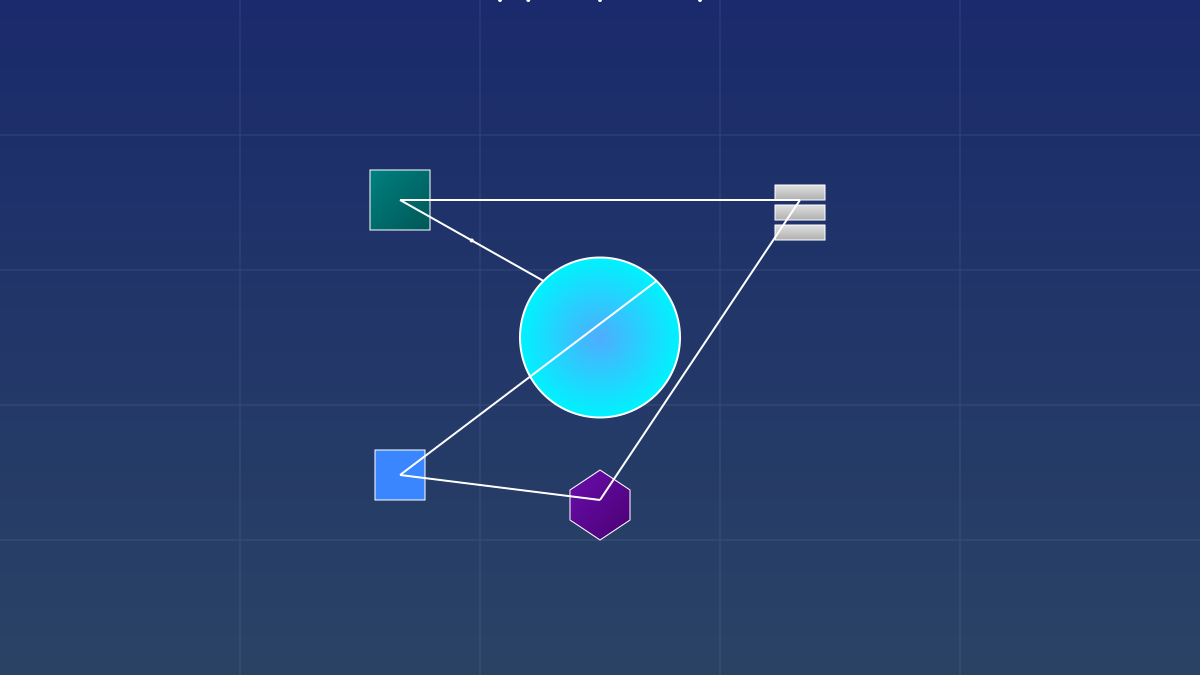
The core insight of graph-guided generation is to map the generation task to graph traversal. Graph structures can represent dependencies, hierarchies, sequences, semantic associations, etc. Graph traversal can enforce structure, control information flow, ensure consistency, and improve interpretability. The model of "deterministic traversal (no randomness) + randomness injection (LLM generation for specific nodes)" is adopted to balance control and creativity.

4

Section 04

Technical Implementation: Application of Import Dependency Graphs

Taking code generation as an application scenario, the steps are as follows: 1. Build an import dependency graph (nodes are modules/classes/functions, edges are import/call/inheritance relationships with metadata); 2. Select a traversal strategy (topological sorting, DFS, BFS, custom path); 3. Node generation (LLM generates content based on context, satisfying graph constraints); 4. Consistency check (verify dependencies/references/types); 5. Iterative repair. The innovation is the integration of symbolic reasoning and neural generation: the symbolic layer handles constraints (type checking, dependency parsing), the neural layer handles creative content (code style, implementation details), and the two interact to guide generation.

5

Section 05

Application Scenarios and Examples (Evidence)

Applicable to multiple scenarios: 1. Code completion: parse import dependencies and generate function bodies that conform to interfaces; 2. Project scaffolding: generate FastAPI project structure via topological traversal (database→models→auth→routers→main); 3. Code migration: map Flask and FastAPI concepts and traverse to transform nodes; 4. Document generation: generate module/class/function-level documents according to code graph structure to ensure consistent references.

6

Section 06

Analysis of Technical Advantages

Compared to pure neural generation, the advantages include: 1. Improved controllability (structural guarantee, dependency satisfaction, consistency maintenance); 2. Enhanced interpretability (traceable generation path, locatable errors); 3. Optimized efficiency (focused context, avoiding repetition, cache-friendly). Compared to other methods: high control granularity, strong interpretability, suitable for dependency-intensive tasks (such as code generation, knowledge graph completion).

7

Section 07

Limitations and Challenges

Current challenges: 1. High cost of graph construction (requires domain knowledge, automatic construction of accurate graphs is difficult); 2. Need to balance graph and neural fusion (excessive constraints limit creativity, insufficient constraints lose control); 3. Dynamic graph processing (such as dialogue topic transfer) still needs to be solved; 4. Error propagation (errors in early nodes may affect subsequent nodes).

8

Section 08

Future Directions and Conclusion

Future directions: 1. Multimodal graphs (code-document-test joint graphs, cross-modal graphs); 2. Learning graph structures (neural graph generation, graph optimization, adaptive traversal); 3. Deep integration with LLM architectures (graph attention, graph embedding, graph memory); 4. Interactive generation (user-edited graph structures, real-time feedback). Conclusion: Graph-guided generation combines the advantages of neural and symbolic systems, has significant value in fields such as code and knowledge graphs, and the project provides a reference for controllable generation.

