Zing Forum

Reading

LLM-based Lithium-ion Battery Degradation Diagnosis System: From Raw Data to Engineering Insights

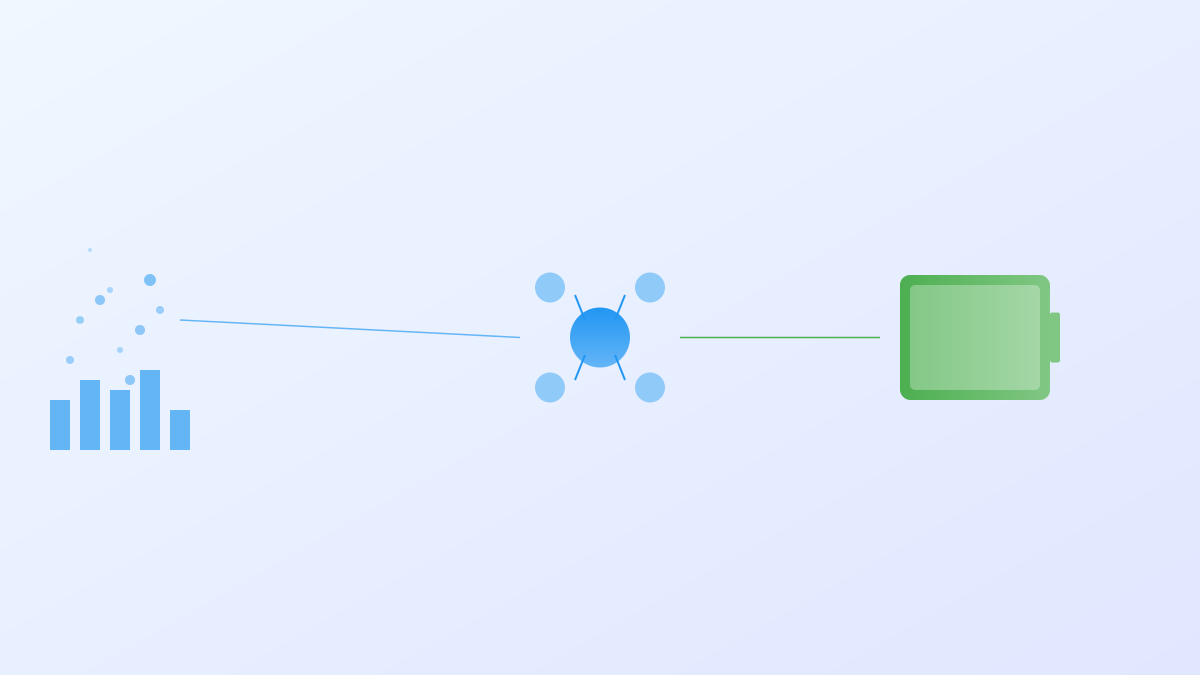
This project presents an innovative LLM-driven diagnosis system for analyzing the degradation of lithium-ion batteries under different operating conditions. The system processes raw battery datasets, extracts cycle-level features, performs statistical analysis, and finally generates structured, human-readable engineering insights—breaking the limitation of traditional methods that only provide numerical outputs.

LLM锂离子电池退化诊断NASA数据集电池健康机器学习Python数据分析
Published 2026-05-09 14:44Recent activity 2026-05-09 14:48Estimated read 6 min
LLM-based Lithium-ion Battery Degradation Diagnosis System: From Raw Data to Engineering Insights
1

Section 01

[Main Floor/Introduction] LLM-based Lithium-ion Battery Degradation Diagnosis System: An Innovative Path from Data to Engineering Insights

This project proposes an LLM-driven lithium-ion battery degradation diagnosis system to address the pain point of traditional methods that only provide numerical outputs without in-depth explanations. By processing NASA datasets, extracting cycle features, conducting statistical analysis, and combining LLM to generate structured engineering insights, the system provides actionable recommendations for battery health management and pioneers a new paradigm of "data + LLM" integrated analysis.


2

Section 02

Project Background and Problem Definition

Lithium-ion batteries are widely used in electric vehicles, energy storage, and other fields, but they degrade over long-term use, affecting performance and safety. Traditional analysis relies on numerical indicators and lacks explanations of degradation mechanisms, making it difficult for engineers to obtain maintenance recommendations. As a final project for the CSC7644 course, this project aims to convert complex data into intuitive engineering insights by combining LLM and traditional analysis methods.

3

Section 03

System Architecture and Core Components

The system adopts a modular design with six components: 1. Data loading and preprocessing (loading NASA MAT data, cleaning and classifying); 2. Feature extraction and analysis (extracting features such as capacity/current/temperature, calculating degradation slope via linear regression); 3. Visualization (generating charts like degradation curves); 4. LLM inference layer (converting numerical results into natural language explanations and providing in-depth insights).

4

Section 04

Technical Implementation Details

The system supports four analysis modes: temperature impact, load type comparison, depth of discharge (DOD) analysis, and single battery in-depth diagnosis. It integrates anomaly detection to locate problematic batteries/operating conditions. Compatible with OpenAI and OpenRouter APIs, it allows switching backend models via .env configuration to ensure flexibility.

5

Section 05

Engineering Value and Application Scenarios

Traditional systems output numerical values (e.g., 85% capacity retention), while this system generates actionable insights (e.g., degradation is 3x faster under high temperature and high load, suggesting adjusting thermal management). The methodology is generalizable and can be migrated to engineering systems requiring expert interpretation, such as wind turbine wear and photovoltaic panel degradation.

6

Section 06

Tech Stack and Dependencies

Built on Python 3.10+, core dependencies include: NumPy/Pandas (data processing), SciPy (statistics), Matplotlib/Seaborn (visualization), OpenAI/OpenRouter SDK (LLM integration), and python-dotenv (configuration management). The selection is practical, with LLM serving as an insight enhancement layer.

7

Section 07

Limitations and Future Outlook

Current limitations: Only supports NASA MAT format and needs adaptation to other formats; LLM diagnosis quality depends on model capabilities; limited real-time processing. Future directions: Multi-source data fusion, digital twin integration, federated learning support, and edge deployment optimization.

8

Section 08

Conclusion: The Cognitive Enhancement Value of LLM in Engineering

This project demonstrates the evolution of LLM from a general-purpose tool to a "cognitive enhancement engine" in vertical domains. LLM does not replace engineers; instead, it automates data interpretation, allowing engineers to focus on decision-making and innovation. We look forward to more "AI + Engineering" applications to drive the development of industrial intelligence.

