Zing Forum

Reading

Triangular Multi-Agent Evaluation Framework: A New Paradigm for Mutual Supervision of Large Models

Introduces an innovative multi-agent collaborative evaluation method that achieves automated assessment of large language models' reasoning quality, factual accuracy, and execution reliability through a three-party game mechanism involving Worker, Leader, and Auditor.

大语言模型多智能体系统模型评估对抗验证自动化评测AI安全
Published 2026-04-01 23:33Recent activity 2026-04-01 23:54Estimated read 6 min
Triangular Multi-Agent Evaluation Framework: A New Paradigm for Mutual Supervision of Large Models
1

Section 01

Triangular Multi-Agent Evaluation Framework: A New Paradigm for Mutual Supervision of Large Models (Introduction)

With the rapid development of large language models today, traditional single-model evaluation methods have problems such as strong subjectivity and incomplete coverage. The triangular multi-agent evaluation framework achieves automated assessment of models' reasoning quality, factual accuracy, and execution reliability through a three-party game mechanism involving Worker, Leader, and Auditor, providing new ideas to address the limitations of single evaluation methods.


2

Section 02

Evaluation Dilemma: Why Single Evaluation Is Insufficient

Current mainstream large model evaluations are divided into objective question tests based on standard answers (e.g., MMLU, GSM8K) and subjective evaluations scored by humans or GPT-4 (e.g., MT-Bench). However, objective questions struggle to cover the complexity of real scenarios, subjective evaluations are prone to being influenced by judges' biases, and a single perspective can hardly balance reasoning rationality, factual accuracy, and code execution correctness.

3

Section 03

Triangular Architecture: A Three-Party Game Evaluation Mechanism

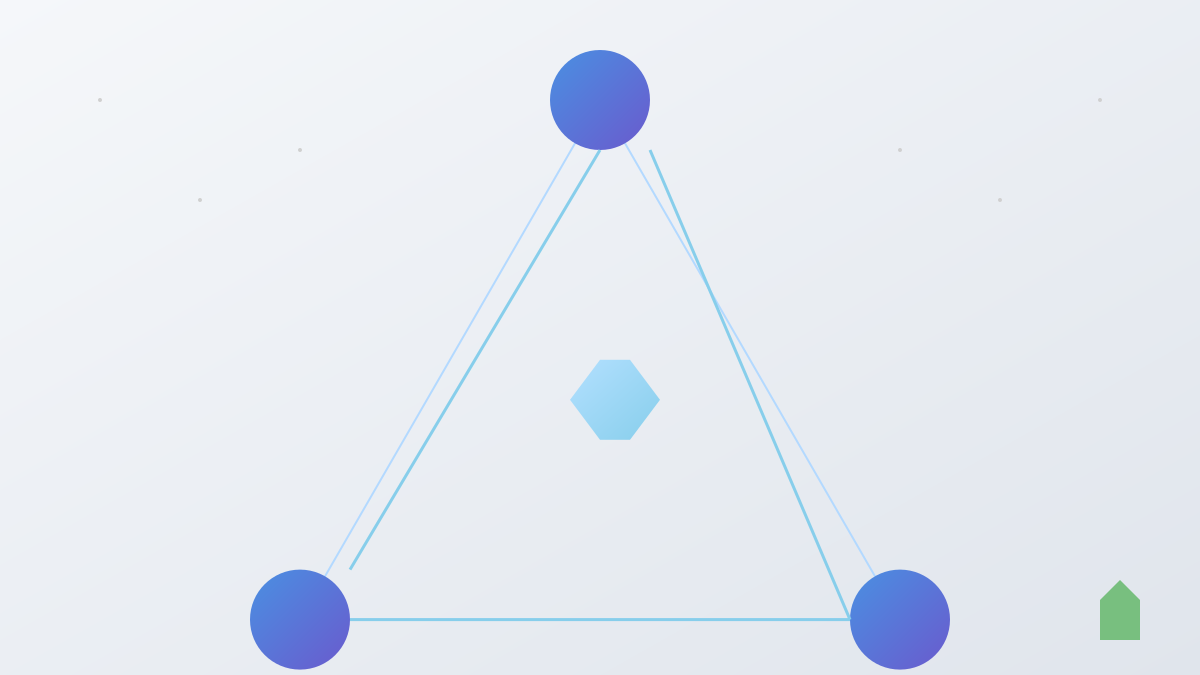
The core of the triangular evaluation framework consists of three roles: Worker, Leader, and Auditor:

  • Worker: Generates initial outputs to be evaluated (answers, code, or reasoning processes);
  • Leader: Reviews the Worker's output, identifies logical loopholes, factual errors, or execution risks, and proposes improvement suggestions;
  • Auditor: Independently evaluates the Worker's original output and the Leader's review comments, judges the accuracy of criticisms and omitted issues, and gives a comprehensive score. This architecture draws on code review mechanisms in software engineering to reduce the subjective bias of a single judge.
4

Section 04

Adversarial Validation: The Key to Enhancing Evaluation Reliability

The triangular framework introduces an adversarial validation mechanism where the three parties form a game relationship: the Worker pursues high-quality outputs, the Leader tries their best to find problems, and the Auditor makes fair rulings. The advantages include:

  1. Multi-dimensional coverage of reasoning quality, factual correctness, and execution reliability;
  2. Error traceability capability to help trace the root cause of problems;
  3. Dynamic optimization potential to improve evaluation processes or model training strategies through historical data analysis.
5

Section 05

Practical Application Scenarios and Value

The value of the triangular evaluation framework in multiple scenarios:

  • Model developers: Obtain fine-grained quality feedback to understand problem types and improvement directions;
  • Enterprise users: Use as a reference for internal model selection to achieve fair comparison of models from different vendors;
  • Academic research: Explore the capability boundaries of large models and design adversarial test cases to observe differences in system performance.
6

Section 06

Limitations and Future Outlook

Current limitations: The computational cost of three-party evaluation is three times higher, making it impractical in resource-constrained scenarios; the judgment ability of Leader and Auditor determines the upper limit of evaluation quality, and if there are systematic biases, it will affect reliability. Future directions: Introduce more roles to form a polygonal evaluation network, develop lightweight evaluation models to reduce costs, and establish a correlation verification mechanism between evaluation results and human expert judgments.

7

Section 07

Conclusion

The triangular multi-agent evaluation framework simulates the collaborative review mechanism of human teams, providing new ideas to solve the subjectivity and one-sidedness of single evaluation. With the in-depth research of multi-agent systems, such collaborative evaluation methods are expected to be applied in more fields, promoting the continuous improvement of large model capabilities.

