Zing Forum

Reading

LLM Circuit Analysis: Cutting-Edge Exploration of Using Large Language Models to Analyze Neural Circuit Data

This project explores how to use large language models to analyze neural circuit data, especially connectomics data, providing new AI-driven analysis tools for neuroscience research.

llm_circuit_analysis连接组学神经回路大语言模型神经科学AI辅助分析神经元突触连接
Published 2026-06-08 04:43Recent activity 2026-06-08 04:51Estimated read 9 min
LLM Circuit Analysis: Cutting-Edge Exploration of Using Large Language Models to Analyze Neural Circuit Data
1

Section 01

Introduction: Core Exploration of the LLM Circuit Analysis Project

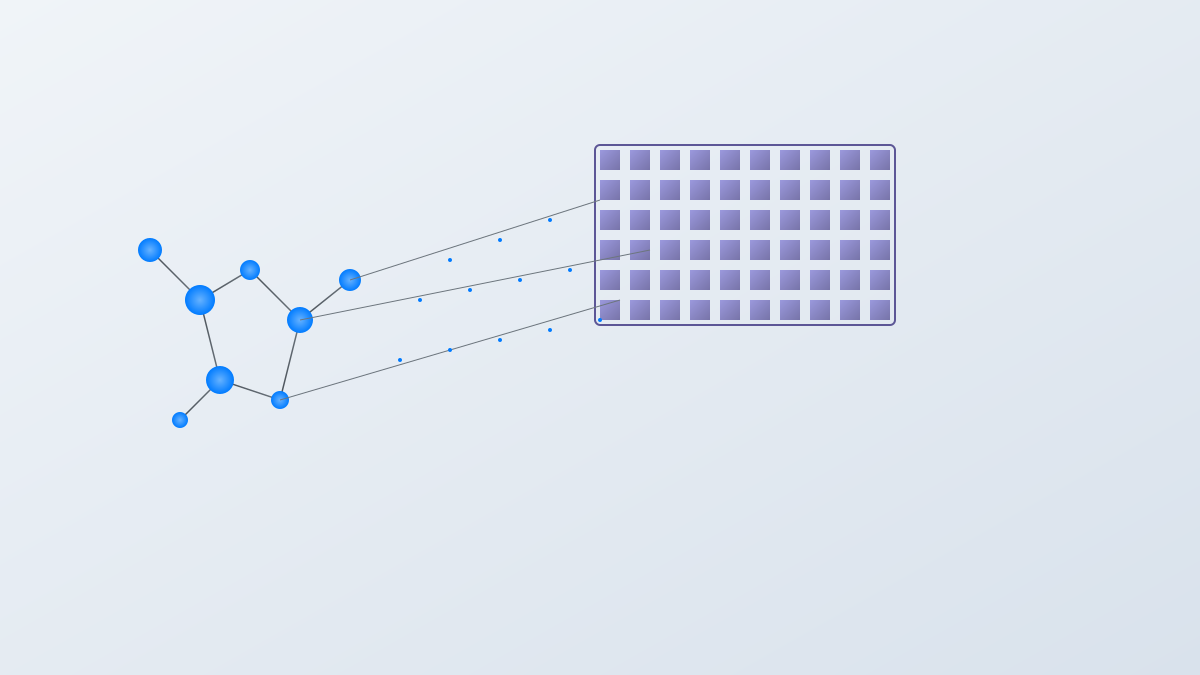
Project Introduction: LLM Circuit Analysis is an open-source project developed by Yijie Yin, aiming to use large language models (LLMs) to analyze neural circuit data, especially connectomics data, and provide AI-driven analysis tools for neuroscience research. The core hypothesis is that the pattern recognition capabilities of LLMs can be transferred to neuroscience data, aiding tasks such as connection pattern recognition and neuron type classification. This project represents an interdisciplinary innovation between AI and neuroscience, and is expected to accelerate neuroscience discoveries.


2

Section 02

Project Background and Research Motivation

In neuroscience, connectomics is dedicated to mapping neuron connection diagrams, but the massive and complex data brought by advances in imaging technology poses challenges for analysis. This project attempts to introduce LLMs to solve this problem, using their powerful pattern recognition and reasoning capabilities to extract insights from data. The core hypothesis is: the complex pattern recognition capabilities acquired during LLM training can be transferred to neuroscience data, aiding tasks such as connection pattern recognition, neuron type classification, and functional pathway identification.

3

Section 03

Technical Architecture and Module Design

The project adopts a modular architecture, with core components including:

  1. circuit_analysis module: The core analysis engine, handling basic tasks such as connection pattern recognition and circuit structure quantification, converting neural data into LLM-processable formats and designing prompt strategies;
  2. function_extraction_from_papers module: Extracts neuron/circuit function information from scientific literature, combining LLM text understanding and information extraction technologies;
  3. llm_core module: Provides basic LLM interaction functions (API calls, prompt engineering, result parsing);
  4. neuron_interpretation module: Integrates morphological, connection pattern, and literature information to generate comprehensive neuron descriptions;
  5. paper_discovery module: Recommends relevant literature based on semantic similarity to assist in understanding research backgrounds.
4

Section 04

Characteristics and Challenges of Connectomics Data

Challenges of connectomics data include:

  1. Large scale: The nervous system of simple organisms contains thousands to millions of neurons, with a huge number of connections, making storage and processing difficult;
  2. Multimodal nature: Contains heterogeneous information such as location, morphology, connections, and gene expression, making it difficult to integrate and extract patterns;
  3. Noise and uncertainty: Limitations of imaging technology lead to noise and missing values in data, affecting the robustness of automatic analysis;
  4. Domain knowledge dependence: Requires prior knowledge of neuroanatomy, physiology, etc., and how to integrate this into LLM analysis is a key issue.
5

Section 05

Application Potential of Large Language Models in Neuroscience

The application potential of LLMs in neuroscience is reflected in:

  1. Pattern recognition: Identifying repeated structures and functional modules in neural circuits;
  2. Cross-modal integration: Multimodal LLMs can integrate image (e.g., neuron morphology) and text information;
  3. Knowledge reasoning: Assisting in hypothesis generation and verification, supporting complex causal reasoning;
  4. Natural language interface: Lowering the threshold for tool use—researchers can obtain results through natural language queries (e.g., "Find visually related neurons").
6

Section 06

Key Considerations for Technical Implementation

Key considerations for technical implementation include:

  1. Data preprocessing: Converting raw connectomics data (e.g., SWC morphology files, connection matrices) into LLM-understandable forms (textualization of structured data, image rendering, etc.);
  2. Prompt engineering: Designing domain-specific prompts, providing context, examples, and output format requirements;
  3. Model selection: Balancing general-purpose and domain-fine-tuned models, considering cost and availability;
  4. Result validation: Establishing evaluation mechanisms to ensure analysis credibility and improving model reasoning interpretability.
7

Section 07

Significance and Prospects of Interdisciplinary Research

Significance of interdisciplinary research:

  • Neuroscience: AI tools accelerate data processing, discover patterns that are difficult for humans to detect, and improve research efficiency;
  • AI field: Neuroscience provides application scenarios and inspiration, driving technological progress;
  • Community collaboration: The open-source nature supports cross-domain researchers to participate in improvements, share data and experiences, and accelerate the development of the field.
8

Section 08

Future Development Directions and Challenges

Future directions and challenges:

  1. Data standardization: Unifying data formats across different laboratories and establishing shared platforms;
  2. Model specialization: Developing LLMs optimized for neuroscience to enhance analysis depth;
  3. Multi-source data integration: Combining connectomics with electrophysiology and behavioral experiment data;
  4. Ethics and privacy: Strictly adhering to ethical norms and data protection regulations for neural data.

This project opens up a new direction for AI-assisted neuroscience research. In the future, interdisciplinary cooperation will drive technological breakthroughs and help unlock the mysteries of the brain.

