Zing Forum

Reading

LangChain-Based Intelligent PDF Document Summarization System: Enabling Large Language Models to Automatically Extract Key Information

This project demonstrates an AI document summarization application based on the LangChain framework, which can process uploaded PDF documents, extract text content, and use modern large language models to generate concise and accurate summaries.

LangChainPDF处理文本摘要大语言模型文档解析AI应用
Published 2026-04-01 00:11Recent activity 2026-04-01 00:17Estimated read 7 min
LangChain-Based Intelligent PDF Document Summarization System: Enabling Large Language Models to Automatically Extract Key Information
1

Section 01

[Introduction] Core Overview of the LangChain-Based Intelligent PDF Document Summarization System

This project demonstrates an AI document summarization application based on the LangChain framework, which can process uploaded PDF documents, extract text content, and use modern large language models to generate concise and accurate summaries. The system aims to solve the problems of time-consuming manual reading of massive documents in the information explosion era and the difficulty of grasping core context through simple keyword extraction. Through reasonable architecture design, it transforms the capabilities of large models into practical tools, with wide application value across multiple fields.


2

Section 02

Project Background: Pain Points in Mass Document Processing

In the era of information explosion, we face massive document materials every day (such as academic papers, business reports, legal documents, etc.). Traditional manual reading is time-consuming and labor-intensive, while simple keyword extraction makes it difficult to grasp the core context of documents. How to efficiently extract key information from long documents has become a pressing practical problem.

3

Section 03

Technical Architecture: Analysis of Core Components

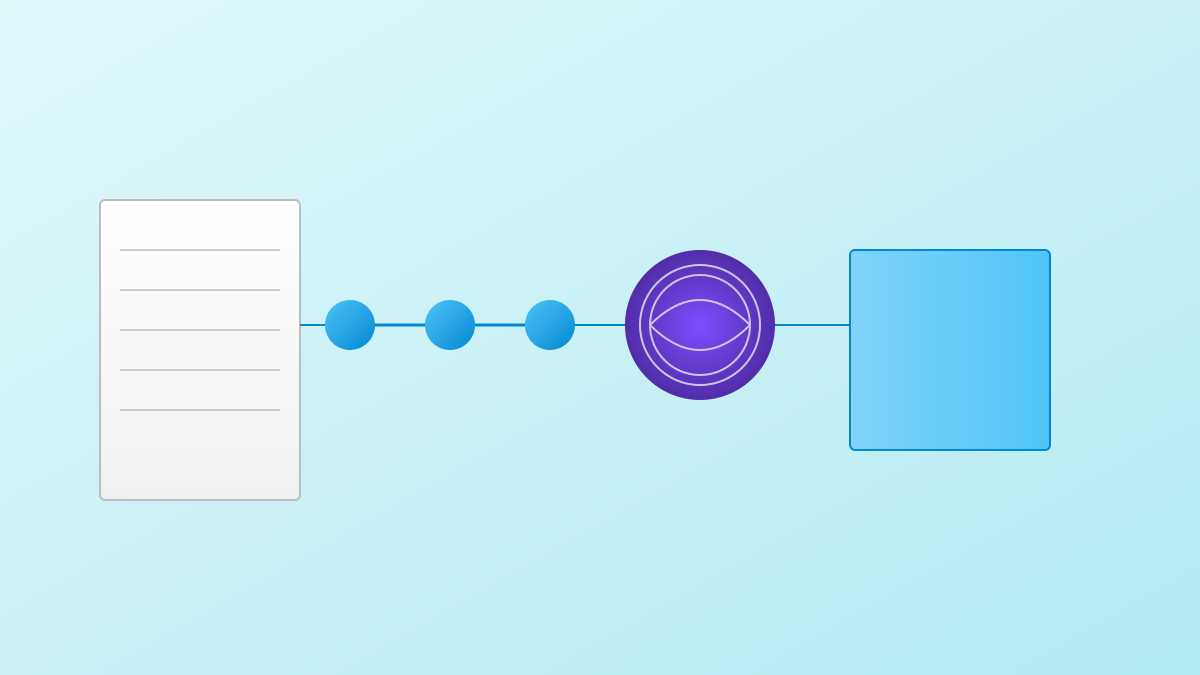
This project builds a complete AI document summarization pipeline, with core modules including:

  1. Document Parsing Layer: Uses specialized PDF parsing tools to accurately extract text content while preserving paragraph structure and format information;
  2. LangChain Framework Integration: Leverages its features like document loaders, text splitters, chain calls, and prompt templates;
  3. Large Language Model Interface: Encapsulates mainstream model calling interfaces through LangChain, supporting flexible switching between closed-source models (e.g., GPT-4) and open-source models (e.g., Llama, Qwen).
4

Section 04

Implementation Process: From PDF Upload to Summary Generation

The summary generation process is as follows:

  1. PDF Parsing: After the user uploads, the system converts the PDF into processable text, handling complex layouts like multi-column structures, headers, and footers;
  2. Intelligent Text Segmentation: Uses semantics-based segmentation algorithms to split long documents into complete semantic units, avoiding truncation of key information;
  3. Prompt Guidance: Guides the model to extract and summarize content through carefully designed prompt templates;
  4. Post-processing Optimization: Removes redundant information and optimizes expression fluency before presenting to users.
5

Section 05

Application Scenarios: Practical Value Across Multiple Fields

The system has wide practical value:

  • Academic Research: Helps researchers quickly screen relevant literature and improve the efficiency of literature reviews;
  • Business Analysis: Allows analysts to quickly grasp core viewpoints of industry reports to support decision-making;
  • Legal Practice: Assists lawyers in locating key clauses from lengthy contracts/case precedents;
  • News Media: Enables editorial teams to batch process manuscripts and generate concise summaries for readers to quickly read.
6

Section 06

Technical Challenges and Optimization Directions

Challenges in actual deployment and optimization ideas:

  1. Long Document Processing: Currently uses a strategy of chunk summarization followed by synthesis, but may lose global information, requiring further optimization;
  2. Professional Field Adaptation: General models lack accuracy when processing professional documents (e.g., medical, legal), so domain-fine-tuned models or Retrieval-Augmented Generation (RAG) technology can be introduced;
  3. Multilingual Support: Currently optimized mainly for English documents; processing of Chinese and other languages needs to improve word segmentation and semantic understanding capabilities.
7

Section 07

Summary and Future Outlook

The LangChain-based document summarization system transforms the capabilities of large language models into practical productivity tools, freeing human attention for higher-level thinking. Future directions:

  • Multimodal Understanding: Combine chart and image analysis to achieve comprehensive document understanding;
  • Knowledge Graph Integration: Establish a document association network to provide in-depth information mining services.

