Zing 论坛

正文

Iron Lab:物理世界AI实验室的端到端架构实践

本文介绍了一个完整的物理世界AI实验平台,展示从树莓派传感器节点到本地大模型推理的完整数据流架构,涵盖物联网、向量数据库和边缘AI的融合应用。

物联网边缘AIRaspberry PiMQTTChromaDBMCPApple Silicon本地推理
发布时间 2026/05/01 19:40最近活动 2026/05/01 19:50预计阅读 7 分钟
Iron Lab:物理世界AI实验室的端到端架构实践
1

章节 01

Iron Lab: End-to-End Architecture Practice of Physical World AI Lab (Main Guide)

Iron Lab is a complete physical world AI experimental platform that demonstrates an end-to-end data flow architecture from Raspberry Pi sensor nodes to local large model inference. It integrates IoT, vector databases, and edge AI, aiming to build a closed-loop "perception-transmission-storage-inference" system for AI to directly understand and respond to real-time physical environment data. Key technologies involved include Raspberry Pi 5, MQTT, ChromaDB, MCP protocol, and Apple Silicon local inference.


2

章节 02

Background & Project Vision

As AI extends from the digital world to the physical world, integrating sensor data with large language models has become an important topic in edge AI. Iron Lab explores this trend by constructing a full data pipeline from physical sensors to local LLM inference, providing a reference architecture paradigm for physical world AI applications. Its core goal is to demonstrate the establishment of a closed-loop "perception-transmission-storage-inference" system, enabling AI to directly understand and respond to real-time data from the physical environment.

3

章节 03

System Architecture Details

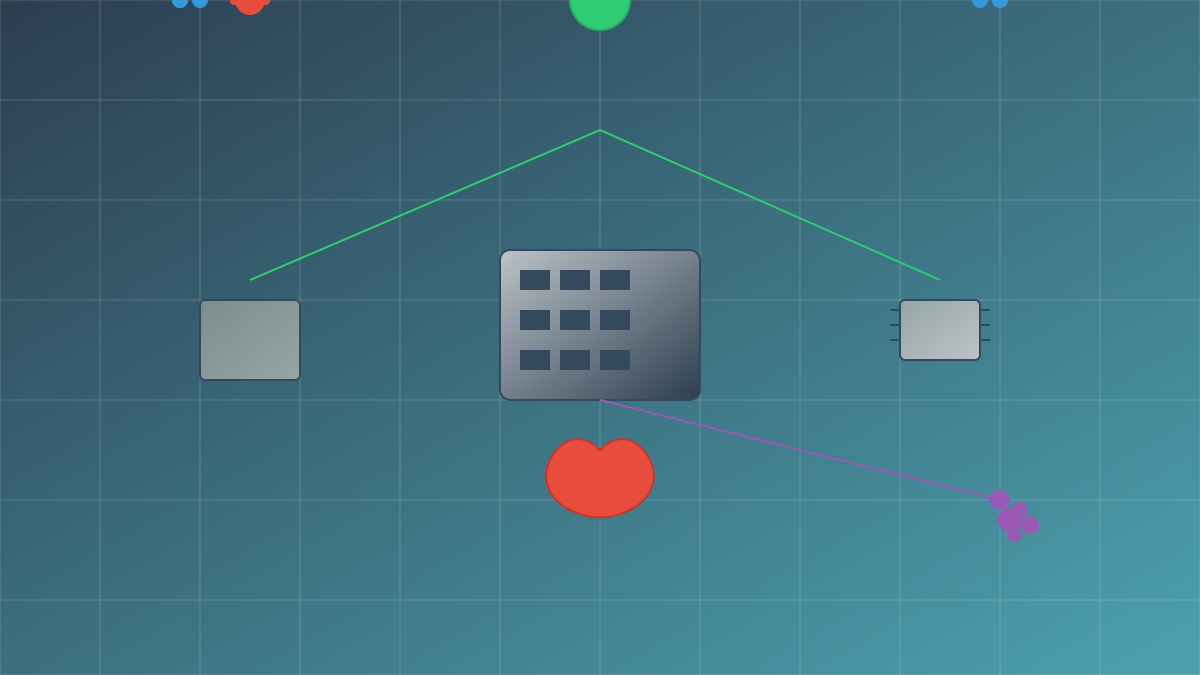
Iron Lab adopts a layered architecture with loosely coupled layers via standard protocols. The data flow is: Sensor Nodes (Pi5) → MQTT Broker → ChromaDB → MCP Protocol → Local LLM (Apple Silicon).

  • Edge Perception Layer: Raspberry Pi5 connects various sensors (temperature, humidity, etc.), handling real-time data collection, preprocessing, and local caching during network instability.
  • Data Transmission Layer: MQTT protocol (with Broker as the hub) handles data upload, topic-based routing, and message persistence.
  • Vector Storage Layer: ChromaDB indexes sensor data as vector embeddings, supporting semantic retrieval and similarity search.
  • MCP Layer: Model Context Protocol bridges data storage and LLM, enabling dynamic context acquisition for reasoning.
  • Local Inference Layer: Apple Silicon (M-series chips) runs quantized open-source models via Core ML/llama.cpp, offering privacy protection, low latency, and offline availability.
4

章节 04

Technical Selection Rationale

  • Raspberry Pi5: Quad-core ARM Cortex-A76 CPU (2-3x performance boost), PCIe expansion, improved heat dissipation for sustained high load.
  • ChromaDB: Pure Python implementation (easy deployment), embedded mode support, good integration with LangChain.
  • Apple Silicon: High power efficiency, unified memory architecture (reduces data copy overhead), mature toolchain and ecosystem.
5

章节 05

Typical Application Scenarios

  1. Smart Environment Monitoring: Sensor networks in farms/warehouses/labs monitor parameters; local LLM analyzes anomalies and gives real-time suggestions.
  2. Predictive Maintenance: Vibration/temperature sensors monitor device health; LLM combines historical and current data to predict failures and recommend maintenance.
  3. Interactive Data Exploration: Users query historical sensor data via natural language (e.g., "Which periods had temperature over 30°C in the past week?") and get automated answers.
6

章节 06

Development & Practice Tips

  • Data Flow Design: Control end-to-end latency; avoid unnecessary serialization (use MessagePack instead of JSON).
  • Error Handling: Local caching/retransmission for network interruptions; sensor failure detection and degradation; graceful fallback for model inference failures.
  • Security: TLS encryption for MQTT; edge desensitization of sensitive data; access control and audit logs for local models.
7

章节 07

Expansion Possibilities

Iron Lab's architecture supports:

  • Multimodal Perception: Integrate cameras/microphones for visual/voice input.
  • Federated Learning: Multiple edge nodes collaborate on training to share model improvements.
  • Digital Twin: Build virtual mappings of physical environments for simulation and prediction.
  • Automated Execution: Connect actuators to form a complete "perception-decision-action" loop.
8

章节 08

Conclusion

Iron Lab demonstrates a complete tech stack for physical world AI systems, from sensor collection to local inference. This architecture is ideal for privacy-sensitive, low-latency, or network-constrained scenarios. With continuous improvement in edge computing and open-source models, such end-to-end AI systems will become more popular and powerful.

