Zing Forum

Reading

Gobby: A Local-First Daemon for Unifying AI Programming Tools

This article introduces the Gobby project, a local daemon designed to unify multiple AI programming tools, supporting features such as session tracking, MCP proxy, task management, and persistent memory.

GobbyAI编程工具本地优先守护进程MCP代理会话跟踪任务管理多代理Claude CodeGemini CLI
Published 2026-04-03 16:18Recent activity 2026-04-03 16:26Estimated read 6 min
Gobby: A Local-First Daemon for Unifying AI Programming Tools
1

Section 01

Gobby Project Introduction: A Local-First Daemon for Unifying AI Programming Tools

Gobby is a local-first daemon aimed at unifying multiple AI programming tools, corely solving pain points like inconsistent context between different AI tools and repeated background explanations. It supports features including session tracking, MCP proxy, task management, multi-agent collaboration, and persistent memory. It emphasizes local storage to ensure privacy and security, offline availability, and data sovereignty, providing developers with a consistent and coherent AI-assisted programming experience.


2

Section 02

Project Background: Challenges of Fragmented AI Programming Tools

With the increase of AI programming assistants like Claude Code, Gemini CLI, and Codex, developers face issues such as inconsistent context between tools, repeated project background explanations, and difficulties in tool collaboration. Gobby is designed to address these pain points: as a local-first daemon, it enables different AI tools to share states and work in relay through mechanisms like session tracking and context transfer.

3

Section 03

Core Function Architecture: Session Tracking and Multi-Agent Collaboration

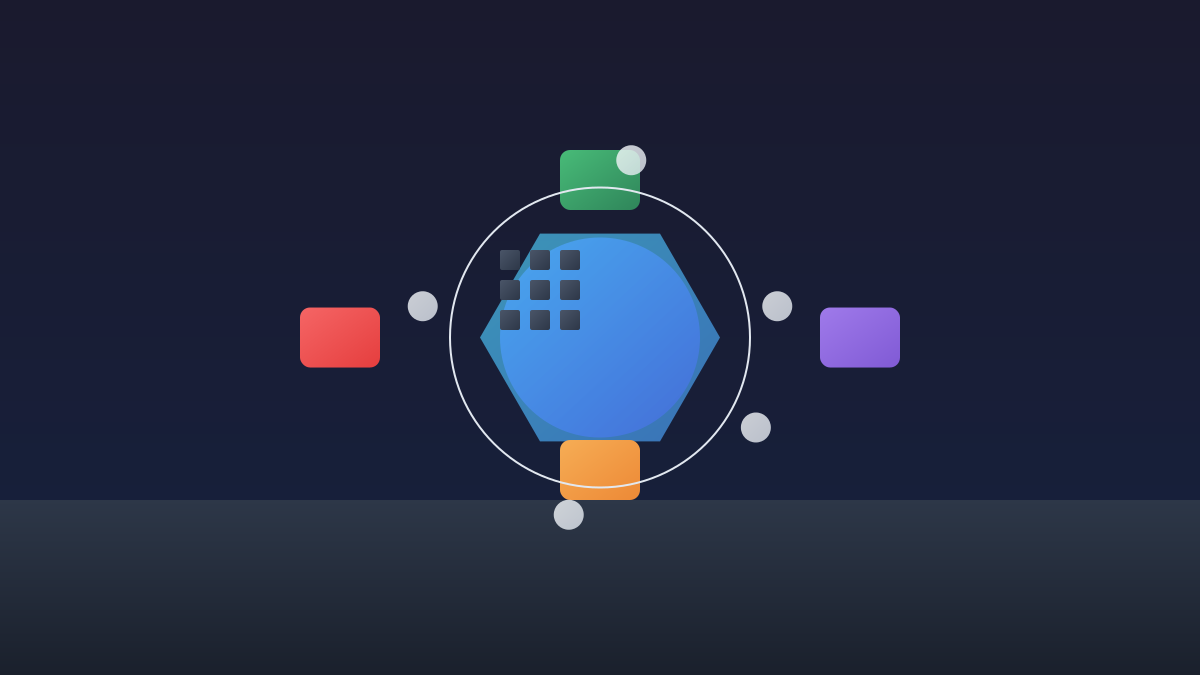
Gobby's core functions include: 1. Session tracking and handover: records complete context and supports seamless switching between tools; 2. MCP proxy: based on Anthropic's open protocol, intelligently discovers tools and avoids context bloat; 3. Task management: structured workflow supporting task definition, dependency configuration, and TDD extension; 4. Agent generation and workspace orchestration: multi-specialized AI agents collaborate, with workspaces isolated yet coordinated and integrated.

4

Section 04

Local-First Design: Privacy Security and Data Sovereignty

Gobby adheres to local-first principles, with all data (session history, memory, task status, etc.) stored locally by default. Its advantages include: privacy security (avoids uploading sensitive data to third parties), offline availability (works without network), and data sovereignty (users fully control data and can export or migrate it).

5

Section 05

Persistent Memory and Extensibility: Personalized Assistance and Custom Workflows

Persistent memory stores information like project tech stacks and coding standards, getting to know the project and developer over time to provide personalized assistance. Extensible workflows and hook mechanisms allow custom operations (e.g., pre-commit code review, automatic fix tasks for test failures). The community can contribute plugin templates, making Gobby an open platform.

6

Section 06

Application Scenarios: Adaptation for Individuals, Teams, and Complex Projects

Gobby applies to multiple scenarios: 1. Individual developers: unified cross-tool experience, choosing the most suitable AI assistant for each task (e.g., Claude Code for architecture, Gemini CLI for code implementation); 2. Team collaboration: share project context, new members integrate quickly, and track task progress; 3. Complex projects: multi-agents process subtasks (frontend, backend, testing) in parallel, with Gobby coordinating and integrating results.

7

Section 07

Technical Implementation and Ecosystem Integration: Open Standards and Community Collaboration

Gobby runs as a daemon, providing continuous background services and interacting via CLI/API. For ecosystem integration, it supports the MCP protocol (compatible with AI models and tools), Git and other version control tools, and hooks to trigger custom scripts. The project is in active development, with the GitHub open-source community continuously contributing feature improvements.

8

Section 08

Summary and Outlook: The Direction of a Unified Platform for AI Programming Tools

Gobby represents the shift from single tools to unified platforms for AI programming tools, providing a coordination layer for developers to integrate tools. Its explored mechanisms like session management, context transfer, and multi-agent collaboration may become standard paradigms for future AI-assisted development, which is worth developers' attention and participation.

