Zing Forum

Reading

GDF: A Community-Driven Distributed Federated Learning Network Enabling Individual GPUs to Participate in Large Model Training

GDF is an open-source community GPU network project that integrates scattered individual GPU resources via peer-to-peer connections to enable distributed AI model training, lowering the hardware barrier for large model training.

分布式训练联邦学习GPU网络社区算力P2PPyTorch开源AI算力民主化模型训练去中心化
Published 2026-04-04 07:43Recent activity 2026-04-04 07:52Estimated read 7 min
GDF: A Community-Driven Distributed Federated Learning Network Enabling Individual GPUs to Participate in Large Model Training
1

Section 01

Introduction: GDF — A Community-Driven Distributed Federated Learning Network

GDF (GPU Distributed Framework) is an open-source community GPU network project. It integrates scattered individual GPU resources through peer-to-peer (P2P) connections to enable distributed AI model training, aiming to lower the hardware barrier for large model training and promote the democratization of computing power. It is compatible with PyTorch training workflows and adopts a decentralized design, allowing ordinary users to participate in the training and inference of large models.


2

Section 02

Computing Power Dilemma in Large Model Training and Limitations of Existing Solutions

Training large language models (LLMs) requires enormous computing power, with costs often reaching millions of dollars and needing thousands of high-end GPUs to run for months, excluding most individual developers and small teams. Inferring a 70B parameter model also requires multiple high-end graphics cards. Traditional distributed training assumes nodes are in the same data center (high-speed and low-latency), but internet nodes face issues of latency, bandwidth, and reliability; pure federated learning, due to the huge model parameters, leads to excessive communication overhead from frequent synchronization, resulting in limited efficiency.

3

Section 03

Core Positioning and Technical Architecture of GDF

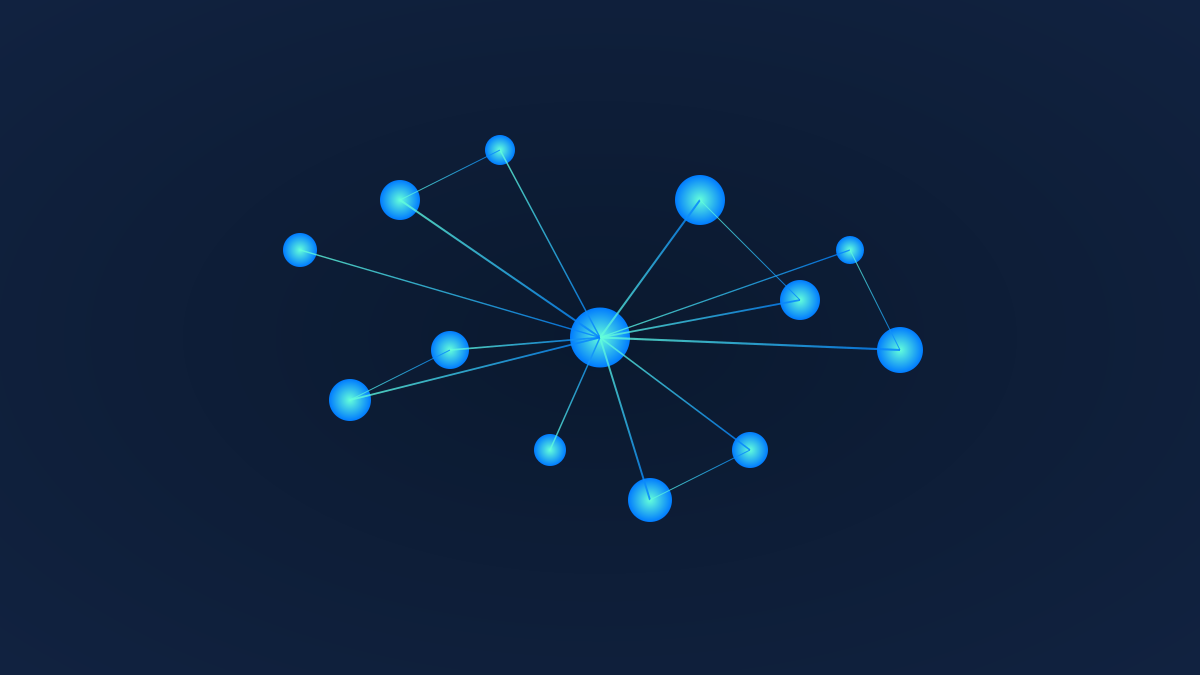
GDF targets four main scenarios: individuals contributing GPUs to gain rewards/recognition, cross-machine training to break single-machine limitations, on-demand use of decentralized resource pools, and compatibility with PyTorch to reduce migration costs. Technical architecture features: P2P architecture (nodes communicate directly without a central server, flexible and scalable), intelligent task splitting (automatically assigns work units), model routing (optimizes communication efficiency), and fault tolerance mechanisms (handles issues like node disconnection).

4

Section 04

User Experience and Deployment Process of GDF

System Requirements: Windows 10/11, internet access, GPU (with drivers), at least 8GB RAM, sufficient disk space. Deployment Process: Download from GitHub → Unzip and run → Select data/cache folder → Create/login node configuration → Allow access through firewall → Verify GPU status → Check training settings. Typical Workflow: Open the application → Connect to the community network → Select a task → Confirm GPU readiness → Start training → Monitor progress. Use Case: A gaming PC installs GDF, connects to the network, collaborates on training open-source models, and only handles part of the tasks.

5

Section 05

Technical Challenges and Limitations of GDF

GDF faces multiple challenges: network latency (internet nodes have latency of tens to hundreds of milliseconds, far higher than the microsecond level in data centers), bandwidth limitations (model parameters are tens of GB, leading to high synchronization consumption), node reliability (personal machines are prone to shutdown/disconnection), security risks (malicious nodes, data poisoning), and incentive mechanisms (fair distribution of contributions and benefits).

6

Section 06

Comparison Between GDF and Existing Solutions

Feature GDF Traditional Distributed Training Pure Federated Learning
Node Location Anywhere on the internet Same data center Anywhere on the internet
Network Requirements Ordinary broadband High-speed and low-latency Ordinary broadband
Applicable Scenarios Community collaborative training Enterprise large-scale training Privacy-sensitive scenarios
Technical Complexity Medium High Medium
Communication Overhead Needs optimization Low High
7

Section 07

Open-Source Model and Community Development of GDF

GDF adopts an open-source model, with its code hosted on GitHub. Open-source advantages: transparency (auditable code), community contributions (developers submit improvements), sustainability (maintainable by the community), and trust building (user trust in the system).

8

Section 08

Significance and Future Outlook of GDF

GDF promotes the democratization of computing power: individual developers can participate in training with consumer-grade graphics cards, research institutions gain supplementary computing power, and the AI community reduces the concentration of computing power. Outlook: With advances in network, compression, and distributed optimization technologies, the feasibility of community GPU networks will improve. In the future, there may be thousands of nodes collaborating to train open-source large models. Those interested can download and try it from GitHub; it is valuable even as a learning project.

