Zing Forum

Reading

Fab Kit: A Specification-Driven Development Workflow for AI Coding Agents

An in-depth analysis of the Fab Kit project—a six-stage development pipeline based on Markdown prompts—exploring how it addresses the bottleneck of "clearly articulating requirements" in AI coding through structured planning, sub-agent reviews, and project memory accumulation.

Fab KitAI 编码规格驱动开发工作流子 Agent 审查项目记忆Markdown 提示六阶段流水线代码质量结构化开发
Published 2026-04-01 02:44Recent activity 2026-04-01 02:54Estimated read 6 min
Fab Kit: A Specification-Driven Development Workflow for AI Coding Agents
1

Section 01

Fab Kit: Introduction to the Specification-Driven Development Workflow for AI Coding Agents

Fab Kit is a structured, specification-driven development workflow framework for AI coding agents, designed to address the bottleneck of ambiguous human requirement definition in AI coding. Its core features include: a six-stage development pipeline (planning, execution, completion), a project memory accumulation mechanism, sub-agent reviews to ensure code quality, confidence-driven fast tracks, and a minimal tech stack of pure Markdown + Shell, helping AI efficiently perform coding tasks under clear constraints.


2

Section 02

Background: New Bottlenecks in AI Coding and Issues with Traditional Processes

With the improved capabilities of large models like Claude and GPT-4, AI coding agents generate code faster, but the bottleneck in the development process has shifted to humans: can they clearly define requirements? Traditional AI coding processes often fall into a cycle of 'ambiguous requirements → AI generation → rework', leading to high communication costs and rework due to lack of clear specifications. Fab Kit solves this problem by reversing the process (planning first, then execution).

3

Section 03

Core Method: Six-Stage Pipeline and Structured Execution

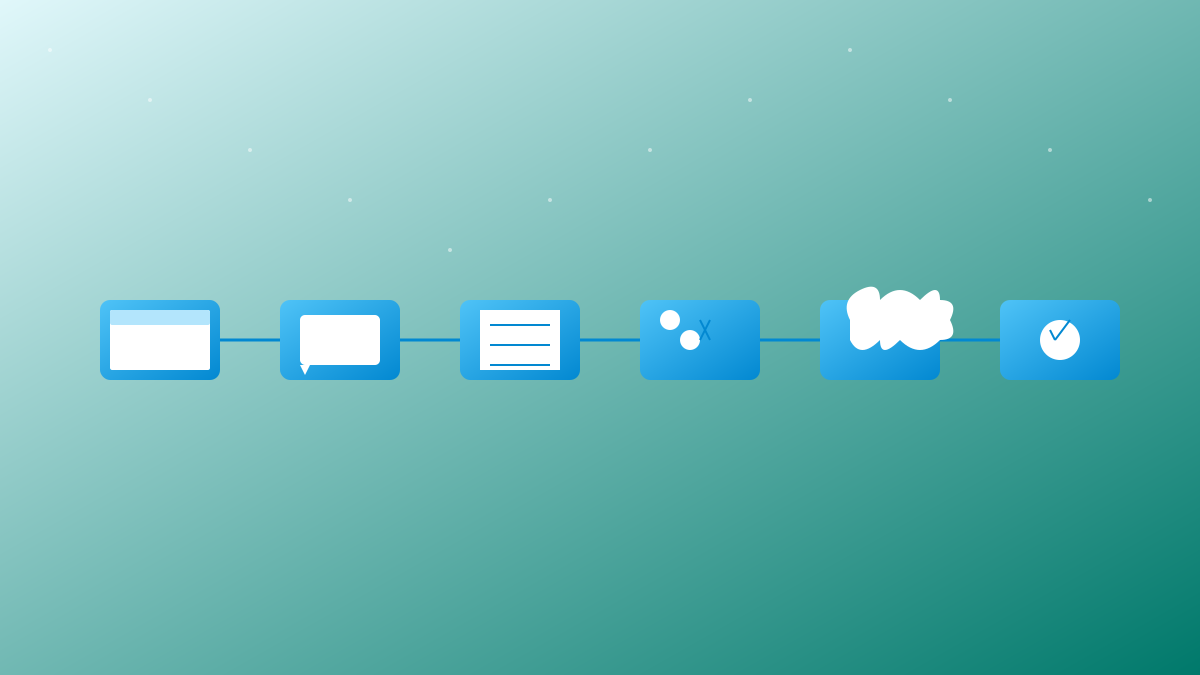
Fab Kit defines a six-stage pipeline, where each change must go through:

  1. Planning phase: INTAKE (capture intent and clarify), SPEC (generate structured requirement specifications), TASKS (break down into task lists);
  2. Execution phase: APPLY (code according to tasks), REVIEW (sub-agent verifies compliance with specifications and architecture rules);
  3. Completion phase: HYDRATE (accumulate experience into project memory). Each phase generates persistent artifacts (e.g., intake.md, spec.md) to support resuming from breakpoints.
4

Section 04

Key Features: Project Memory, Fast Tracks, and Parallel Development

Key features of Fab Kit include:

  • Project Memory: Stores project knowledge (docs/memory) and architecture rules (constitution.md), automatically injects context to avoid repeated errors;
  • Fast Tracks: /fab-ff (skip planning), /fab-fff (full fast track), constrained by confidence scores;
  • Parallel Development: Each change has an independent folder, supports Git worktree isolation, and allows parallel AI sessions;
  • Minimal Tech Stack: Pure Markdown prompts and Shell scripts, no SDK or vendor lock-in.
5

Section 05

Code Quality Assurance and Applicable Scenarios

Code Quality Assurance: Architecture rules and coding standards are defined via constitution.md, and sub-agents strictly verify during the REVIEW phase. Applicable scenarios include: large projects (maintain architectural consistency), team collaboration (traceable changes), critical systems (high code quality requirements), and long-term maintenance (accumulate project knowledge). Rapid prototyping or one-off scripts may not require the full process.

6

Section 06

Conclusion: Value and Future Outlook of Fab Kit

The unique value of Fab Kit compared to existing tools: prioritization of structured thinking, memory accumulation rather than session isolation, independent sub-agent reviews, confidence-driven processes, and pure prompts without SDKs. In the future, it will be optimized as AI capabilities improve (more accurate specification understanding, in-depth reviews, richer memory) to amplify human structured thinking abilities. It represents the evolution of AI coding from 'handicraft workshops' to 'industrial production', providing a sustainable framework for production-grade AI coding.

