Zing Forum

Reading

ESP32-LLM-Converter: Browser-Based Model Conversion for Edge AI Deployment

ESP32-LLM-Converter is a browser-based model conversion tool that converts HuggingFace safetensors models into INT8 binary format compatible with ESP32-S3, enabling local inference of large language models (LLMs) on microcontrollers.

边缘AIESP32模型量化浏览器工具微控制器INT8量化模型部署
Published 2026-03-28 23:13Recent activity 2026-03-29 01:06Estimated read 7 min
ESP32-LLM-Converter: Browser-Based Model Conversion for Edge AI Deployment
1

Section 01

【Introduction】ESP32-LLM-Converter: Browser-Based Model Conversion for Edge AI Deployment

ESP32-LLM-Converter is a browser-based model conversion tool whose core function is to convert HuggingFace safetensors format models into INT8 binary format compatible with ESP32-S3, enabling local inference of large language models (LLMs) on microcontrollers. This tool requires no software installation or development environment configuration; all conversions are done locally, balancing ease of use and data privacy, and providing a convenient path for edge AI deployment.


2

Section 02

Challenges of Edge AI and AI Potential of ESP32-S3

Edge AI has become a trend due to its advantages of low latency, offline availability, and data privacy, but deploying large language models to resource-constrained microcontrollers faces challenges such as model size and computing power. As a high-performance microcontroller from Espressif Systems, ESP32-S3 integrates Wi-Fi, Bluetooth, and AI acceleration capabilities with vector instruction sets, providing a hardware foundation for microcontrollers to run simplified LLMs. However, converting mainstream models into ESP32-compatible formats requires complex processes.

3

Section 03

Introduction to ESP32-LLM-Converter Project and Advantages of Browser Architecture

ESP32-LLM-Converter aims to simplify the deployment process of LLMs to ESP32-S3 and runs entirely in the browser. Its browser architecture has significant advantages: no need to install dependencies like Python or PyTorch, lowering the barrier to use; model conversion is done locally, protecting intellectual property and data privacy; WebAssembly technology provides near-native execution efficiency, supporting complex quantization computations.

4

Section 04

Detailed Technical Implementation: From Model Parsing to Binary Generation

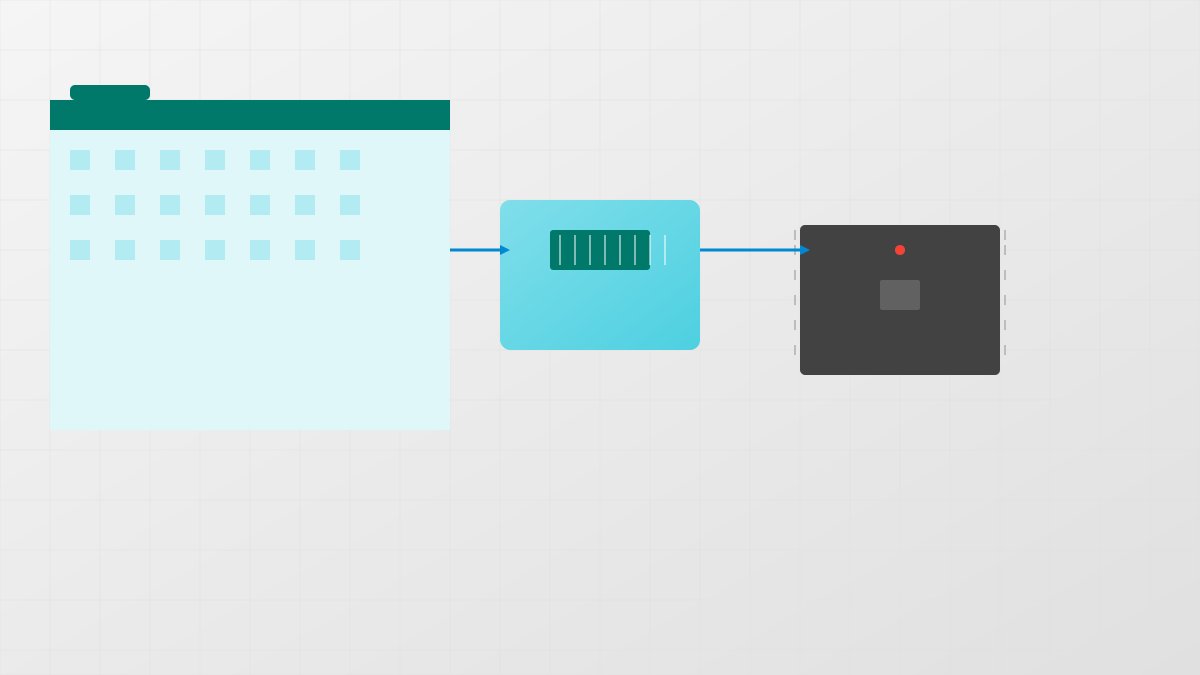
The technical implementation includes four main steps:

  1. Safetensors Parsing and Loading: A pure JavaScript parser processes HuggingFace's safetensors format, parsing weights, configuration, and tokenizer data;
  2. INT8 Quantization Strategy: Uses symmetric INT8 quantization to compress models, providing schemes such as layer-wise, channel-wise, and dynamic range quantization;
  3. Operator Fusion and Graph Optimization: Fuses LayerNorm, activation functions, and linear transformations, and optimizes attention computation patterns to adapt to ESP32's memory architecture;
  4. ESP32 Binary Generation: Packages quantized weights, configuration, and inference code into a firmware image that can be directly flashed to the device.
5

Section 05

Use Cases and Practical Examples

Typical use cases of the tool include:

  • Smart Home Voice Assistants: Deploy local models on low-cost devices to handle simple command recognition and basic conversations;
  • Offline Translation Devices: Support basic phrase translation in network-free environments, suitable for outdoor adventures and international travel;
  • Educational Programming Kits: Students can complete conversions in the browser and run AI applications on ESP32 development boards to understand the full edge AI workflow.
6

Section 06

Technical Limitations and Trade-off Considerations

Technical limitations and trade-offs:

  • Model Size Constraints: Only supports small models with fewer than hundreds of millions of parameters (e.g., TinyLlama, trimmed versions of Phi-2), requiring a balance between model capability and hardware limitations;
  • Accuracy Loss: INT8 quantization leads to accuracy degradation; the tool provides a before-and-after quantization comparison function to help evaluate quality;
  • Function Trimming: Needs to limit context length, simplify attention mechanisms, etc., which affects the model's full functionality but adapts to specific scenarios.
7

Section 07

Ecosystem Significance and Future Development Directions

Ecosystem significance: Promotes AI democratization, lowers the threshold for edge AI deployment, and allows more developers and small teams to participate in AI application creation. Future development directions include: supporting more quantization strategies like INT4, more efficient operator implementations, integrating mainstream edge AI frameworks such as TensorFlow Lite Micro, and exploring support for other microcontroller platforms.

8

Section 08

Conclusion: New Possibilities for Edge AI Deployment

ESP32-LLM-Converter makes the deployment of LLMs on microcontrollers accessible by simplifying complex conversion processes. Although limited by hardware capabilities in terms of the size of runnable models, it opens up new possibilities for the intelligence of IoT devices. With the advancement of edge AI technology, we look forward to the popularization of local AI capabilities in more daily devices.

