Zing Forum

Reading

Engineering Agent Behavior Lab: A Comparative Experiment Platform for Multi-Model Engineering Intelligent Agents

A multi-model engineering intelligent agent experiment platform built on AWS Strands, supporting the comparison of workflow performance between OpenAI, Claude, and Ollama across different engineering tasks.

工程智能体多模型对比AWS StrandsOpenAIClaudeOllamaLLM评估代码生成智能体工作流模型选型
Published 2026-04-03 04:17Recent activity 2026-04-03 04:24Estimated read 6 min
Engineering Agent Behavior Lab: A Comparative Experiment Platform for Multi-Model Engineering Intelligent Agents
1

Section 01

[Introduction] Engineering Agent Behavior Lab: A Comparative Experiment Platform for Multi-Model Engineering Intelligent Agents

The Engineering Agent Behavior Lab is a multi-model engineering intelligent agent experiment platform built on AWS Strands. It aims to address the pain point of the lack of systematic multi-model comparison in existing LLM evaluations, supporting the comparison of workflow performance of mainstream models such as OpenAI, Claude, and Ollama in engineering tasks, and helping to understand the capability boundaries and behavioral differences of different models.


2

Section 02

Background: Pain Points of Existing LLM Evaluations and Reasons for the Platform's Birth

With the widespread application of LLMs in the field of software engineering, developers face the problem of performance differences between different models in engineering tasks. Existing evaluation methods mostly focus on single models or tasks, lacking systematic multi-model comparative analysis. This platform was created to address this pain point, providing an experimental environment to understand the "personality" and capability boundaries of models.

3

Section 03

Methodology: Technical Foundation and Architecture Design of the Platform

Technical Foundation: AWS Strands

AWS Strands is Amazon's AI agent framework, with core features including modularity, observability, workflow orchestration, tool integration, state management, etc.

Platform Architecture

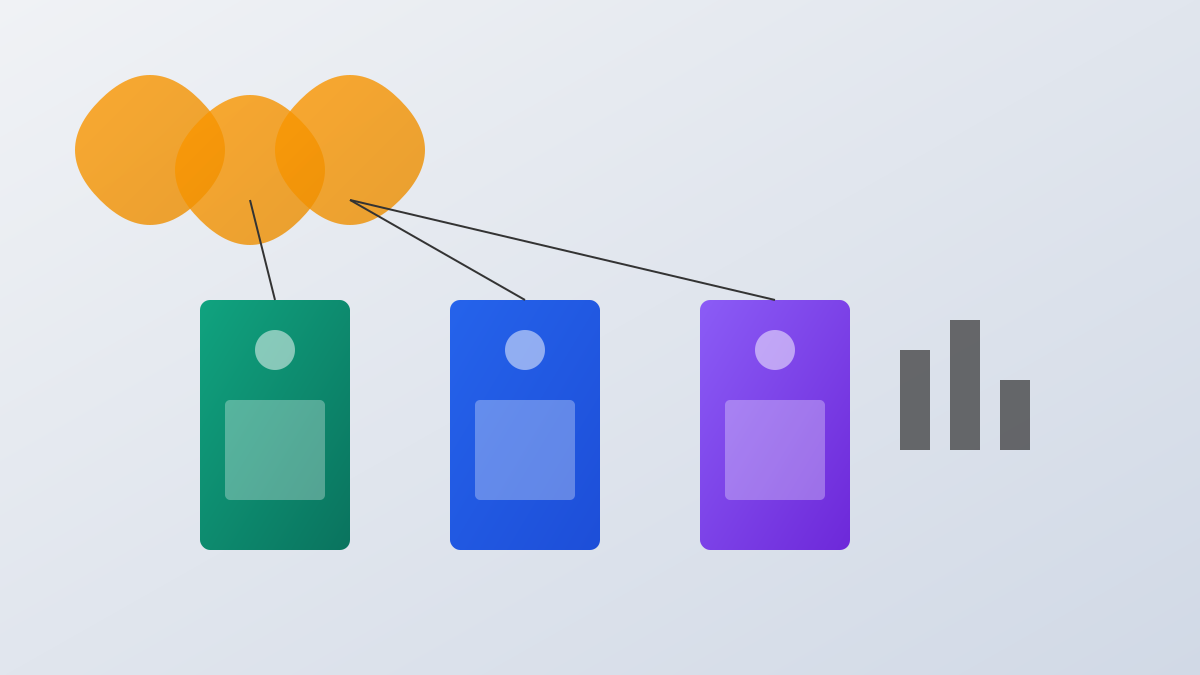
  • Multi-model Abstraction Layer: Decouples upper-layer workflows from specific models, supporting seamless switching, unified interfaces, and easy expansion.
  • Experimental Task Design: Covers the software development lifecycle, including tasks such as code generation (function implementation, test cases, completion), code understanding (summarization, dependency analysis, bug localization), and engineering decision-making (architecture design, technology selection, refactoring suggestions).
4

Section 04

Evidence: Model Comparison Dimensions and Experimental Result Insights

Model Comparison Dimensions

  • Capability Performance: Accuracy (syntax/function/semantic correctness), efficiency (time/Token/cost), robustness (input perturbation/boundary cases/multi-round consistency).
  • Behavioral Characteristics: Reasoning style (GPT concise, Claude detailed, Ollama cautious), tool usage patterns, error handling strategies.

Experimental Results

  • Performance-Cost Trade-off: Local models (Ollama) approach the performance of large models in some tasks but with extremely low cost; large models are better for complex tasks.
  • Impact of Context Window: Performance declines after ultra-long contexts; Claude has better stability.
  • Multi-modal Value: GPT-4V and Claude3 have significant advantages in tasks involving visual information.
5

Section 05

Conclusion: Core Principles of Model Selection and Platform Value

This platform provides a systematic LLM evaluation framework to help developers objectively understand the advantages and disadvantages of models. Core principle: There is no universally best model, only the model most suitable for a specific scenario. This is the key to effectively utilizing LLM technology.

6

Section 06

Recommendations: Application Scenarios and Usage Guidelines of the Platform

Model Selection Decision Support

  • Run tasks similar to business scenarios to compare the accuracy, latency, and cost of candidate models.

Prompt Engineering Optimization

  • Test the performance of the same prompt across different models to optimize prompt strategies.

Education and Research

  • Demonstrate model capability boundaries and explore multi-model integration strategies.
7

Section 07

Limitations and Future Development Directions

Current Limitations

  • Task Coverage: Focuses on general engineering tasks, with insufficient coverage of specific fields (embedded systems, hardware).
  • Subjective Factors: Some evaluations (code style) require manual judgment.
  • Dynamic Environment: Cannot fully simulate the dynamic scenarios of real engineering.

Future Directions

  • Multi-agent collaboration evaluation.
  • Comparison of model continuous learning capabilities.
  • Evaluation of model output security.

