Zing Forum

Reading

Drug Routing: Discovering Drug-Disease Reasoning Paths via Neural-Guided A* Search

By combining neural networks with the A* search algorithm, this work discovers interpretable reasoning paths between drugs and diseases in biomedical knowledge graphs, providing new insights for drug repurposing.

药物重定位知识图谱A*搜索神经网络可解释AI计算生物学
Published 2026-04-27 12:09Recent activity 2026-04-27 12:21Estimated read 6 min
Drug Routing: Discovering Drug-Disease Reasoning Paths via Neural-Guided A* Search
1

Section 01

Introduction to the Drug Routing Project: Neural-Guided A* Search Facilitates Drug-Disease Reasoning Path Discovery

The Drug Routing project aims to address the core challenge in drug repurposing: systematically identifying drug-disease associations and understanding their biological mechanisms. By combining the learning capabilities of neural networks with the precision of the A* search algorithm, it discovers interpretable reasoning paths between drugs and diseases in biomedical knowledge graphs, offering new ideas for drug repurposing.


2

Section 02

Dilemmas in Drug Discovery and Opportunities in Drug Repurposing

Developing a new drug usually takes more than a decade and billions of dollars in investment. As a cost-effective alternative strategy, drug repurposing can apply approved drugs to new indications. However, how to systematically identify potential drug-disease associations and understand the underlying mechanisms remains a core challenge in computational biology.

3

Section 03

Detailed Explanation of Drug Routing's Technical Methods

Biomedical Knowledge Graph as the Search Space

The knowledge graph organizes biomedical information into a structured network of entities (drugs, proteins, diseases, etc.) and relationships (targeting, regulation, etc.), which serves as the foundation for path search.

Heuristic Search Guided by Neural Models

Neural networks are used to learn the heuristic function for A* search. Trained on large-scale biomedical data, they capture complex semantic relationships and intelligently guide the search process.

Interpretability Design Goal

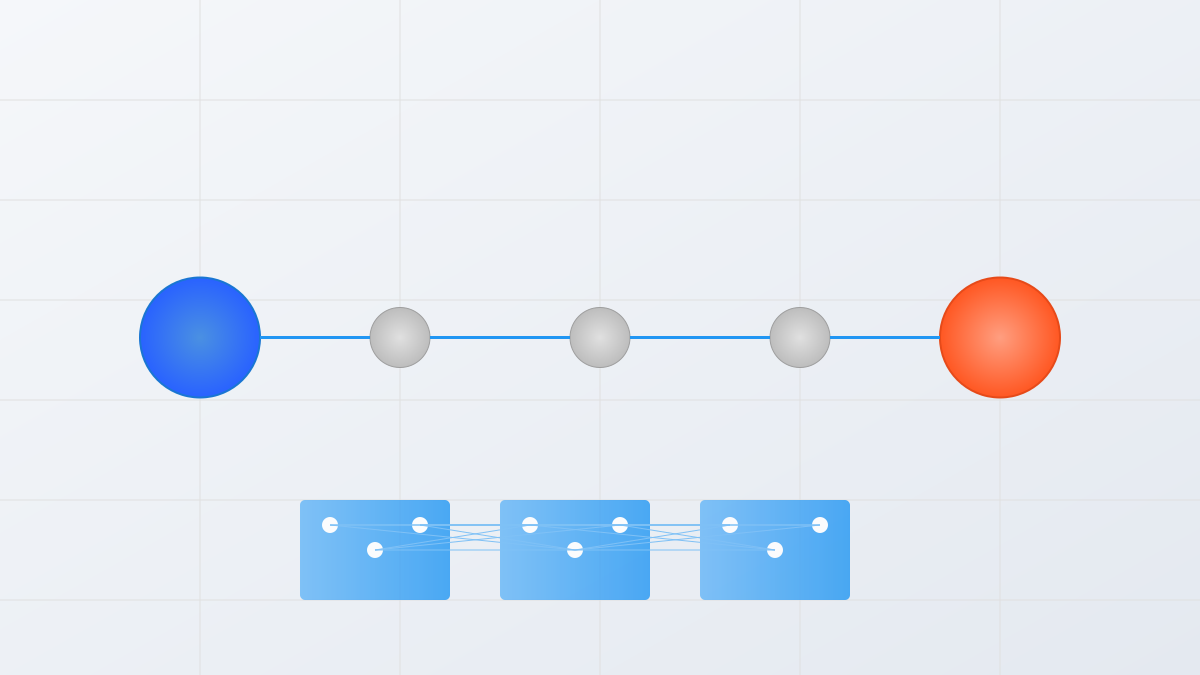
It outputs confidence scores for drug-disease pairs and specific reasoning paths (e.g., "Drug A → Inhibits Protein B → Downregulates Pathway C → Alleviates Symptoms of Disease D") to ensure transparency.

4

Section 04

Application Scenarios and Value of Drug Routing

Discovery of Drug Repurposing Candidates

It helps quickly screen drugs with repurposing potential and identify non-intuitive associations (e.g., the potential link between antihypertensive drugs and Alzheimer's disease).

Optimization of Combination Therapy Strategies

It identifies paths of drug synergy, designs effective combination schemes, and avoids antagonistic effects.

Research on Side Effect Mechanisms

It analyzes reasoning paths from drugs to adverse reactions, understands the molecular mechanisms of side effects, and guides drug structure optimization.

5

Section 05

Technical Advantages and Innovations of Drug Routing

Practical Application of Neuro-Symbolic Artificial Intelligence

It combines the pattern recognition ability of neural networks with the interpretability and precision of symbolic reasoning, making it suitable for rigorous biomedical problems.

Computational Efficiency Optimization

Through neural-guided A* search, it significantly reduces the search space and finds high-quality reasoning paths within a reasonable time.

6

Section 06

Project Limitations and Future Development Directions

Limitations

It relies on the coverage and quality of the knowledge graph; unincluded entities or relationships will limit its reasoning ability.

Future Directions

Integrate more data sources (literature mining, clinical trial data), support temporal reasoning (dynamic process of disease progression), and form a closed loop with experimental validation.

7

Section 07

Conclusion: The Value of Interpretable AI in Drug R&D

Drug Routing provides a promising technical path for computational drug discovery. It emphasizes that in biomedical applications, artificial intelligence should not only pursue prediction accuracy but also focus on interpretability and scientific insight. It is worthy of in-depth exploration by researchers in drug R&D, bioinformatics, and medical artificial intelligence fields.

