Zing Forum

Reading

DontKillMyVibe: A Multi-Agent Orchestration DAG Workflow Framework

This project provides a multi-agent orchestration framework that supports DAG (Directed Acyclic Graph) workflows, PIV (Plan-Implement-Verify) cycles, PRD (Product Requirements Document) implementation, and other features. It adopts a BYOAgent (Bring Your Own Agent) architecture, allowing developers to integrate different AI models and tools.

多智能体工作流编排DAGPIV循环BYOAgent智能体协作PRD实现自动化开发
Published 2026-05-21 15:14Recent activity 2026-05-21 15:26Estimated read 8 min
DontKillMyVibe: A Multi-Agent Orchestration DAG Workflow Framework
1

Section 01

DontKillMyVibe Framework Guide: A Structured Solution for Multi-Agent Orchestration

DontKillMyVibe is a framework for multi-agent collaboration orchestration, designed to solve the coordination problem of multiple agents in complex workflows. Its core features include support for DAG (Directed Acyclic Graph) workflows, PIV (Plan-Implement-Verify) cycles, automated PRD (Product Requirements Document) implementation, and a BYOAgent (Bring Your Own Agent) architecture, which allows developers to integrate any AI models and tools, providing a structured solution for multi-agent collaboration scenarios.


2

Section 02

Background: Orchestration Challenges of Multi-Agent Systems

With the development of AI agent technology, developers face the challenge of multi-agent collaboration orchestration: a single agent can complete specific tasks, but complex workflows (such as requirement analysis → code generation → test verification → review) require multiple agents to execute in sequence and according to dependencies. The DontKillMyVibe project is designed to address this problem.

3

Section 03

Core Methods and Architecture Analysis

BYOAgent Architecture

The framework adopts a BYOAgent (Bring Your Own Agent) design, allowing developers to integrate any AI models/tools (such as OpenAI GPT-4, Claude, local models, etc.), while the framework handles coordination and collaboration.

DAG Workflow

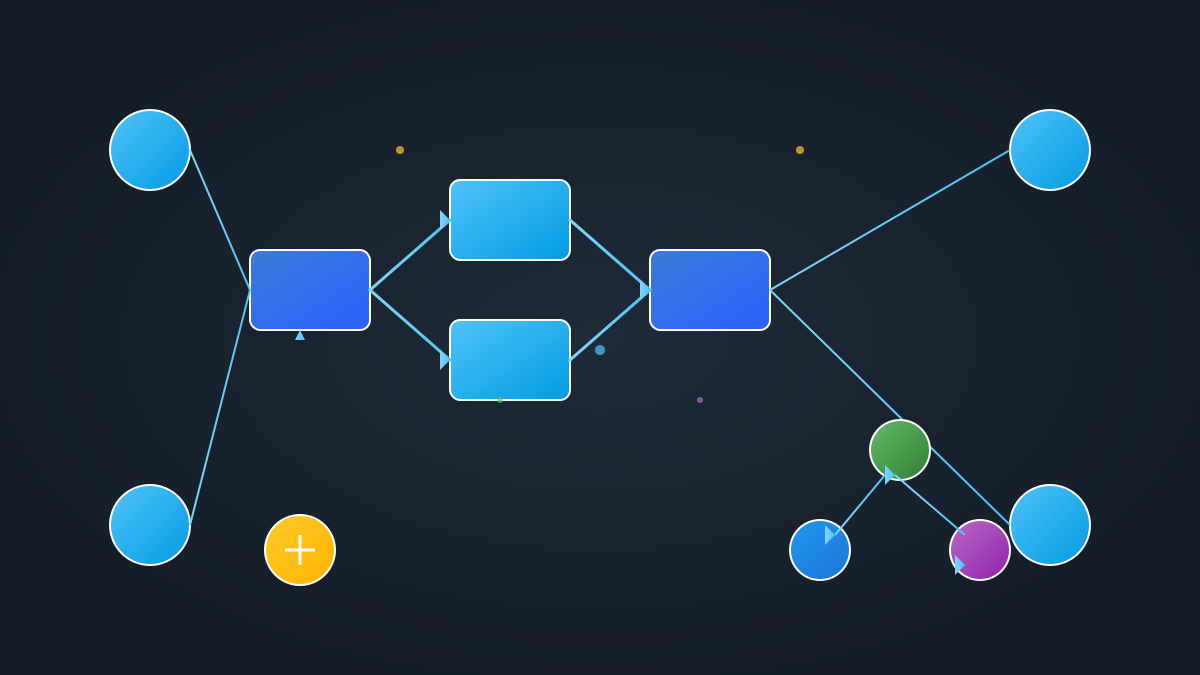
Task sequences and dependencies are defined via directed acyclic graphs to ensure topological execution, supporting parallel tasks and fault isolation (e.g., the dependency chain of requirement analysis → architecture design → code generation, while document generation and technology selection can be done in parallel).

PIV Cycle

An iterative Plan-Implement-Verify model: agents make a plan → execute actions → verify results; if not satisfied, adjust the plan and retry. This is suitable for scenarios like code generation and document writing.

PRD Implementation Process

Automated process from PRD to code: parse PRD to extract requirements → decompose into technical tasks → schedule execution via DAG → verify against acceptance criteria.

4

Section 04

Application Scenario Examples

  1. Automated Software Development: Parse PRD to generate a task DAG, then execute architecture design, front-end and back-end code generation, testing, and review in sequence, finally creating a PR automatically.
  2. Content Creation Pipeline: Use the PIV cycle to create blogs: research agents develop an outline → writing agents generate a draft → editing agents verify quality, with iterative optimization.
  3. Data Pipeline Orchestration: Manage ETL processes (data extraction → cleaning → transformation → loading) via DAG, with each stage handled by dedicated agents to ensure data quality.
5

Section 05

Technical Implementation and Framework Comparison

Technical Key Points

  • State Management: Manages agent execution status, dependencies, intermediate results, and error retries.
  • Error Handling: Supports rollback for single agent failures, compensation for partial failures, timeout retries, and manual intervention triggers.
  • Observability: Provides execution logs, DAG visualization, performance metrics, and cost tracking.

Framework Comparison

Feature LangChain AutoGPT DontKillMyVibe
Orchestration Granularity Chain Call Autonomous Decision DAG Workflow
Human Control High Low Medium
Interpretability Good Poor Good
Flexibility Medium High High
Applicable Scenarios Simple Processes Open Tasks Structured Workflows
6

Section 06

Limitations and Best Practice Recommendations

Current Limitations

  1. Agent Coordination Overhead: Communication and state synchronization between multiple agents add extra costs.
  2. Error Propagation: Errors from upstream agents may affect downstream tasks.
  3. Cost Control: Multiple API calls lead to higher costs.
  4. Debugging Complexity: Distributed execution increases the difficulty of problem localization.

Best Practices

  1. Divide tasks reasonably to avoid overly fine granularity.
  2. Set checkpoints at key nodes to support resuming from breakpoints.
  3. Monitor API costs in real time and set a budget cap.
  4. Introduce manual review at key decision points.
7

Section 07

Summary and Outlook

The DontKillMyVibe framework provides a structured solution for complex multi-agent collaboration scenarios (such as automated development, content creation, and data processing) through DAG workflows, PIV cycles, and the BYOAgent architecture. As AI agent technology matures, such orchestration frameworks will become important infrastructure for building complex AI applications.

