Zing Forum

Reading

CrewAI Multi-Agent System: Exploring Cutting-Edge Practices in AI Collaborative Automation

The multi-agent system built on the CrewAI framework demonstrates how AI agents can complete complex tasks through role division and collaboration, providing a new technical paradigm for automation research, content generation, and process management.

CrewAI多智能体系统AI协作自动化工作流管理大语言模型智能体任务编排
Published 2026-05-14 02:15Recent activity 2026-05-14 02:23Estimated read 6 min
CrewAI Multi-Agent System: Exploring Cutting-Edge Practices in AI Collaborative Automation
1

Section 01

CrewAI Multi-Agent System: Guide to Cutting-Edge Practices in AI Collaborative Automation

Core Overview

The multi-agent system based on the CrewAI framework breaks through the limitations of single-agent capabilities through role division and collaboration, providing a new paradigm for fields such as automation research, content generation, and process management. This article will analyze its background, framework design, collaboration mechanisms, application scenarios, and future directions.


2

Section 02

From Single Agent to Multi-Agent: A New Era of AI Collaboration

Background: Evolution of AI Collaboration

In the early stages, large language models served as independent assistants and struggled to handle complex tasks. Multi-Agent Systems (MAS) emerged as a solution, decomposing complex tasks into subtasks that are collaboratively completed by specialized agents. Each agent has a role, expertise, and tools, with interactive collaboration being its core capability.

3

Section 03

Analysis of Core Concepts of the CrewAI Framework

Introduction to the CrewAI Framework

CrewAI is an open-source multi-agent framework that emphasizes role-driven design. Core concepts include:

  • Agent: An AI entity with a specific role and goal
  • Task: A unit of work that an agent needs to complete
  • Crew: A collection of agents that jointly complete a set of tasks
  • Process: The order of task execution and collaboration methods
4

Section 04

CrewAI System Architecture and Role Division

System Architecture and Role Design

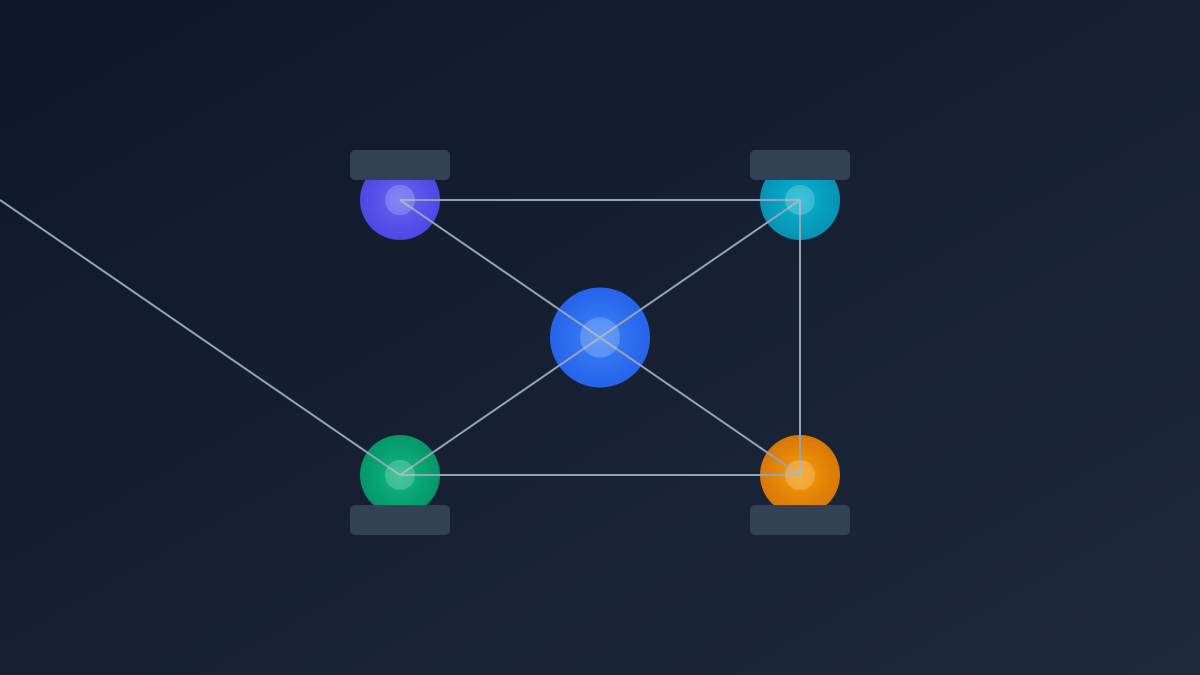
The system includes multiple specialized agents:

  • Research Agent: Collects and analyzes information, equipped with web search tools
  • Planning Agent: Formulates execution plans, decomposes tasks, and determines priorities
  • Content Generation Agent: Generates high-quality text based on plans
  • Automation Agent: Handles repetitive tasks (data entry, format conversion, etc.)
  • Workflow Management Agent: Monitors system operation, coordinates handovers, and handles exceptions
5

Section 05

Detailed Explanation of CrewAI Multi-Agent Collaboration Modes

Collaboration Mechanisms and Communication Modes

CrewAI supports multiple collaboration modes:

  • Sequential Collaboration: Agents process tasks in a predefined pipeline order
  • Parallel Collaboration: Multiple agents handle independent subtasks simultaneously
  • Hierarchical Collaboration: Simulates human organizations, where managers assign tasks and executors complete them
  • Negotiation Collaboration: Agents communicate and negotiate dynamically to adapt to uncertain environments
6

Section 06

Tool Expansion Capabilities of CrewAI Agents

Tool Integration and Capability Expansion

Agents can integrate various tools:

  • Search Tools: Access internet information and evaluate result reliability
  • Calculation Tools: Perform mathematical operations and data analysis
  • Code Execution Tools: Write and run programs, handle data, and automate tasks
  • API Integration Tools: Connect to online services (weather, translation, image generation, etc.)
7

Section 07

Practical Application Scenarios of the CrewAI Multi-Agent System

Application Scenarios and Practical Value

The multi-agent architecture is applied in multiple fields:

  • Content Marketing: End-to-end automation of research → planning → generation → publishing
  • Software Development: Collaboration in requirement analysis → architecture design → code generation → testing
  • Customer Service: Intent recognition → routing → solution provision → feedback collection
  • Research Assistance: Literature retrieval → summarization → analysis → report writing
8

Section 08

Advantages, Challenges, and Future Outlook of the CrewAI System

Advantages, Challenges, and Future Directions

Advantages: Specialized capabilities, parallel efficiency, modular expansion, strong fault tolerance Challenges: Coordination overhead, consistency issues, complex debugging, resource consumption Future: Adaptive collaboration, fine-grained tool usage, human-machine hybrid teams, cross-modal processing The CrewAI ecosystem continues to develop, providing a technical foundation for multi-agent applications.

