Zing Forum

Reading

Claude-NIM-Bridge: Bringing NVIDIA GLM-5 Deep Thinking Capabilities to Claude Code CLI

This agent proxy bridging project enables developers to use NVIDIA's GLM-5 deep thinking model and high-performance inference in Claude Code CLI, optimized specifically for the 2026 Slime RL workflow and supporting interleaved inference tokens.

Claude CodeNVIDIA NIMGLM-5智能体代理深度思考AI桥接CLI工具模型推理
Published 2026-04-02 07:15Recent activity 2026-04-02 07:24Estimated read 6 min
Claude-NIM-Bridge: Bringing NVIDIA GLM-5 Deep Thinking Capabilities to Claude Code CLI
1

Section 01

Introduction: Core Overview of the Claude-NIM-Bridge Project

Claude-NIM-Bridge is an agent proxy bridging project whose core goal is to bring NVIDIA's GLM-5 deep thinking model and its high-performance inference capabilities into Claude Code CLI. This project supports interleaved inference tokens and is optimized for the 2026 Slime RL workflow, allowing developers to enjoy the advantages of Claude's coding assistant and NVIDIA's high-performance inference in a familiar CLI environment without switching tools.


2

Section 02

Background of AI Development Toolchain Integration

The AI development tool domain saw an integration trend from 2025 to 2026: advantageous products from different vendors are integrated via bridging solutions. Developers no longer need to choose between Claude's intelligent coding assistant and NVIDIA's high-performance inference. Claude-NIM-Bridge is a representative of this trend, connecting two originally independent ecosystems through a proxy architecture and complementing their respective strengths (Claude's interactive experience and code management, NVIDIA's inference performance).

3

Section 03

Technical Implementation Details of the Proxy Architecture

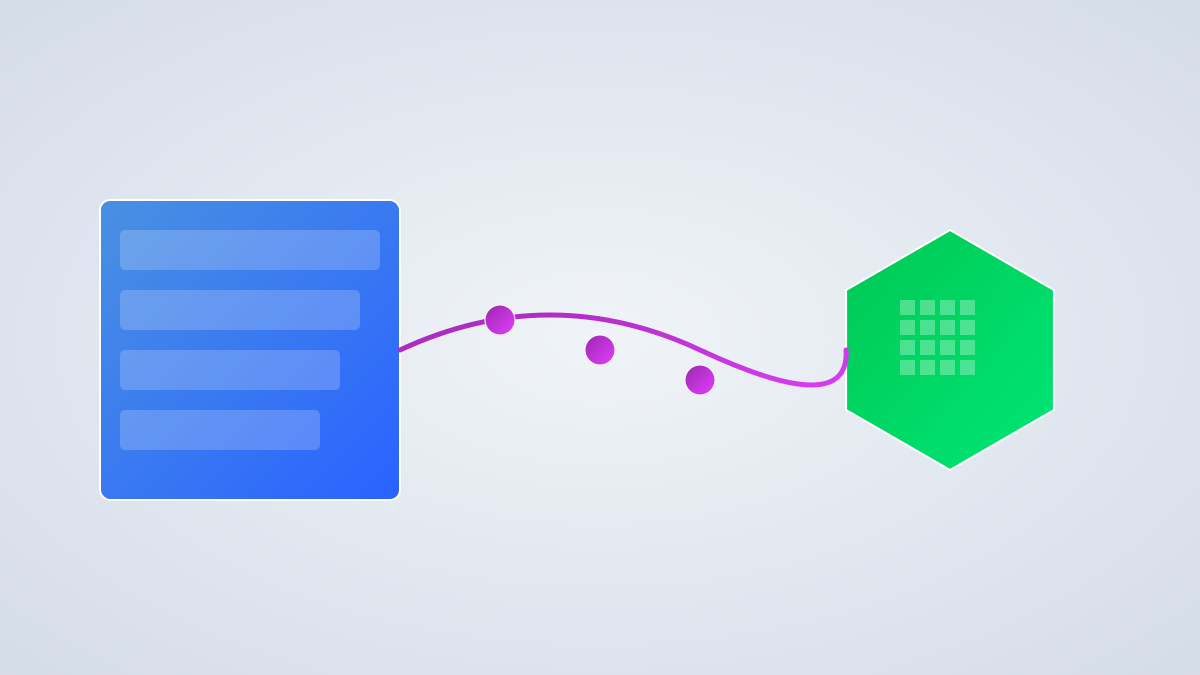
As an agent proxy, the core of Claude-NIM-Bridge lies in protocol conversion and request routing: converting Claude Code CLI requests into NVIDIA NIM API format and forwarding them, then converting responses back to the format required by the CLI. The implementation faces four major challenges: 1. Authentication and authorization management (proper handling of Anthropic and NVIDIA credentials); 2. Streaming response support (ensuring SSE transmission is not disrupted); 3. Context management (passing CLI conversation history and file references); 4. Error handling and degradation strategies (fallback mechanism when NIM is unavailable).

4

Section 04

GLM-5 Deep Thinking Capabilities and Scenario Optimization

The project highlights GLM-5's deep thinking capabilities: supporting multi-step reasoning, self-correction, and in-depth analysis, suitable for complex programming tasks (such as architecture design, algorithm implementation, bug troubleshooting). It also fully supports interleaved inference tokens to help debug model behavior and optimize prompts. Additionally, the project is optimized for the 2026 Slime RL workflow, adapting to the reinforcement learning feedback loop (generate-execute-feedback-adjust) to ensure efficient interaction and rapid convergence.

5

Section 05

Value of the Project to Developers and the Ecosystem

Value to developers: 1. Flexibility in model selection (switch between Claude native or NVIDIA-hosted models based on tasks); 2. Cost optimization (choose models with appropriate pricing for tasks); 3. Performance improvement (NVIDIA infrastructure reduces latency); 4. Function expansion (GLM-5's deep thinking capabilities enhance complex task handling). Significance to the ecosystem: Promotes open interoperability, allowing users to freely combine tools and vendors to expand product coverage; however, it faces challenges (vendor restrictions on interoperability, API changes disrupting stability, model behavior differences affecting experience).

6

Section 06

Development Status and Future Outlook

The current project is in WIP (Work in Progress) status. Early adopters can participate in shaping the direction but may encounter instability issues. Future outlook: 1. Multi-model routing (integrate more vendor models); 2. Intelligent model selection (automatically match tasks with models); 3. Local deployment support (abstract deployment differences to meet enterprise data security needs). Conclusion: This project breaks down AI tool barriers, creates more possibilities for developers, and is a typical case of proxy architecture in AI integration, worthy of attention.

