Zing Forum

Reading

CatalyticMLLM: A Unified Multimodal Large Model Enabling Closed-Loop Optimization for Catalytic Material Property Prediction and Inverse Design

This article introduces QE-Catalytic-V2, a unified graph-text multimodal large language model that integrates catalytic material property prediction and inverse design through a shared representation space, enabling closed-loop optimization and outperforming decoupled baselines.

多模态大语言模型催化材料属性预测逆向设计闭环优化AI4Science材料发现
Published 2026-05-17 12:31Recent activity 2026-05-19 10:19Estimated read 5 min
CatalyticMLLM: A Unified Multimodal Large Model Enabling Closed-Loop Optimization for Catalytic Material Property Prediction and Inverse Design
1

Section 01

[Main Floor/Introduction] QE-Catalytic-V2: A Unified Multimodal Large Model Enabling Closed-Loop Optimization for Catalytic Materials

This article introduces QE-Catalytic-V2, a unified graph-text multimodal large language model that integrates catalytic material property prediction and inverse design through a shared representation space. It addresses issues such as inconsistent representations and distribution shifts in traditional decoupled paradigms, enables closed-loop optimization, and outperforms decoupled baselines, providing a tool for the intelligent transformation of materials science.


2

Section 02

Background and Challenges: Limitations of Traditional Decoupled Paradigms

In catalytic material research, property prediction and inverse design have traditionally been separated. While this facilitates the 'generation-evaluation-screening' process, inconsistencies in representation spaces and training objectives lead to data distribution shifts and evaluator biases, limiting the stability of closed-loop optimization. Core issues include: inconsistent representations, distribution shifts, evaluation biases, and unstable optimization.

3

Section 03

QE-Catalytic-V2 Solution: Unified Architecture and Bidirectional Capabilities

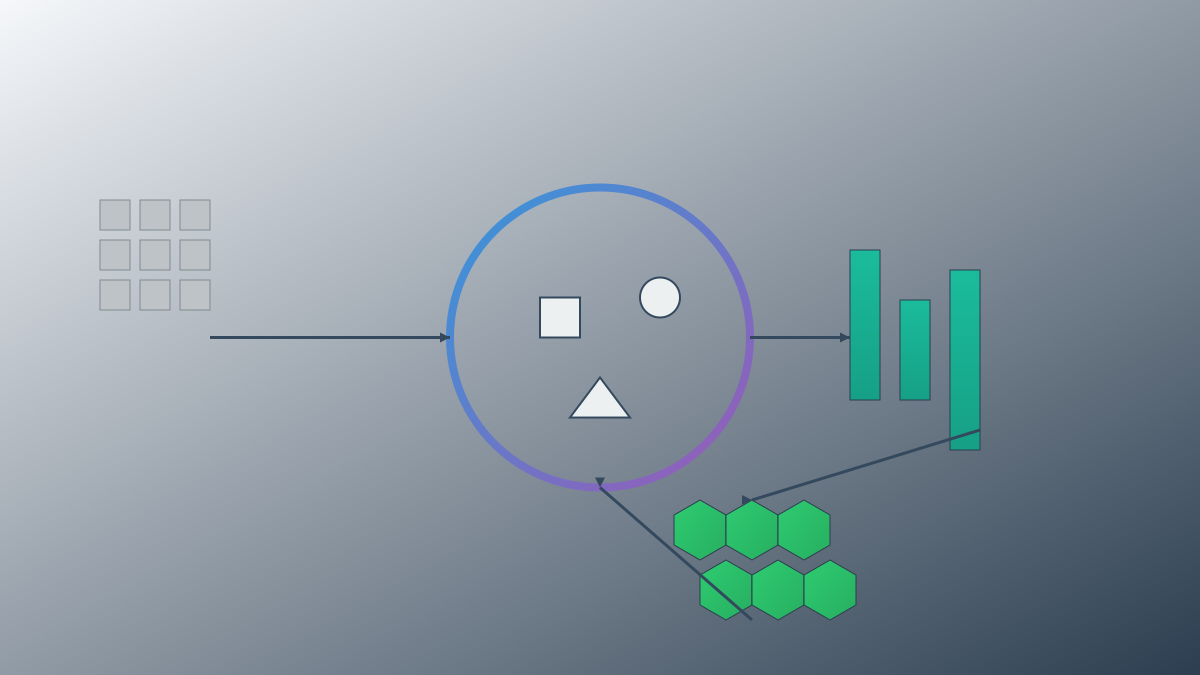
QE-Catalytic-V2 adopts a graph-text multimodal architecture, processing 3D structures (CIF format) and textual information with a shared representation space. It has bidirectional capabilities: forward prediction (structure → performance) and inverse generation (performance → structure). It implements a closed-loop optimization process: inverse design → property prediction → intelligent screening → iterative optimization. Technical highlights: guarantees of physical feasibility (chemical rationality, crystallographic constraints, energy stability) and end-to-end training (simultaneously optimizing prediction and generation).

4

Section 04

Experimental Results: Unified Paradigm Outperforms Decoupled Baselines

Experiments show: In terms of prediction performance, the unified paradigm significantly reduces prediction errors for catalytic relaxation energy; in terms of design quality, generated structures meet performance requirements with better diversity and rationality; in terms of closed-loop stability, the accumulation of errors in iterative optimization is reduced, outperforming decoupled methods.

5

Section 05

Practical Significance: Accelerating Material Discovery and Cross-Domain Transfer

This work can accelerate material discovery (rapid screening, guiding experiments, discovering new materials), transfer across domains such as batteries, optoelectronic materials, and drug molecules, promote the development of AI4Science, and provide a new methodological reference.

6

Section 06

Summary and Outlook: Future Research Directions

QE-Catalytic-V2 addresses the problem of separating property prediction and inverse design, verifying the advantages of the unified paradigm. Future directions: expanding material categories and performance indicators, introducing experimental feedback, integrating molecular dynamics simulations, and developing interactive interfaces.

