Zing Forum

Reading

Camoflauge: An AI-Driven Automated Cybersecurity Exercise Framework for Red-Blue Team Adversarial Drills

Introducing the Camoflauge project—a multi-agent cybersecurity simulation framework based on LangGraph and local LLMs, enabling autonomous adversarial drills between AI red and blue teams, including architecture analysis, technical implementation, and practical application value.

网络安全红蓝对抗LLMLangGraph多智能体DockerAI安全自动化测试漏洞演练
Published 2026-05-29 03:42Recent activity 2026-05-29 03:47Estimated read 5 min
Camoflauge: An AI-Driven Automated Cybersecurity Exercise Framework for Red-Blue Team Adversarial Drills
1

Section 01

Camoflauge Framework Overview: An AI-Driven Autonomous Red-Blue Team Adversarial Drill System

Camoflauge is a multi-agent cybersecurity simulation framework based on LangGraph and local LLMs, designed to enable autonomous adversarial drills between AI red and blue teams. It uses air-gapped Docker sandbox environments to allow agents to conduct offensive and defensive operations using real cybersecurity tools. Its core values include reducing exercise costs, accelerating talent development, validating defense strategies, and supporting AI security research.


2

Section 02

Background: Pain Points of Traditional Red-Blue Team Confrontations and AI Solutions

Traditional red-blue team confrontations rely heavily on manual participation, which is costly and difficult to scale. With the evolution of LLM capabilities, the Camoflauge project emerged—it builds a fully autonomous multi-agent framework that allows AI to continuously conduct offensive and defensive operations in isolated environments, addressing the efficiency and cost issues of traditional exercises.

3

Section 03

Core Architecture: Multi-Agent Collaboration Under the Director-Actor Model

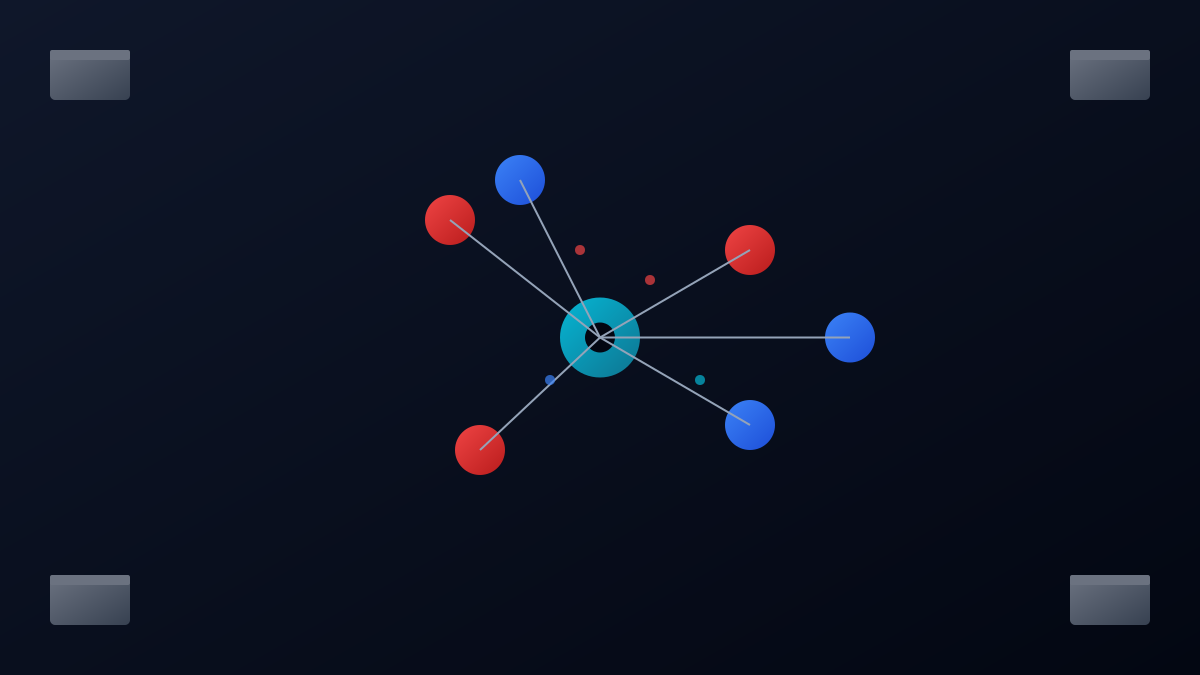
Camoflauge adopts a director-actor architecture: the central Director acts as the coordination brain, routing intelligence and assigning tasks via LangGraph; the red team includes a scanner (for port/service reconnaissance) and an exploiter (for building vulnerability payloads); the blue team includes a defender (for monitoring logs to detect anomalies) and a patcher (for deploying firewall rules). Each agent focuses on its professional domain, enabling efficient collaboration.

4

Section 04

Technical Implementation: Integration of Local LLMs and Real Toolchains

The technology selection balances security and practicality: Ollama is used as the local LLM engine (default Qwen2.5:7b) to ensure local data isolation; agents use real tools (nmap, iptables, vulnerability exploitation frameworks) in Docker containers, making the exercise results practically referable.

5

Section 05

Operational Flow: A Complete Closed Loop from Reconnaissance to Remediation

After executing the run command, the full cycle starts: 1. Environment preparation (clear old rules); 2. Reconnaissance and detection (red team nmap scan); 3. Vulnerability exploitation (red team builds and executes payloads); 4. Threat detection (blue team monitors logs to identify anomalies); 5. Automatic remediation (blue team deploys iptables rules); 6. Metric reporting (W&B records data such as MTTD and mitigation rate).

6

Section 06

Observability and Evaluation: Metrics for Quantifying AI Offensive and Defensive Capabilities

Core metrics are tracked via Weights & Biases: Mean Time to Detect (MTTD), mitigation rate (percentage of successfully blocked attacks), token efficiency, hallucination rate (proportion of missed threats), and agent routing paths. These metrics help optimize performance and provide a quantitative benchmark for AI offensive and defensive capabilities.

7

Section 07

Practical Value and Future Outlook: From Cost Reduction to Research Applications

Practical value: reducing exercise costs (24/7 automation), accelerating talent development (newcomers learn offensive and defensive strategies), validating defense strategies, and supporting AI security research. Future roadmap: support for more LLM models, batch execution cycles, web interface, CVE vulnerability database, and multi-target sandboxes.

