Zing Forum

Reading

BookSlot Multi-Agent Workflow: .NET 10-Powered SaaS Architecture and Five-Agent Collaboration System

This article deeply analyzes the architectural design of the BookSlot project, exploring how to build a Vertical Slice Architecture (VSA) SaaS application based on .NET 10 and implement an intelligent workflow pipeline composed of five specialized agents.

.NET 10垂直切片架构VSA多智能体Agent工作流SaaS架构BookSlot智能代理软件架构AI集成
Published 2026-05-05 04:15Recent activity 2026-05-05 04:24Estimated read 5 min
BookSlot Multi-Agent Workflow: .NET 10-Powered SaaS Architecture and Five-Agent Collaboration System
1

Section 01

BookSlot Project Introduction: .NET10-Powered VSA + Multi-Agent SaaS Architecture

The BookSlot project demonstrates a cutting-edge SaaS architecture paradigm: based on the .NET10 tech stack, it combines Vertical Slice Architecture (VSA) with a multi-agent workflow consisting of five agents to build an intelligent system with clear business boundaries and autonomous collaboration capabilities. This architecture provides a valuable reference model for modern SaaS application development.


2

Section 02

Background: Transformation of Traditional SaaS and BookSlot's Architectural Paradigm

With artificial intelligence rapidly permeating software development today, traditional SaaS architectures face issues such as high code coupling and unpredictable impact scope of changes due to increasing business complexity. The BookSlot project innovatively combines Vertical Slice Architecture (VSA) with multi-agent workflows, bringing transformation to traditional SaaS architectures.

3

Section 03

Methodology: Core Concepts of Vertical Slice Architecture (VSA) and .NET10 Practices

Vertical Slice Architecture (VSA) organizes code by business functions; each slice contains all components needed to complete a specific business use case, with advantages like high cohesion, low coupling, and independent evolution. .NET10 provides strong support for VSA through features such as Minimal API, source generators, native AOT compilation, and Keyed Services.

4

Section 04

Methodology: Role Division and Orchestration Patterns of the Five-Agent Intelligent Workflow

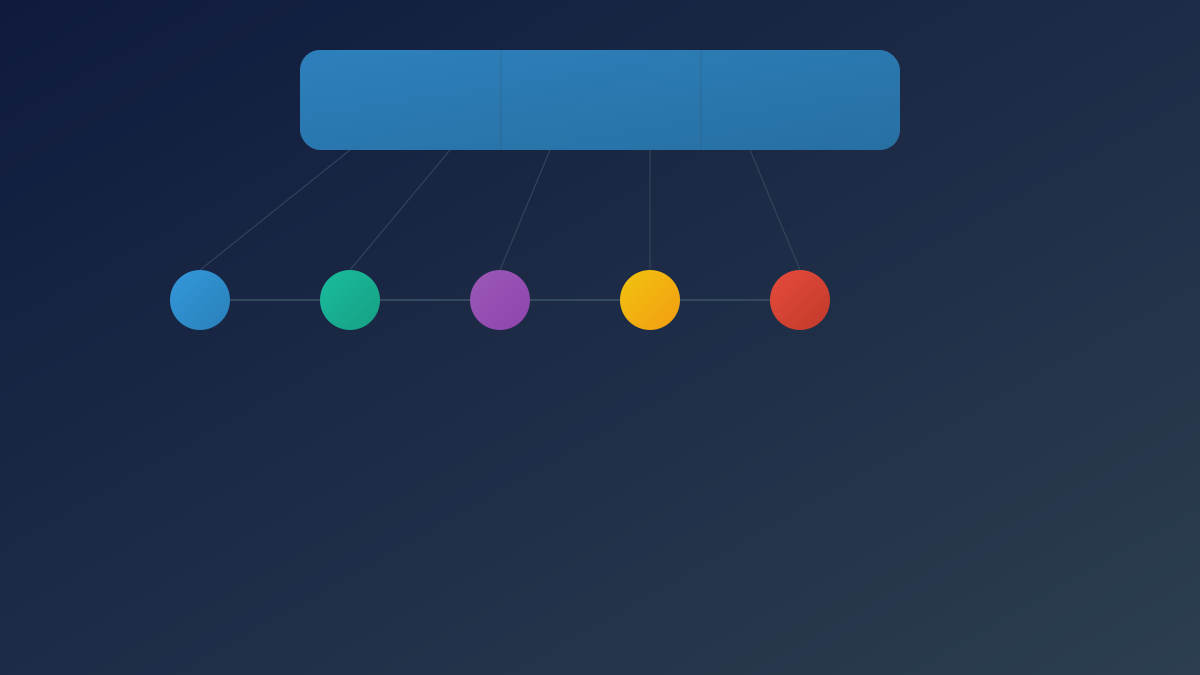
BookSlot adopts a five-agent collaborative division of labor model: the Intent Understanding Agent parses user input, the Knowledge Retrieval Agent obtains data support, the Business Logic Agent executes core rules, the Content Generation Agent produces user responses, and the Coordination & Monitoring Agent schedules the overall workflow. Workflow orchestration can use patterns like sequential pipelines, routing distribution, parallel collaboration, and iterative optimization.

5

Section 05

Methodology: Key Considerations for SaaS Architecture (Multi-Tenancy, Scalability, Observability)

As a SaaS application, BookSlot needs to address key issues such as multi-tenant isolation (data, configuration, resource isolation), scalability (stateless services, asynchronous processing, caching strategies), and observability (distributed tracing, agent performance metrics, workflow visualization).

6

Section 06

Evidence: Technical Implementation Highlights and Application Scenarios

Technical implementation highlights include AI integration in the .NET ecosystem (Semantic Kernel, LLM client abstraction, vector storage integration), inter-agent communication protocols (structured output, function calls, state management), and error handling & fault tolerance mechanisms. Application scenarios cover vertical domains like appointment scheduling systems, intelligent customer service, content creation, and code generation.

7

Section 07

Recommendations: Future Development Directions of the BookSlot Architecture

The BookSlot architecture can evolve in directions such as adaptive workflows (auto-optimizing collaboration patterns), enhanced human-machine collaboration (manual review for key decisions), and multi-modal expansion (processing image/voice/video inputs).

8

Section 08

Conclusion: Value and Significance of the BookSlot Architecture

The BookSlot project demonstrates the evolutionary direction of modern SaaS application architectures: combining VSA with multi-agent systems to maintain code maintainability while leveraging AI capabilities. This project proves the competitiveness of Microsoft's tech stack in the AI era for .NET developers and provides practical references for architects on the integration of SaaS and AI.