Zing Forum

Reading

BloomBee: Decentralized Large Language Model Inference and Fine-tuning System

A distributed LLM service framework based on P2P networks, enabling ordinary GPUs to collaboratively run ultra-large models through technologies like tensor offloading, speculative decoding, and lossless compression.

去中心化AILLM推理P2P网络分布式训练GPU卸载开源模型BloomBee
Published 2026-05-24 03:38Recent activity 2026-05-24 03:48Estimated read 6 min
BloomBee: Decentralized Large Language Model Inference and Fine-tuning System
1

Section 01

BloomBee: Decentralized LLM Inference & Fine-tuning System (Introduction)

BloomBee is a decentralized offline LLM service framework based on P2P networks. It uses technologies like tensor offloading, speculative decoding, and lossless compression to enable ordinary GPUs to collaboratively run ultra-large models. Key keywords: decentralized AI, LLM inference, P2P network, distributed training, GPU offloading, open-source models, BloomBee. Source: GitHub repo by ai-decentralized organization, with related paper arXiv:2604.21072 (published April 2026).


2

Section 02

Background & Challenges

Generative AI's rapid development drives huge demand for LLM inference services. While open-source LLMs are competitive, high cost and limited GPU resources are major barriers—running a 405B parameter model usually requires hundreds of thousands of dollars in professional hardware. BloomBee aims to solve: how to let ordinary users use scattered, idle GPU resources to get large model inference capabilities at low cost?

3

Section 03

Core Architecture & Working Principle

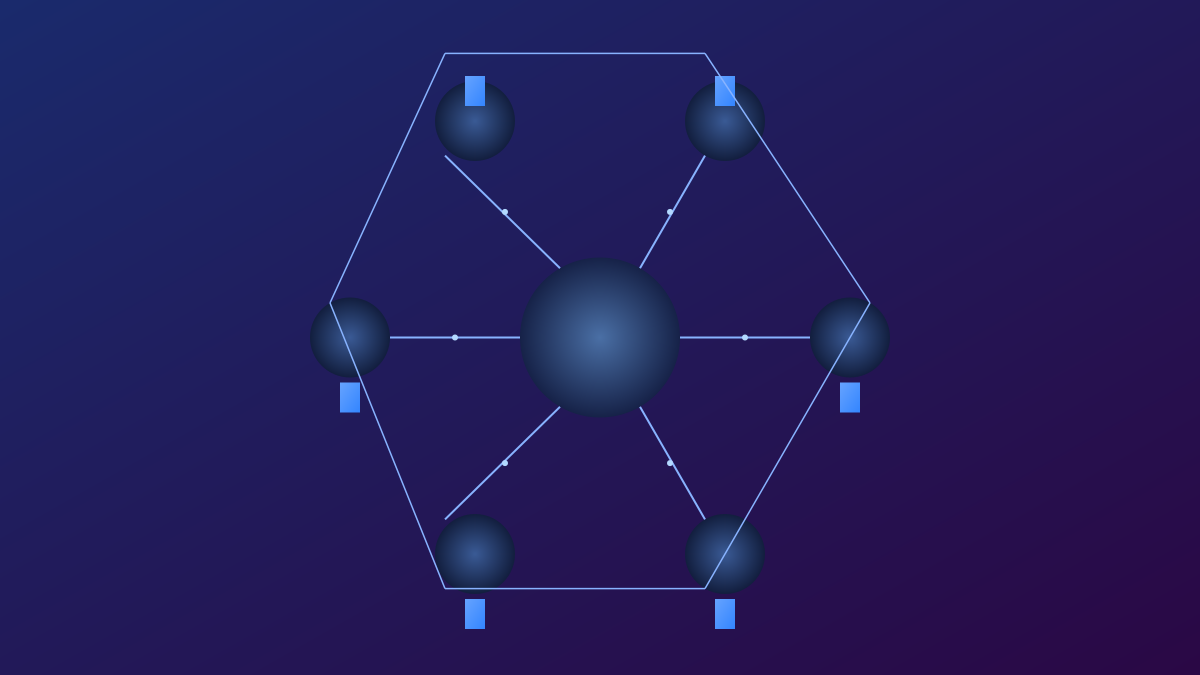
BloomBee's core idea is to split the model's transformer blocks and distribute them across P2P network nodes.

  • Client: Runs word embedding and LM head locally, routes to remote layers via DHT.
  • Workers: Each node hosts different layers (e.g., Worker A:0-15, Worker B:16-31, Worker C:32-47).
  • DHT: Tracks which server hosts which layers; clients auto-discover and route to available nodes. Servers are fully decentralized—anyone with compatible GPU can join and contribute computing power.
4

Section 04

Key Technical Optimizations

To address bandwidth and memory bottlenecks in decentralized GPU runs:

  1. Tensor Offloading: Reduces per-node memory usage, allowing more layers per peer and fewer network hops (flexible scheduling between VRAM and RAM).
  2. Speculative Decoding: Sends multiple draft tokens per round trip, reducing communication frequency (critical for high-latency networks).
  3. Lossless Activation Compression: Compresses activation values without precision loss, lowering bandwidth demand (vital for cross-internet collaboration).
  4. Micro-batch Pipeline: Overlaps communication and computation to hide network latency, improving overall throughput.
5

Section 05

Supported Models & Quick Start

Supported Models: Covers multiple mainstream architectures (LLaMA/LLaMA2/LLaMA3, BLOOM, Falcon, Mixtral, Qwen3, Gemma-4) with examples like meta-llama/Llama-2-7b-hf, bigscience/bloom-7b1, etc. Any matching HuggingFace model can be loaded via AutoDistributedModelForCausalLM. Quick Start: 3 steps:1. Start bootstrap node (build DHT network base).2. Start worker server (join network and host specified layers).3. Run inference (client auto-discovers nodes to complete inference).

6

Section 06

Project Development & Community

Updates:2025.11 (multi-batch inference, shared memory optimization);2026.1 (speculative decoding);2026.2 (micro-batch processing, lossless compression);2026.4 (paper on arXiv). Community & License: Apache-2.0 open-source license; Discord community support; install via pip install bloombee.

7

Section 07

Significance & Outlook

Practical Significance: Represents an important attempt at democratizing AI infrastructure—allows individuals to contribute idle GPUs, building an open, censorship-resistant, low-cost AI inference network. Lowers threshold for resource-limited researchers/developers to access state-of-the-art open-source models. Technical Contributions: Multi-dimensional optimization strategies (tensor offloading, speculative decoding, compression, pipeline) provide reusable engineering paradigms for distributed deep learning inference. Outlook: With network bandwidth and decentralized protocol improvements, performance and usability will further improve. BloomBee is a practical response to 'who controls AI and how to access it'.

