Zing Forum

Reading

Binary MoE: Building a Distributed AI Inference Architecture Using 3-RMB MCUs and Consumer GPUs

Binary MoE is an innovative distributed AI architecture that processes real-time decisions using lightweight 3KB models on low-cost MCUs while offloading complex inference tasks to GPUs, enabling a low-cost, high-efficiency edge AI deployment solution.

边缘AI分布式推理MoE模型压缩MCU物联网二值化神经网络
Published 2026-06-06 23:03Recent activity 2026-06-06 23:21Estimated read 6 min
Binary MoE: Building a Distributed AI Inference Architecture Using 3-RMB MCUs and Consumer GPUs
1

Section 01

Binary MoE: Building a Distributed Edge AI Inference Architecture with 3-RMB MCUs and Consumer GPUs (Introduction)

Binary MoE is an innovative distributed AI inference architecture designed to address the cost-performance balance challenge in edge AI deployment. It assigns simple real-time tasks to 3-RMB MCUs (running lightweight 3KB models) and offloads complex inference to consumer GPUs, enabling a low-cost, high-efficiency edge AI solution. This article will cover its background, architecture, technical highlights, application scenarios, and more.


2

Section 02

Background: The Cost Dilemma of Edge AI

With the rapid advancement of Large Language Model (LLM) capabilities, edge AI deployment faces a dilemma: either use expensive edge computing devices to run full models, or send data to the cloud for processing at the cost of real-time performance and privacy. The Binary MoE project proposes a distributed mixture-of-experts architecture that intelligently allocates tasks to hardware at different levels, balancing cost and performance.

3

Section 03

Architecture and Core Methods

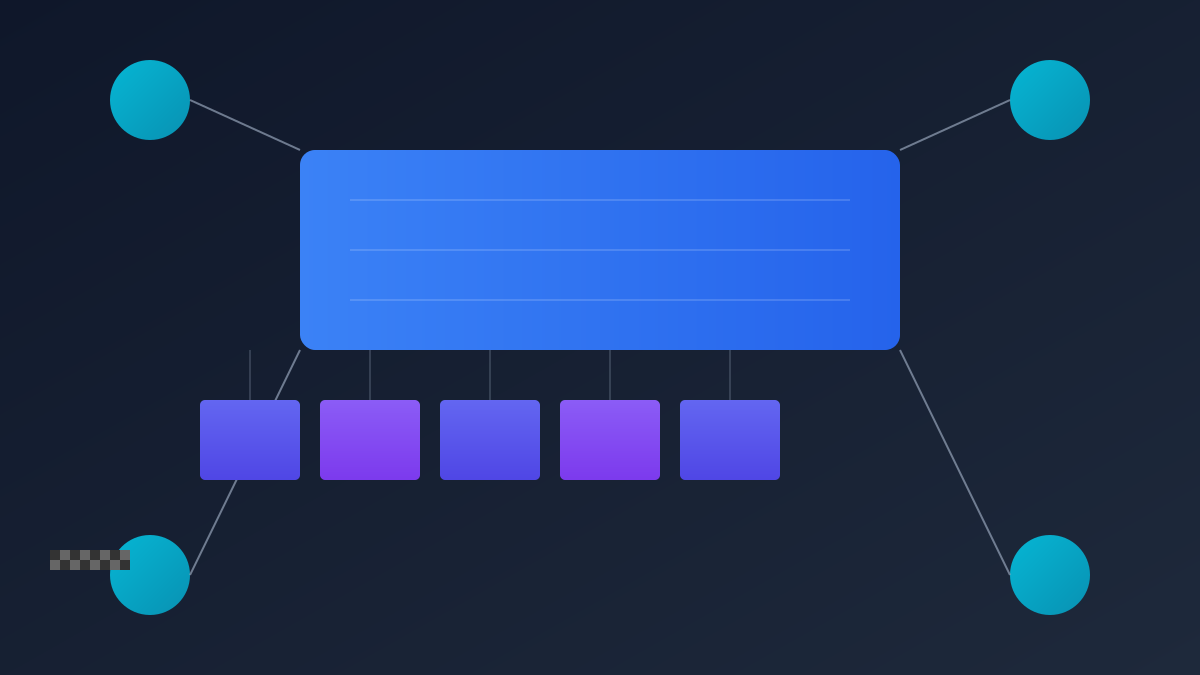
Binary MoE adopts a three-layer distributed design:

  1. MCU Layer: 3-RMB chips run 3KB binary neural network models to handle high-frequency simple tasks (sensor data filtering, trigger condition judgment, emergency response);
  2. WiFi Communication Layer: Connects MCUs and GPUs, transmitting preprocessed data and inference results;
  3. GPU Layer: Consumer GPUs (e.g., RTX 4060) handle complex tasks (natural language understanding, multimodal fusion). Technical highlights include dynamic expert routing (80% of tasks processed locally) and extreme model compression (binary neural networks, knowledge distillation, structured pruning).
4

Section 04

Cost-Effectiveness and Evidence of Technical Validity

Cost comparison shows Binary MoE's significant advantages:

Solution MCU Cost GPU Cost Total Cost Application Scenario
Pure Cloud Solution ¥0 ¥0 Subscription Fee Non-real-time Applications
Pure Edge Solution ¥200+ ¥0 ¥200+ Offline Scenarios
Edge GPU Solution ¥0 ¥3000+ ¥3000+ High-performance Requirements
Binary MoE ¥3 ¥2000 ¥2003 General Scenarios
Its dynamic routing and compression technologies ensure efficiency, making it suitable for large-scale IoT deployments.
5

Section 05

Practical Application Scenarios

Binary MoE is applicable to multiple scenarios:

  • Smart Home: MCUs detect abnormal sounds in real time, while GPUs process complex voice commands to protect privacy;
  • Industrial IoT: MCUs monitor equipment vibration/temperature, and GPUs diagnose faults and generate reports;
  • Agricultural Monitoring: Low-cost MCU nodes cover farmland, and GPUs aggregate data for analysis and provide planting recommendations.
6

Section 06

Technical Challenges and Future Directions

Current challenges and improvement directions:

  1. Network Latency and Reliability: Introduce offline caching and support protocols like LoRa/Zigbee;
  2. Model Collaborative Training: Explore federated learning and cross-device gradient synchronization;
  3. Security: MCU firmware encryption, communication channel authentication, and adversarial sample defense.
7

Section 07

Summary and Insights

Binary MoE demonstrates a pragmatic approach to edge AI: allocating computing resources based on task characteristics instead of running large models on a single device. Insights include: model size is not the only metric, heterogeneous computing is a trend, and architectural innovation can significantly reduce edge AI costs. This distributed architecture is expected to become a mainstream paradigm for edge AI.

