Zing Forum

Reading

AT.field: A Native macOS Terminal Cockpit Built for the AI CLI Era

AT.field is a native macOS application that addresses the "invisibility" pain point of pure CLI AI tools through a three-column interface and Sidecar visualization layer, enabling engineers to get an IDE-level visual experience while executing commands in the terminal.

AI CLImacOS终端Claude CodeCodex CLI开发者工具终端模拟器SidecarSSH串口AI编程
Published 2026-05-27 21:15Recent activity 2026-05-27 21:18Estimated read 5 min
AT.field: A Native macOS Terminal Cockpit Built for the AI CLI Era
1

Section 01

Introduction: AT.field — The macOS Terminal Cockpit for the AI CLI Era

AT.field is a native macOS application designed to solve the "invisibility" pain point of pure CLI AI tools. Through its three-column interface and Sidecar visualization layer, it allows engineers to get an IDE-level visual experience while executing AI commands in the terminal. It supports scenarios like SSH and serial ports, and also has the advantages of lightweight and efficient native performance.


2

Section 02

Background: Collaboration Pain Points of Pure CLI AI Tools

With the popularity of AI programming assistants like Claude Code, Codex CLI, and aider, developers are used to collaborating with AI in the terminal. However, pure command-line interfaces have fundamental issues: when AI generates files, starts services, or outputs differences, users need to switch back and forth between the terminal, Finder, browser, and VS Code. Context interruptions severely reduce the smooth experience, and AT.field was created to address this.

3

Section 03

Core Philosophy and Three-Column Layout Design

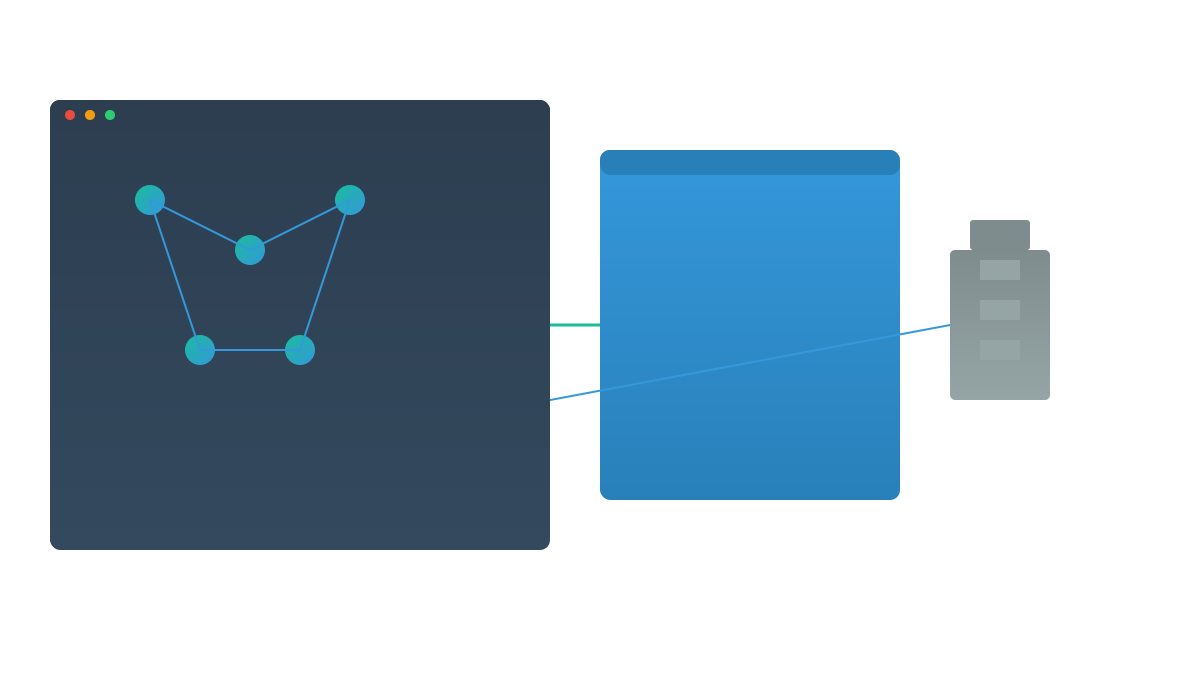
AT.field's design philosophy is to "maintain a terminal-first workflow while adding a visual Sidecar layer", not to replace existing IDEs or terminal emulators. It uses a three-column layout: left navigation bar (project management, file browsing, SSH/serial device management), middle terminal area (local shell, AI CLI, SSH sessions, etc.), and right Sidecar (preview files, URLs, diffs, etc.), integrating scattered functions into a unified window.

4

Section 04

Intelligent Sidecar and Multi-Scenario Support

Sidecar is the core innovative feature. It automatically identifies file paths, local URLs, images, PDFs, code differences, etc., in terminal output and renders them in real time. SSH and serial ports are treated as first-class citizens, manageable in the connection center, and sessions can be separated into floating windows that stay on top. The native SwiftUI+AppKit architecture brings advantages: cold start <0.1 seconds, memory ~80-100MB, which is lighter than Electron-based tools.

5

Section 05

Applicable Scenarios and Target Users

AT.field is particularly suitable for the following scenarios: AI-assisted programming (obtain visual feedback when used with Claude Code, etc.), full-stack development (manage front-end and back-end services), embedded IoT (serial port hardware debugging), remote server management (SSH + file preview), and Git workflow (real-time difference viewing).

6

Section 06

Complementary Relationship with Existing Tools

AT.field does not replace existing tools but complements and integrates them: compared to iTerm2/Terminal, it provides richer visualization and AI workflow support; compared to VS Code/Cursor, it is a lightweight AI terminal companion; when used with AI CLI tools, it provides a visual layer. It can be understood as a fusion of functions like iTerm2 + tmux + Preview + SSH manager.

7

Section 07

System Requirements and Acquisition Method

AT.field requires macOS 14.0 (Sonoma) or higher, supporting Apple Silicon and Intel processors. Users can download the DMG installation package from the GitHub Releases page and install it by dragging and dropping.

8

Section 08

Conclusion: A New Paradigm for AI Development with Terminal + Sidecar

Against the backdrop of the popularity of AI agents, the design of human-computer collaboration interfaces is becoming increasingly important. AT.field balances terminal execution and visual supervision, and the "Terminal + Sidecar" architecture may become a new paradigm for development tools in the AI era.

