Zing Forum

Reading

AskIt: A Multimodal Agent Application Architecture Integrating RAG, MCP, and Visual Reasoning

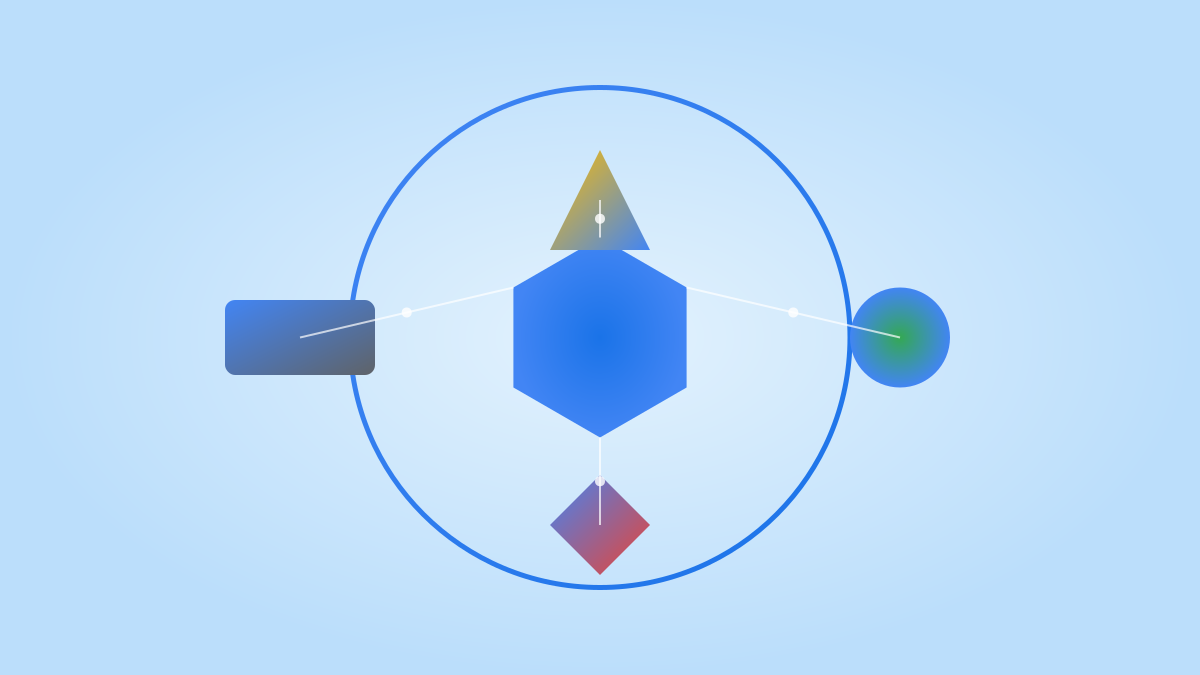
AskIt is a high-performance AI web application that adopts an advanced multimodal agent architecture, seamlessly integrating Retrieval-Augmented Generation (RAG), Model Context Protocol (MCP), and visual reasoning capabilities.

RAGMCP多模态智能体AI应用视觉推理大语言模型
Published 2026-05-23 13:14Recent activity 2026-05-23 13:25Estimated read 8 min
AskIt: A Multimodal Agent Application Architecture Integrating RAG, MCP, and Visual Reasoning
1

Section 01

AskIt: An Introduction to the Cutting-Edge AI Application Integrating Multimodal Agent Architecture

AskIt is a high-performance AI web application positioned as "premium", adopting an advanced multimodal agent architecture that seamlessly integrates Retrieval-Augmented Generation (RAG), Model Context Protocol (MCP), and visual reasoning capabilities. Maintained by Atharva0808, this project is open-sourced on GitHub (Original link: https://github.com/Atharva0808/Askit, Updated at: 2026-05-23T05:14:01Z), representing a significant trend in the AI application development field of integrating multiple cutting-edge technologies.


2

Section 02

Project Background and Positioning

AskIt is not a simple chatbot or single-function AI tool, but a comprehensive intelligent platform. It supports input understanding and output generation across multiple modalities such as text and vision, and achieves higher-level autonomous decision-making and task execution capabilities through its agent architecture, reflecting the current trend of AI applications moving towards multi-technology integration.

3

Section 03

Core Technical Component: Retrieval-Augmented Generation (RAG)

Retrieval-Augmented Generation (RAG) is one of the core technologies of AskIt. Its core idea is to retrieve relevant contextual information from external knowledge bases before the model generates answers, and provide it along with the user's query to the language model. The advantages of RAG include: knowledge timeliness (access to the latest information), factual accuracy (reducing hallucinations), traceability (with reference sources), and domain adaptability (no need for retraining to adapt to specific domains). Through RAG, AskIt allows users to interact with an intelligent assistant that can access external knowledge and provide well-documented answers.

4

Section 04

Core Technical Component: Model Context Protocol (MCP)

Model Context Protocol (MCP) is an open protocol standard launched by Anthropic, aiming to standardize the interaction method between AI models and external data sources/tools (similar to the "USB-C interface" for AI applications). The value of MCP includes: standardized integration (unified connection method), ecosystem interoperability (component reuse), reduced development complexity (no need for separate adaptation layers), and enhanced scalability (plug-and-play for new components). AskIt's support for MCP demonstrates its forward-looking architectural design, which can be compatible with the ever-evolving AI tool ecosystem.

5

Section 05

Core Technical Component: Visual Reasoning Capability

Visual reasoning capability enables AskIt to understand and analyze image content, and reason answers based on visual information, which is key to realizing multimodal AI. Its application scenarios include: image question answering (users upload images to ask questions), document analysis (understanding scanned documents/charts/screenshots), visual-assisted decision-making (providing suggestions based on images), and multimodal content generation (generating text descriptions based on images). Combined with RAG and MCP, AskIt can handle complex queries (e.g., "Analyze this chart and compare it with historical database data").

6

Section 06

Significance and Application Scenarios of the Agent Architecture

AskIt's agent architecture represents an important paradigm shift in AI application development. Unlike traditional one-time question answering, agents can autonomously plan (decompose complex tasks), call tools (invoke search engines/APIs, etc.), maintain state (context memory for multi-turn interactions), and self-correct (adjust strategies). This architecture enables AskIt to handle complex tasks (e.g., "Analyze the trend of key financial report indicators and compare them with industry averages"). Potential application scenarios include enterprise knowledge management, intelligent customer service, research analysis, and personal assistants.

7

Section 07

Technical Integration Challenges and Insights for Developers

Integrating RAG, MCP, and visual reasoning faces challenges: system complexity (difficulty in component coordination), performance optimization (latency in multimodal processing), quality assurance (error accumulation), and user experience (intuitive multimodal interaction design). Insights for developers: it demonstrates the core technology stack combination of current AI applications, showcases the architecture for integrating multiple AI capabilities, reflects support for open standards (MCP), and implies the market demand for high-quality AI applications (premium positioning).

8

Section 08

Conclusion

AskIt represents the evolution direction of AI applications from single-function to multimodal, multi-capability integrated intelligent platforms. By integrating cutting-edge technologies such as RAG, MCP, and visual reasoning, it demonstrates the possibility of building next-generation AI applications and is an open-source project worth studying and referencing for developers focusing on AI application architecture.

